Wednesday, November 30, 2011

News After It Happens

Apparently some erstwhile DawnNews staffers are mighty miffed that we haven't given the sudden closure of Express 24/7 early this morning the same sort of coverage that we once gave to DawnNews' woes (when it existed as an English channel). They might be upset for their own personal reasons but it really was neither completely unexpected nor will it have the same repercussions on the group or on the media market.


There is no doubt that we did not have the story before it happened, but then neither did most of the staff at Express 24/7. Consider the following tweets from some staffers:

@Rabail26: Express 24/7 is closing down & I'm jobless, so I guess its time to edit the twitter bio. #tweetingtodistractingself

@mirza9: Not sure about the details of the channel closing down. I just found out in an e-mail. #Express24/7RIP

@mirza9: So should I text message my mom and tell her so she doesn't find out when she wakes up at 530AM and checks my twitter feed?

@mirza9: wow the channel has already stopped running news. Only promos running now. That was quick. Express 24/7 quick death.

@ahmedjung: no one has any idea about what's next and it's funny that even the HR claims that they didn't know about this!

@ahmedjung: lhr office staff told me that the drivers didn't pick the English morning shift staff! Even drivers knew before us

@ayza_omar: Executive producer EN24/7 giving his final speech. Said he didn't hav a clue till 2am.V went off air at 1am.Says its good we didn't knw.how?

@ayza_omar: All will get their November salaries immediately. One month salary for every year worked will be compensation.

I suppose you could congratulate the Lakhanis on a secret well kept. However, there are two things to consider here:

1. There was never any financial sense in running Express 24/7, not especially after the ignominious backtracking of DawnNews from being 'Pakistan's first English language channel' into an Urdu channel and the still-birth of Geo English had made the business feasibility abundantly clear. The only people really watching Express 24/7 were diplomats who did not know Urdu at all and wanted to keep abreast of what Pakistani media was covering (here's a thought: perhaps they should have been asked to fund the channel). The fact that it continued to exist for almost three years was primarily because the media house's owners made it a matter of prestige and ego. The claim by the owners that the closure was a result of "a dismal economic climate" is thus slightly disingenuous. It was always a losing proposition and it was only a matter of time that the plug was pulled. Mr Sultan Lakhani, the CEO, is however, spot on in his further explanation:

"Unlike other countries where niche channels can survive and even prosper through subscription and where there are multiple distribution platforms such as DTH, in Pakistan niche channels are wholly dependent on advertising. This system works well for mass market channels like our sister channel Express News but does not work effectively for niche channels which cater to a smaller audience.”


Express 24/7 Lahore staffers pose for a group photo (Photo: Khurram Husain)


2. While one sympathises with those of the staff who will not be "accomodated" in the media house's other ventures (and there are likely to be a substantial part of the 100-odd staff) as promised by the CEO, we would like to remind readers of what we had written back in 2009 about the way Mr Lakhani often does business. Although we had recounted this anecdote in reference to the launch of Express Tribune (which is in no danger at the moment) and not Express 24/7, it may seem very prescient to some recently laid-off staffers of the channel:

"All those being recruited may want to ask one simple question of Mr Lakhani: what about Business Today? Some of you may remember that that paper, also owned by Sultan Lakhani, was shut down one fine day at 5 pm with Mr Lakhani coming in and telling the newsroom that the paper would not be publishing the next day and that everyone should henceforth go home. They may want to ensure that this is not the fate awaiting them one fine day down the road..."


Perhaps the only funny thing about this whole episode is that, as of now - some 24 hours after it officially went off air - Express 24/7 continues to run promos detailing itself as 'Pakistan's only English news channel', and proclaiming 'Bringing you the news is our only business' and 'News as it happens', even as there is no news now available on the channel. Only the travel and personality fillers it had developed running incessantly...

...Which leads one to question whether the slot is being saved for the intended launch in January or February of the planned Express Entertainment channel. Incidentally, Dunya too is set to launch its own entertainment channel around the same time, which may give an indication of how the scales have tipped in Pakistan's media market. Suddenly, entertainment is once again being seen as a revenue earner after a long run wherein news and political talk shows were the only game in town.


Thursday, November 17, 2011

Open Letter to PTA

Now that the Pakistan Telecommunication Authority (PTA) has unfortunately allegedly indefinitely deferred its proposed ban on scurrilous words and phrases such as 'fingerfood', 'harder', 'deeper', 'Randhwa' [widower] and 'Carrom board', I believe it is time to step back, take a deep breath and re-evaluate, without all the deafening media hysteria, the fine, fine work being carried out by the telecom regulator. And yes, appreciate its commitment to promoting the country's progress in spheres that, in all honesty, is not its responsibility but which it takes on purely as a matter of conscientious citizenship. It is time for those of us whose voices were drowned out by the cacophony of knee-jerk anarchic reactionary-ism to step forward and bring a semblance of thoughtfulness back to public discourse.

In this regard, I have taken the liberty of writing an open letter of appreciation to PTA, which I hope those amongst you who were equally troubled by the wild and libelous accusations against the regulator, will endorse...


Chairman
Pakistan Telecommunication Authority
Islamabad.

Dear Sir,

Let me place on record our deep and abiding appreciation of your much misunderstood initiative to purge our cell phones of words and phrases that rightfully should not ever be heard by unsuspecting ears, much less read by eyes that can burn holes inside innocent brains.

1. Your drive to return public discourse to civilized norms by removing the temptations of referring to gutter vocabulary like 'Athlete's Foot', 'Bewakoof', 'Breast', 'Cocktail', 'Creamy', 'Deposit', 'Dome', 'Evl', 'Femme', 'Four Twenty', 'Glazed Donut', 'Harder', 'Hole', 'Hostage', 'Idiot', 'Joint', 'K Mart', 'Kill', 'Looser', 'Lotion', 'Low Life', 'Mary Jane', 'Murder', 'Nimbu Sharbat', 'Oui', 'Phrase', 'Pussy Cat', 'Roach', 'Robber', 'Slant', 'Slime', 'Sniper', 'Spit', 'Stringer', 'Suicide', 'Tampon', 'Taxi', 'Trojan' and 'Trots' is very commendable. These words and phrases truly should remain where they belong, i.e. in the gutter.

2. But even more deserving of appreciation was your attempt to stand as a bulwark against the creeping Westernization of our culture by prohibiting references to NFL American 'football' players ('Rae Carruth', 'He Hate Me'; is Shahid Afridi not good enough for these degenerates?), American cable channels ('Showtime'; Hum TV zindabad!), American concepts of revenue generation ('Primetime'), West African nations ('Niger'; what have they ever done for us?), Anglo-American serial murderers ('Jack the Ripper', 'Dahmer'; the ignoring of our indigenous Javed Iqbals is shameful) and imported racist terms ('Nigga', 'Yellow Man', 'Polack'; when he have our own homegrown terms like 'choorrha', 'matarwa' and 'phheena', what is the need to look elsewhere?). In fact, you have also prophetically pointed out terms which we actually have no idea about ('Ingin', 'Giehn') but which we are sure are part of the same dirty conspiracy to subvert indigenous Pakistani culture.

3. As a special exception, we are also grateful that you have recognized the vulgarity introduced by 'Chunni'. Ms. Saigol, who presents herself as a doyenne of eastern culture, should immediately desist from using this diminutive form of her name, which in any case, does not befit the high prices she charges for her jewellery.

4. We are also extremely appreciative of your attempts to wipe out the scourge of cruelty against animals, who are, after all, God's beautiful creatures but cannot express themselves in the same ways that humans can. Thus we are happy that references to 'Flogging the Dolphin', 'Spanking the Monkey' and 'Axing the Weasel' have been made verboten. However, may we in all humility suggest that 'Choking the Snake', 'Corralling the Tadpoles', 'Draining the Monster', 'Flogging the Dog', Galloping the Antelope', 'Grappling the Gorilla', 'Hacking the Hog', 'Loping the Mule', 'Milking the Moose', 'Perling the Oyster', 'Petting the Lizard', 'Playing with the Spitting Llama', 'Pounding the Bald-headed Moose', 'Pumping the Python', 'Ramming the Ham', 'Roping the Pony', 'Shooting Flies', 'Slapping the Hamster', 'Snapping the Monkey', 'Stroking the One-Eyed Burping Gecko', 'Smacking the Bacon', 'Taunting the One-Eyed Weasel', 'Choking the Chicken' and 'Brushing the Beaver' are also worthy of your attention. Such inhumane treatment of poor, dumb animals should also be declared off-limits in your next iteration.

5. Your efforts to expand the horizons of sometimes parochial Pakistanis have been met with little understanding and typical obstinacy but we would like you to know that we are all for the inclusion of other Asian languages in your lists even if they may not be understood by the majority of Pakistanis. Terms such as 'Mayyaada', 'Deli Mali Guti', 'Kute Liche Ho Chublo', 'Meli Mali Guta', 'Monney Podey', 'Peasah Nah Mahr', 'Aayush', 'Lun Chung', 'Kamche', 'Chafu Gaan', 'Pim Pim' 'Havesh', 'Ranayadha', 'Gui Jo Tung', 'Pelay Ka Dala Ona Mandam', 'Lavander', 'Chinaal' and 'Mangachinamun' may not make much sense to most. But that's only until they, intrigued, make the effort to learn new languages. We understand your contribution to advancing the cause of education in this country.

6. We would also like to commend your team for attempting to ban perversions such as 'unfuckable' and 'No Sex'. As we all know, there is no such thing as the former and the latter is simply a conspiracy to deny the future might of Pakistani multitudes.

7. Few have understood or appreciated your single-handed, and may we add brilliant, ploy to change the worldwide image of Pakistan as a country constantly associated with terrorism, militancy, lack of governance and tinpot military dictatorships. But we, Chairman sahib, understand it well and give you a standing ovation for this. If any proof is needed for doubters, you should tell them to watch the following clip:


Tell them, sir, to point out another instance where the mention of Pakistan brought a smile on the lips of Americans. Tell them to point out when was the last time they heard something about Pakistan in the foreign media and did not hear the adjectives 'double-dealing', 'disastrous', 'corruption-ridden' or 'crumbling' also mentioned. Bravo, sir, bravo! It takes real brilliance for such ingeniousness and insight into media handling.

P.S.: You should however write to Rachel Maddow and correct her disinformation. People should know that it is not 'Monkey Crotch' that is banned but 'Crotch Monkey' and that there's a difference. She should also be told that 'Butt' by itself is not forbidden (we are not so naive!), only 22 variations of when it is combined with other words.

8. We could go on but finally, sir, we wish to give you plaudits for raising the morale of the civil servants who work under you. Months of bureaucratic work must have seemed like one big festive party to your staff which no doubt transformed a government job from a daily grind into something to look forward to every day. We have mental imagery of your staff spending raucous days surfing porn sites to gather the search 'tags' that contributed to your lists, long sessions of camaraderie wherein staff recollected and explained obscure swear-words from their own adolescence to include in the non-English compilations, mirth and giggling previously unheard of in dour government offices and possibly copious amounts of consumption as well. A happy government office is a sign of a happy country. This is an atmosphere that should be encouraged and continued and we are happy to note that PTA has pointed out that the process will not stop here and pledged to continue updating the lists. However, just as a note of caution, you should possibly do regular tests on the quality of dope being supplied to the PTA offices. You would not want any unforeseen medical emergencies to come in the way of the good and important work you are doing.

We hope the recent misinformed hullabaloo over your endeavours is resolved soon and that you can continue raising the stature of Pakistan.

With the best of regards,

Sincerely,

Team Cafe Pyala

Tuesday, November 15, 2011

You Are Not The Story

I have been meaning to write about a clip from the DawnNews show Kab Tak titled 'Hasool-e-Insaaf Ki Jidojehd' (The Struggle for Justice) that aired last month but is only now doing the social media rounds. The clip features an angry broadcast journalist, Sophia Jamal, confronting the alleged rapist of a 6-year-old girl outside the court and screaming at him, in the process throwing any pretense of an unbiased, objective voice out the window.


I was, fortunately for my own mental health (considering I would have had to watch it over and over again to formulate comments), beaten to it by Nadia Zaffar. Ms. Zaffar, who is a former DawnNews staffer, does an excellent job of using it as a case study establishing "yays and nays for journalists." Her take on it should be mandatory reading for newsrooms across Pakistan:


"You are not the judge: As a reporter, please try to refrain from passing out judgments on people facing charges. Let the process of law and justice take its course without handing out opinions of what you think happened. Every man is innocent until proven guilty in a court of law. Tell us what happened, what the man said, what the facts are, don’t tell us what you think happened, you are not that important and we are not very interested. 
You are not the police, moral or otherwise: You are not out in the field to tell people the consequences of their actions. Don’t tell them they are going to hell, don’t tell them their children are going to suffer a terrible fate and definitely don’t tell them that they deserve to die. These instructions seem to be too obvious to discuss, but as in instances like these we are unpleasantly surprised. As a reporter I want to know what the law says about such cases, what punishment can this man possibly get if convicted, and what are the statistics for child rape cases in the area. 
Let others talk: It might come as a surprise but the point of journalism is all about letting the people in the story talk. Please don’t show us a four and half minute piece with two words from someone other than you. Its a simple idea but one that many Pakistani journalists seem to forget. Brace yourself and let the people tell the story. The real job of a journalist is to ask tough questions. And yes, wait for the answers. 
Keep your notions and beliefs to yourself: In a country ruled by majorities, Pakistanis easily forget and discount all other cultures, beliefs, religions and ideas when they start talking. As a journalist you not only have to remember to talk to all sides of the story, you must also make sure that you keep your personal assumptions out of your questioning. Don’t assume what a person believes and to whom he is answerable. Don’t threaten him with religious consequences that might not even be his own. 
Also, while the rape of a six-year old girl is immensely disturbing, there is no way the rape of an adult woman will be less so. In this piece the reporter not only passes judgment, threatens and talks incessantly, she also says to the man facing charges whether he couldn’t find an older woman. That, is unacceptable. As a reporter, please be aware of each word that comes out of your mouth. That’s your job. 
Stay calm: Don’t make the story about your voice and your pain. The story is about the six-year-old girl, it is about her parents and it is about the society they are in. It is definitely not about how hurt you are about this, how angry this makes you and as a reporter there must be a concerted effort on your part to make sure this is not about you. Yelling and screaming just cheapens the story, reduces it to a street brawl, and the people in your story deserve more."


have three further comments:

1) Were the producers asleep? If they were, has anybody bothered to wake them up and ask them if they'd like a longer nap, perhaps at home? Bad journalism that makes it to publication or broadcast reflects bad organizational structure and bad organizational culture. Ultimately, the people most responsible for both should be the people at the top. At the very least, people at the helm should develop compulsory handbooks laying out guidelines for their staff. Channel heads have in the past come together to arrive at consensus about e.g. the depiction of dead bodies on television after public outcry. There is no reason why they cannot be proactive rather than reactive and develop broader journalistic ethics guidelines as well that their staff can refer to on a regular basis.

2) Anchor Sophia Jamal's complete ceding of all moral authority to The Almighty (there is only one God, and He apparently watches DawnNews) and her implicit sense of 'aik mussalman ki haisiat say' superiority is to me a cause for great concern. Quite apart from the fact that, as Ms. Zaffar points out, personal beliefs have no place in what should be fact based coverage of a legal case, or even no place in any 'objective' journalism, the 'we are special' mindset her rant exposes is not so different from the one she claims the man she is shrieking at inhabits. Also, whatever some of us might privately feel about madrassahs and beards, inflammatory - as opposed to objective and informed - comments about either in public achieve nothing except establishing our own prejudice. All madrassahs are not breeding grounds or safehouses for pedophiles, as implied. Gandalf and Che Guevara had beards too. Enough said.

3) This clip also underscores, for me, another aspect of journalism in Pakistan that has not been adequately observed or addressed, i.e. the toll ceaseless exposure to the harshest of realities takes on the psyches of those who must observe them. Every day, in every way, they come face to face with humanity's most coarse and brutal aspects. Some of them learn to develop a thick skin. Some of them can't. Kab Tak's anchor, who I have seen on other episodes be about as animated as a painted teapot, seems to have finally cracked. She probably deserves censure for overstepping the line, but she (and a whole lot of other anchors) probably also deserves counseling for PTSD.

Just in case you harboured the illusion that it's only Dawn News and young anchors like Sophia Jamal that need such counselling and guidelines, here's a clip of veteran television host Jasmine Manzur from November 10 on Samaa, going hammer and tongs at the self-confessed necrophiliac recently caught in Karachi. The clip amply demonstrates how, faced with an admittedly gut-wrenching and frustrating situation, television reporters can literally snap. Compare the low-key interview of the policeman in the beginning with the final (and pointless) scream-fest that kicks in around 12:45...


Tuesday, November 1, 2011

On Hyperbole


"Laal’s new and most revolutionary video to date. Please paste to your profile to spread awareness against religious extremism."


Thus spake the Twitter-feed of Laal the band’s lead singer, guitarist-songwriter-Marxist-academic-revolutionary Dr. Taimur Rahman, announcing the upload of the band’s latest track onto YouTube.


The song, which features an anti-American/CIA/ISI visual collage, plus Comrade Taimur's delightfully uninhibited-by-hipness moves, and a chorus of "Dehshatgardi Murdabad" (Death to Terrorism), hasn’t received as much hype as some of their earlier offerings. One theory is that this is not because of its subject matter, or the moves (you know someone is committed to their cause when they even dance earnestly), but because it simply isn’t good music. (Though some people feel that a song that incorporates spitting out the words "Pitthoo", "Chamchay" and "Tattu" deserves the same special cult status reserved for e.g. films by Ed Wood.) Still, it has accumulated more than its fair share of ‘this rocks’ and ‘I love it’ and ‘brilliant!’ in the etherworld.

Another reason why Laal hasn’t received the adulation they usually receive from the proletariat might be that, in this month’s anthem for doomed youth by doomed youth race, they were pipped to the post by the Lahori trio, the delightfully named Beyghairat Brigade. Their debut single Aalu Anday – which an objective analysis suggests has no musical merit but does include references to nobel laureate Abdus Salam, a poke at hypocritical piety and a slew of made-for-T-shirts slogans – went viral, then epidemic.


Comments on online forums dubbed the trio the avatars of Hope, Future, Progress and Blaziken the Pokemon. NFP placed it in its proper socio-political context. The BBC translated it for white people. The Indian media checked it for skidmarks. In yesterday’s Dawn Huma Yusuf diluted an otherwise sensible take by waxing lyrical about its "bravery and brilliance." And a little while ago XYZ told me:

"Personally I also think you underestimate the Aalu Anday video's sociological/ cultural significance in an environment where "radical" is usually attached to musicians who attack thr US' policies or drones or terrorism (can we get any more safe consensus?). Whatever you may think of the quality of the music - which is no doubt basic - I think the real reason it struck a chord is because it's the first time any of the conspiracy theories / looney ideologies of the right were taken on in musical format on television and that too in a light satirical way rather than the hammer (and sickle) on the head style of Laal."


Which I took to mean: ‘Achha theek hai yaar logon nay yeh batain pehlay bhi boli hain but no one’s ever set it to music before. In 2011.’

It is these hyperbolic reactions, and not the songs themselves or the issues they inhabit, that I’ve been thinking about.

Sometimes I feel the bar has been set so low only pygmies can limbo safely beneath it.

Which brings me to the third subject of this post, Imran Khan. That’s right. Immy Bhai. Also known, since yesterday, as Yes We Khan, The Face Of Our Future, The Country’s New Beginning and Pakistan’s Last Hope.

Imran Khan's moment in Lahore yesterday

Now, you might be asking, what do revolutionary private dancers, satirical musical hobbyists and Imran Khan have in common?

One, good intentions, which, as some of you might have heard, are the Devil’s Envicrete. Two, a youthful embrace, which, as some of you might also have heard, might be wonderful at the time but really does not compare to the ministrations of a slightly more experienced lover.

For me, good intentions = good music does not compute, and good intentions = good leadership does not compute. So yes musical taste is subjective, and yes I’m happy that young people want to bring death to terrorists and impressionable young groupies to their rooms, but no I’m not going to call it ‘brilliant’ or ‘revolutionary’, I’m going to call it ‘clever’, ‘catchy’ and ‘common sense.’

Similarly, I don’t have to like Imran Khan to be impressed by his newfound street power. I don’t have to agree with his simplistic interpretations of complex realities to welcome the throwing of another cap into the political ring. I don’t have to have a bouffant to think he is right to demand politicians declare their real assets. But I’m not going to call it ‘a new beginning’ or ‘Pakistan’s Last Hope’. I’m going to say ‘show me your policies before I give you my vote’, ‘I’d be more optimistic if he’d suggested he was going to deal with extremism by following Bangladesh’s keep-religion-out-of-politics lead rather than praying on stage’ and ‘a flock of 300,000 sheep is still a flock of sheep.’

For this position, this notion of life in continuity instead of life just now, I might well be called a cynic. But I think there is a pattern here. Life has taught Pakistanis to diminish their expectations rather than maintain them, and our rush to embrace the mediocre as a heartbreaking work of staggering genius, just because the young do, makes those of us who really should know better complicit in this sorry state of affairs.

So celebrate, by all means, good things like earnest young musicians, smartass kids and politicians finally being able to actualize their messianic fantasies. Just don’t act like it’s the second coming of Christ, fer Chrissake.

Thursday, October 27, 2011

A Case of Exploding Nerves

We have been frequent critics of Imran Khan the politician in the past and with very good reason. I still hold that his prescriptions for Pakistan's various ills are entirely simplistic and that his flirtations with the mullah lobby are dangerous indicators of his muddle-headed analysis of this country's political economy. And if anything gets my back up more, it's his and his supporters' dour self-righteousness on top of it all.

But even I have to admit that for the first time ever Immy bhai exhibited a sense a wit when he dubbed Nawaz Sharif and Shahbaz Sharif, presiding over a grossly personalized maladministration in the Punjab, the "Dengue Biradraan" (the Dengue Brothers). It actually made me laugh. Perhaps a rising popularity graph in the province can do wonders for your self-confidence. It's certainly loosened Immy bhai's stiff neck it seems.


Imran Khan addressing a big rally in Gujranwala in September


A showdown of egos now looms as the PMLN stages its Lahore rally tomorrow, followed by the Tehrik-e-Insaf (PTI) rally in the city on the 30th. Since Immy bhai has boasted that the size of the back to back rallies in Lahore will determine "whether Lahore is with Insaf (justice) or with dengue", much is at stake for both parties but particularly for the Sharifs who understandably consider Lahore their home turf. It's unlikely that any real analysis can be drawn from the relative sizes of the two rallies (unless one turns out to be surprisingly small, which is unlikely) and, in any case, when have political jalsas - with their bused-in supporters - ever given a clear picture of a party's electoral prospects?

But if any further proof were needed that Immy bhai's apparent advances in the Punjab (Gujranwala's large turnout on September 26 was the turning point) have rattled the PMLN, you need only read the statement given by their Senator Mushahidullah yesterday:


"About Imran Khan’s PTI, he said how they could talk to a person who talks about sweeping the country like a tsunami and builds his arguments on hearsays [sic] and uses ‘uncivilised’ language against political rivals. He alleged that Imran was and is [an] agent of certain forces active only to damage the PML-N vote bank and is politically ‘immature’. 
He claimed that they had documentary evidence about financial corruption of ‘Mr Clean’ and would make it public at an appropriate time. He asked where from [sic] the PTI chief had got the money to arrange successive sit-ins and rallies in the country as just a few months ago he (Imran) had said on record that the party lacked funds to arrange big shows and perform other publicity stunts. 
“Either he has got funds in an underhand deal with the PPP government or the agencies or through betting in cricket as (cricketer) Salman Butt talked to Imran before accepting the alleged deal with the bookies,” the PML-N information secretary added."


Now, one should realize that Mr Mushahidullah was nothing more than a mid-tier officer in the state-owned PIA, active in the airline's PMLN-affiliated union before he was bestowed with the favour of senatorship by his patron Nawaz Sharif. According to PIA sources, his primary job at PIA was apparently carrying the Sharifs' bags whenever they travelled. We have previously posted items about his own level of civility (here and here) which can give you some idea of his intellectual level. However, this is a new low even for him.

Whatever differences one may have with Imran Khan's politics, no one has ever accused him of personal financial impropriety (which, incidentally, the Sharifs have much to answer about despite the media's amnesia on the matter). For Mushahidullah to then go on and insinuate that he was somehow involved in the spot-fixing saga involving Salman Butt (Butt claimed he spoke to Imran Khan from London to get cricketing tips mainly as a way of deflecting allegations that he was more interested in making money with bookies than in the game itself, Imran confirmed the call, and nobody has even in the slightest implied that the former skipper was in any way connected to the fixing scandal), is to only betray the PMLN senator's own absurdity and nervousness.

If, as is apparent from Mushahidullah's rant, the PMLN is clutching at straws, this rivalry should make for some very interesting viewing in the coming days.

Monday, October 24, 2011

Nusrat Bhutto, 1929-2011

Much has already been written and will be written about Begum Nusrat Bhutto, who passed away yesterday. I don't wish to regurgitate those words (you can read more about her life and times here, here and here). But I do want to write a couple of lines for those who did not live through the times that really defined her (and most Pakistanis now, it should be recalled, were born after 1993) and who wonder what the massive outpouring of emotion at the death of an 82-year-old woman who had not been seen in public for more than a decade is all about.

Nusrat Bhutto with Chinese premier Zhou En Lai and Foreign Minister Zulfikar Ali Bhutto in 1964 (Photo: Dawn)

To understand the connection that millions of people - and not just the supporters of the Pakistan Peoples Party - feel with Nusrat Bhutto, one must understand how her grace under pressure and in the face of overwhelming tragedy - here was a wife and mother who lived to see most of her immediate family wiped out - inspired countless others with her fortitude. Hers was a human story that transcended her class or her position in the elite stratosphere of politics. And yet, having lived a life of comfort and luxury for most of her early life, she was also never accused of being aloof from the trials and sufferings of the ordinary workers of the party she led after her husband's incarceration by the military. She had the 'touch' that made her more than just the wife of a wrongly-hanged leader. It could be argued that her real character and mettle only emerged when she was faced with the most demanding test of her private and public life. That she never wavered in her convictions is what endeared her to those millions who needed a figurehead symbol in the fight against the most brutal tyranny Pakistan has ever endured.


An injured Nusrat Bhutto at an impromptu anti-Zia rally in Lahore, 1977

At the same time, one must also acknowledge her symbolism, for those who mourn today, of a bygone era, before religious fanaticism and guns and venal corruption came to define this country's politics. When she stood, with blood streaming down her face from wounds inflicted by the sticks of General Zia's goons, she stood with a defiant moral authority that needed no certification from the media, maulvis or armed security guards.

Nusrat Bhutto, rest in peace.

Tuesday, October 18, 2011

Why Your Parents Warned You Against Taking Too Many Drugs

I had the chance, or misfortune, to stumble upon yesterday's Khari Baat Lucman Ke Saath on its repeat today and I am still reeling at the heights of lunacy achieved in that programme. And no, I am not referring to the fact that, as an intro to the show, Mubasher Lucman kept pretending to present declassified and Wikileaked US government documents, which are freely available on the web and which have been written and talked about for the past one year, as documents that he had somehow mysteriously and surreptitiously got his hands on ("I have got Anne Patterson's entire email," he once proclaimed). I'm not even referring to how he claimed that one of his guests, Asfandyar Kasuri (who he claimed needed no introduction but who at least I have no idea about aside from the fact that he apparently likes to be known as 'Fundy' on Facebook) had a show shut down on Aaj TV because he had, horror of horrors, interviewed Noam Chomsky. (Yes, I'm sure the fact that the show, called Washington Report, looked like VoA's bland Khabron Se Aagay and was in English with Urdu subtitles played no part in its being axed.)

No, the task of raising the psychosis quotient immeasurably was laid at the feet of that well known expert on globalization and Pakistan-US relations, Ali Azmat. In his opening lines, Azmat pointed out that he was smiling to himself at some of the initial discussion of US foreign policy hypocrisy between Lucman and Kasuri, because, hey, "We'd been saying it all along for five years and we were dubbed conspiracy theorists by people." After the obligatory-for-a-Lucman-show segue into an attack on Najam Sethi as a slave of American capitalists,  Azmat got really warmed up. (Mr Azmat did sort of confuse the name of the think tank Sethi is a fellow at, calling it the Project for the New American Century rather than the New America Foundation, but that was only the smallest confusion in the mind of the former 'bad boy of rock'.)

Here's the first part of Ali Azmat expounding his dialectical vision (the relevant bit begins around 05:45):


In the space of next few minutes, Azmat told us the following (and I swear I am not making this up):

1. The music of Michael Jackson and The Beatles was developed by the Tavistock Institute in England to wean people away from their indigenous culture and impose cultural imperialism on the world. 
2. The Rockefeller Foundation forced musicians ("by hook or by crook") to tune their instruments' A-note at 440 Hz after 1945 since that is the frequency that causes human beings' "cellular structure" to be unsettled the most, in order to propagate "mass hypnotism and mass crowd control." 
3. This mass brain-washing was dubbed "counter-culture" and was led by a consortium of record companies, television channels and General Electric. 
4. Hollywood's end-of-the-world type disaster films, zombie movies and vampire flicks are all part of the same "orchestrated and planned" conspiracy to confuse people whether "Balochis are killing us or Punjabis are killing Balochis." 
5. The Occupy Wall Street Movement in a thousand cities across the globe is being funded by the same capitalists it is ostensibly fighting against. 
6. The "North Command" of the US Army which is ostensibly responsible for domestic security is preparing for the Third World War within the US employing mercenary Poles and Ghanaians. 
7. Corporations put fluoride in the water (anyone else remember Dr Strangelove?), poison in toothpastes and "monoxide sodium glutamate" {sic} in chips and juices to spread cancer.

Here's the clear-headed Mr Azmat in all his glory:


As a sum-up Asfandyar Kasuri (who is either really the most tolerant person on the planet or the yin to Mr Azmat's yang) first helpfully points out the meaning of the phrase "military industrial complex" and that the American media is controlled by big commercial interests, with nary a sense of irony about the fact that he is sitting on a channel and a show that runs on corporate advertising. When he mentions the power of wealthy advertisers such as Exxon, Lucman boastfully tells him to go ahead since "Exxon does not give us any advertising." Unfortunately for him and Dunya, Ali Azmat then goes on to mention a local bank's name which is dutifully bleeped out by the channel and leads to Lucman grumbling that Azmat would get him into trouble. These televangelical radicals are almost funny.


Oh, and the solution to these problems (because, you know, Lucman loves solutions)? According to Azmat, we should stop dealing with banks completely since they take commissions on every transaction thereby destroying Pakistan's and the world's economy. And lest you ask, as Lucman does, whether we should then keep our money in socks: we should not keep money in any case and instead buy gold and silver. I really am not making this up.

We should also stop buying corporate products. Ostensibly this includes some of the telecom and fast-food products Mr Azmat himself sold until recently and the products that funded this show.


Wednesday, October 12, 2011

The Problem With Hired Protesters

Credit for digging up this Video of the Day, and even inspiring the title should go to @shahidsaeed on Twitter...

This is from the anti-Zulfiqar Mirza protests outside the Karachi Press Club on October 10, which followed the return to Pakistan of the former Sindh Home Minister and his attempts to stoke controversy yet again by bilious rants against his bete noire, the MQM and its leader Altaf Hussain. The MQM castigated the media for giving too much importance to the "nobody" Mirza and pretended it had nothing to do with the "spontaneous" protests while at the same time, through its testy reactions, it probably gave Mirza exactly the importance he craved. In any case, do not miss this hilarious clip where the chant leader begins with slogans of 'Altaf Kutta', which he belts out twice before realizing what protest he's at, upon which he slaps his head and does a 'tauba'. Unfortunately, it still doesn't prevent him from receiving a reproachful whack and being dragged away... As I said, bloody hilarious!

Friday, October 7, 2011

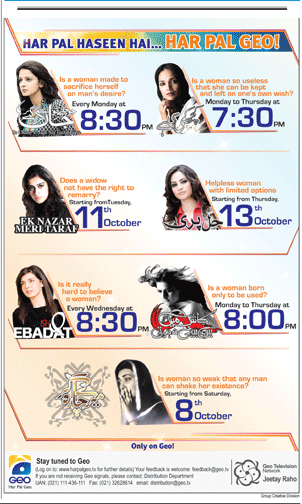
Geo Does Women Empowerment, Kinda

You know how, sometimes, you want to write a post on something big and important but then along comes something trivial but so funny that it's hard to pass up? Well, that's what I feel right now.

See the following ad featured on the back page of The News today, featuring a line up of Geo TV's drama serials for the week:

Geo TV ad in The News today


Read the descriptions of the storylines. In the interest of easy reading, I am reproducing them verbatim below (my favourite has to be #4):

1. Is woman made to sacrifice herself on man's desire?
2. Is a woman so useless that she can be kept and left on one's own wish?
3. Does a widow have the right to remarry?
4. Helpless woman with limited options.
5. Is it really hard to believe a woman?
6. Is a woman born only to be used?
7. Is woman so weak that any man can shake her existence?


What a rollicking week of entertainment to look forward to. Or could one say that the success of the relentlessly misery-focused Bol has gone to Geo's head?


Monday, October 3, 2011

Comedy As Serious Business

“Ever wondered what you could do in light of ongoing terrorism, the Haqqani network, the Taliban, the al Qaeda? Tried shooting off a punch line, or throwing a joke at them?”


So began this piece in the Express Tribune today praising This Is Standup Comedy, a four-part web series in which local comics Saad Haroon and Danish Ali ostensibly “try and explore the effect terrorism has had on Pakistani society”. In the interests of full disclosure, I have to say that as the series loaded I was already thinking but haven’t we got any psychologists for that?


Half the point of good comedy is that it isn’t earnest, well-meaning or motivated by the desire to please people or explain the world. It is about subversion. A good comic will not say the right things. He or she will say the wrong things. And if, in the process of saying the wrong thing, they punch a hole in my own Line Of Bullshit Control, well then ladies and gentlemen we have a winner. Or rather, a loser. Because that’s what genuinely funny people or POVs tend to be, losers aka misfits, underdogs, freaks, misanthropes, outsiders.

Take the delightful David Baddiel-written film starring Iranian funnyman Omid Djalili, The Infidel:


Take Sanjeev Bhaskar, Kulvinder Ghir, Meera Syal and Nina Wadia’s experiences of growing up in multicultural Britain in Goodness Gracious Me:


Take Fifty Fifty, which proved that censorship doesn’t have to be a bar to the pithiest of social commentary:


Take Chris Cooper, Sam Bain and Jesse Armstrong’s Four Lions, which showed us the difference between making fun of jihadis and making a funny about jihadis:


Now take This Is Standup Comedy, which consists largely of Saad Haroon and a host of other people pretending stand up comedy didn’t exist before English-speaking Muslims in a post-9/11 world discovered it, lamenting how hard it is to a) be misunderstood b) get a visa, and go outside and jump up and down on it.

You should do this not just because it’s good for your hams and glutes, but also because both Haroon and Sami Shah* – the genuinely wacky Danish Ali, despite his top billing, sadly only has four lines – are both talented, experienced comics and really should have known better than to try to pass of intellectual laziness as an ethical stance.

[*Update: We have received clarification from Sami Shah that he was not involved in the creation of the series and was merely interviewed for it. We apologize if a misleading impression was given by the above lines.]

The series does not explore the effect terrorism has had on Pakistani society as much as it explores the unfortunate results of comics being unable to transcend their own social/religious/ethnic/sexual identities. The answer to why this is so might lie in this line from the ET review:

"Haroon and Ali are well known among the hip crowd for being Pakistan’s première English language stand-up comics."

This is pretty much the comedic equivalent of jumping into a river with a concrete block around your ankles, which, as anyone else who has tried it at home can tell you, is really not funny.

When it happens – as This Is Standup Comedy inadvertently showcases - what you are left with is not the tight writing or detached dissection of universal human traits the four examples above feature but different versions of punch lines that can be summarized thus:

Terrorists are stupid.

People who think I’m a terrorist are stupid.

Why don’t you like me?


Live shows or series inhabiting this position don’t do themselves any favors. First, the comics seem to feel that being brown, from a conservative background and funny is in itself a novelty so they don’t work very hard and the material just isn’t good enough, especially when you compare it to thematically similar work that has already been done in both English and vernacular languages. This goes back to that notion of the wider world, and specifically discrimination, not existing before 9/11. Local comics looking to get mileage out of Islamophobia as a lived experience should look to the Jews. Not to convert (you’d have to be a real motherfucker to do that) but to contemplate what Jewish comics learned years ago; the trick is not to make fun of the goyim being anti-Semitic but to make fun of the Jew experiencing anti-Semitism instead. For example, Sami Shah's throwaway line about just wanting to 'understand the Taliban' could have led into a riff on hipsters at Espresso discussing ideology over a latte, but instead we are left again with the hackneyed profiling joke.

Second, I don’t really believe a stand up show on the day after a bomb blast is fighting the Taliban any more than I believe a fashion show an hour after a bomb blast is fighting the Taliban or my naanwala sticking bread in a tandoor the morning after a bomb blast is fighting the Taliban. Sometimes trying to make a living is just that, trying to make a living. The only difference between a certain kind of Pakistani in the creative sphere and my naanwala is that he doesn’t make a song and dance (and documentary) about it.

And now for something completely different…


Sunday, October 2, 2011

This Lucman Is No Hakeem

I had not actually planned to write this post but am doing so on the insistence of some of our friends on Twitter who think, quite rightly, that that medium is a rather ephemeral one and the information supplied on it should be preserved in a relatively more easily accessible format such as this one.

This post is a follow-up to Pakistan Media Watch's scrutiny of an apparent campaign against well-known journalist and television anchor Najam Sethi, which raises some very valid questions about who is behind the vilification and to what end. They are obviously mainly rhetorical questions since we can all tell what the possible motivations are when one looks at some of the illustrious names involved and the means employed. However, the PMW post also includes links to two television appearances by current Dunya TV talk show host Mubasher Lucman, wherein he attacks Sethi by name almost without provocation, and this is what prompted sharing this story.

Here is the first of them, from Lucman's own programme Khari Baat - Lucman Ke Saath from September 26. The relevant bit begins around 8:45 into the clip when Lucman suddenly diverts a discussion about US-Pak relations into an attack on Sethi:


For those who cannot understand Urdu, here is a brief transcript of the relevant comments between Lucman and his guest, the reporter Sami Ibrahim who until recently covered the US for Geo in Washington and now works for Dunya:

Sami: ...Evidence exists with the Pakistan army that the CIA is involved in Balochistan and in the Tribal Areas and that India is fighting its proxy war. But the Pakistanis have not yet presented this proof [publicly].
Lucman: The problem is because of people like you, journalists like you who want to take favours from the US, and for which they are selling Pakistan and denigrating it... For example, people like, a name I took this morning in a programme too, Najam Sethi sahib...Look at how much he has maligned Pakistan just to get [American] nationality for himself and his children.. can you justify that?
Sami: Look Mubashar sahib, any journalist who keeps getting invitations from the US, whose earning comes from the US, he will obviously call Pakistan bad names and try and put American interests front and centre and try to justify it. And now if Sethi sahib is trying to do that...
Lucman: He's been doing it for such a long time and all of you are silent, all of you have made a lobby [for him], all of you America promoting journalists...
Sami: No, but I think the Pakistani people have understood these things. Whether it's such a journalist or politician or intellectual or whoever, I think they stand exposed. And now the way the Pakistani nation has expressed itself in a united way against the US, I don't think I am wrong in my understanding that the Pakistani people have understood these underhand tactics.


I will come back to Lucman (whose claims that Sethi says what he says to get US nationality for himself and his children could easily fall foul of defamation laws) but just want to point out a couple of things about what Sami Ibrahim says. For those who cannot tell the nuances from the translated transcript, Sami is obviously very much in on the diatribe against Sethi, the fake berating by Lucman belied by the unabashed smile on Sami's face. Secondly his attack on those journalists whose earnings are tied to the US is a bit rich coming from someone who represents a channel that has taken US funding to set up a bureau and pay the salary of its correspondent there.


In any case, coming back to Lucman, here is the other clip that PMW linked to, this one from the morning show on Pakistan Television earlier that same day, hosted by former film star Noor, in which Lucman is a guest. The relevant bit begins around 2:00 into the clip:


Here, once again, is a translated transcript of the relevant portion:

Noor: Which anchors are there which you think [present a constructive point of view on television]...?
Lucman: Better you not get me started... I can tell you the ones that I dislike intensely. I'll take the names too, I have no problems.
Noor: Ok, tell us.
Lucman: The one I dislike the most is Najam Sethi. Anyone who promotes America, I don't like. Those who earn from Pakistan, who have been made by Pakistan and then go and defame Pakistan, I curse such people. There are many such people.

Now, Lucman's dislike for Sethi and Sethi's views can be justified as his opinion and aside from the potential slander pointed out earlier, the principles on which Lucman professes his antipathy to Sethi cannot be called into question. Many 'nationalist' Pakistanis would feel the same way in theoretical terms about anyone who was promoting the agenda of some other country because of some vested interest. But note that I am NOT going into the actual content of what Lucman finds disturbing about Sethi's views - personally I have never considered Sethi's criticism of the Pakistani state as denigrating Pakistan, rather perfectly valid critiques that any right-thinking person needs to make - and as PMW has shown, there seems to be far more to this campaign than the simple views of a man who equates critique of the establishmentarian mindset with bad mouthing the country (and it should be remembered that Mubashar Lucman's father was, after all, in the military).

But what I find rather rich is the self-righteous claptrap about "defaming Pakistan" Mr Lucman is able to consistently spew on television (he has vigorously defended match-fixers such as Salman Butt and attacked rape survivors such as Mukhtaran Mai on his programme), given his own rather chequered past. I want to relate a small anecdote that should show how much he actually has done to keep Pakistan's flag flying high.

In 2005, before his advent on TV, Mubasher Lucman directed his first and (thankfully) only feature film, Pehla Pehla Pyar. The hype was immense but when it was finally released in 2006, it turned out to be the biggest flop of the year. However, the controversy that simultaneously engulfed Lucman was far more problematic. It turned out that Lucman, who had had post-production work done at a lab in Thailand had fled from there without paying off his bill, valued by the studio at around US$80,000. In fact, he had defrauded the lab by taking a work-print (which is sort of an unfinished draft print) on the pretense that he needed to have the film censored in Pakistan, and then used that print to make cinema release copies from other labs in India. (Labs generally do not release prints or negatives until their bills are settled.) The result of this fraud was not only that the release prints were of very poor quality (made as they were from an unfinished work print rather than the original negatives which were still with the Thai lab), but that Thai studios collectively banned all Pakistani filmmakers from using their facilities. In addition, the Thai lab then wrote a letter to Pakistani film associations detailing the fraud. Under the threat of legal action and immense pressure from film associations in Pakistan, Lucman finally, ostensibly, settled the dues, allowing Pakistani filmmakers from accessing Thai facilities once again.

And that is how Mr Lucman contributed to raising the stature of Pakistan himself. Ostensibly this was not considered when he was conferred Pakistan's third highest civilian award, the Sitara-e-Imtiaz this year. But what's that they say about those living in glass houses?


Saturday, October 1, 2011

Fear and Loathing in AfPak

In this lead story from the online edition of the New York Times on the 26th of September, reporter Carlotta Gall humanizes one of the 16 American and Afghani officials allegedly ambushed and killed in cold blood at the Pakistani outpost of Teri Mangal in 2007, at the end of what they had thought would be a peaceful meeting to resolve a border dispute:

"…a Pakistani soldier opened fire with an automatic rifle, pumping multiple rounds from just 5 or 10 yards away into an American officer, Maj. Larry J. Bauguess Jr., killing him almost instantly. An operations officer with the 82nd Airborne Division from North Carolina, Major Bauguess, 36, was married and the father of two girls, ages 4 and 6."

US Major Larry J. Baugess (source: NYT)


Ms Gall’s story, the publication of which coincided with an increase in the verbal volleys being fired in Pakistan’s direction, blended seamlessly into the narrative currently being fed to the American public by its mainstream media. The narrative can be summarized by this editorial, The Latest Ugly Truth About Pakistan, in the same publication two days before:

"Those who came under fire that day remain bitter about the duplicity of the Pakistanis. Colonel Kuchai remembers the way the senior Pakistani officers left the yard minutes before the shooting without saying goodbye, behavior that he now interprets as a sign that they knew what was coming."


The increased rhetorical aggression is, in its own words, just the latest play in this game:

“The Pentagon hopes public exposure will shame the Pakistanis — who receive billions of dollars in aid — into changing their behavior.”


But realpolitik aside Ms. Gall – who is an award winning, experienced reporter covering Afghanistan and Pakistan - and the New York Times, are right to seek to ‘tell the truth’ and expose this story of ambush, murder and injustice in the AfPak borderlands in 2007. That, along with making a profit, is what serious journalists and serious publications are supposed to do. Here is another example of a similar story about the unjust ambush and murder of 16 men in the AfPak borderlands in 2006.


 The Spin Boldak massacre of 2006 (Photos from Afghan CID via The Atlantic)


This one is the culmination of a two-year investigation by roving reporter Matthieu Aikins. It is the story of smuggler Shin Noorzai and the 15 companions (farmers, traders, and a 16-year-old boy) who were traveling with him in Afghanistan in 2006 when he accepted an invitation from Mohammed Nadeem Lalai, an officer in the Border Police, to stop in Kabul on their way to the northern city of Mazar-e-Sharif to celebrate Nauroz. Lalai led them to a house where, during the festivities, the 16 were drugged, bound, gagged, loaded into vehicles with official plates and driven 500 kilometers south to Spin Boldak, by a smuggler/Border Police colonel named Abdul Raziq:

"Raziq and his men loaded their captives into a convoy of Land Cruisers and headed out to a parched, desolate stretch of the Afghan-Pakistani border. About 10 kilometers outside of town, they came to a halt. Shin and the others were hauled out of the trucks and into a dry river gully. There, at close range, Raziq’s forces let loose with automatic weapons, their bullets tearing through the helpless men, smashing their faces apart and soaking their robes with blood. After finishing the job, they unbound the corpses and left them there."

Brig General Abdul Raziq (source: The Atlantic)


If the name Abdul Raziq sounds familiar to anyone who follows developments in Afghanistan, it is because he is now Brigadier General Abdul Raziq of the Border Police, and also acting Police Chief of Kandahar, where he continues to exercise his penchant for torture and killing. The drug trafficker's rapid rise through the ranks is all the more remarkable, Mr Aikins establishes, when you consider how well documented his extracurricular activities have been:

"Though Raziq has risen in large part through his own skills and ambition, he is also, to a considerable degree, a creation of the American military intervention in Afghanistan. (Prior to 2001, he had worked in a shop in Pakistan.) As part of a countrywide initiative, his men have been trained by two controversial private military firms, DynCorp and Xe, formerly known as Blackwater, at a U.S. -funded center in Spin Boldak, where they are also provided with weapons, vehicles, and communications equipment. Their salaries are subsequently paid through the Law and Order Trust Fund for Afghanistan, a UN-administered international fund, to which the U.S. is the largest contributor. Raziq himself has enjoyed visits in Spin Boldak from such senior U.S. officials as Ambassador Karl Eikenberry and Generals Stanley McChrystal and David Petraeus."


In her story, Ms Gall hints at how official inquiries into the 2007 incident seemed opaque and half-hearted:

"General McNeill, who is retired, remembers the episode as the worst moment of his second tour as commander in Afghanistan, not only because he knew Major Bauguess and his family, but also because he never received satisfactory explanations in meetings with his counterpart, the Pakistani vice chief of army staff, Gen. Ahsan Saleem Hyat."


In his, Mr Aikins notes a similar pattern of investigative shortcomings on the other side of the line:

"In public, American officials had until recently been careful to downplay Raziq’s alleged abuses. When I met with the State Department’s Moeling at his Kandahar City office in January, he told me, “I think there is certainly a mythology about Abdul Raziq, where there’s a degree of assumption on some of those things. But I have never seen evidence of private prisons or of extrajudicial killings directly attributable to him."
"Yet, as a 2006 State Department report shows, U.S. officials have for years been aware of credible allegations that Raziq and his men participated in a cold-blooded massacre of civilians, the details of which have, until now, been successfully buried."


Both include the obligatory search for meaning in the tragedy reference. Ms Gall with:

"As for the Afghans, they still want answers. “Why did the Pakistanis do it?” General Same of the Afghan Army said. “They have to answer this question."


Mr Aikins with:

"It was a tribal conflict,” Waheed said, shaking his head, his long fingers trembling as they tapped against his cheek. “Raziq had a problem with Shin, but why did he have to kill all the others?"


To the jaded eye weary of reading endless accounts of the death and destruction wrought by mankind’s continued obsession with playing toy soldiers, the most interesting thing about Ms Gall’s piece was its timing, and this account of one of her previous interactions with Pakistani intelligence. Mr Aikins', on the other hand, kept my attention, partly because of nuggets like the following:

"Toward the end of 2009, senior ISAF officials reportedly thought about pushing for Raziq to be replaced. According to leaked cables, a high-level meeting was convened in Kabul, chaired by Deputy Ambassador Earl Wayne and Major General Michael Flynn, to discuss the problematic behavior of Raziq, among others. “Nobody, including his US military counterparts,” one cable noted, “is under any illusions about his corrupt activities.” Ultimately, however, General McChrystal, who was then the commander of ISAF and U.S. forces, decided that Raziq was too useful to cut loose, according to an article in The Washington Post. (McChrystal, through a spokesperson, declined to comment.) Cables also reveal that an American information-operations team even proposed a plan, “if credible,” for “the longer-term encouragement of stories in the international media on the ‘reform’ of Razziq."


We wait with bated breath for a time when there will be a US policy push for the longer-term encouragement of stories in the international media on the ‘reform’ of Pakistan.


Footnote:

Hunter S. Thompson

These two strikingly similar and yet markedly different stories had me reaching for a passage from the beginning of Hunter S. Thompson’s The Rum Diary, describing the hard-drinking clientele of Al’s Backyard:

"Vagrant journalists are notorious welshers, and to those who travel in that rootless world, a large unpaid bar tab can be a fashionable burden.

There was no shortage of people to drink with in those days. They never lasted very long, but they kept coming. I call them vagrant journalists because no other term would be quite as valid. No two were alike. They were professionally deviant, but they had a few things in common. They depended, mostly from habit, on newspapers and magazines for the bulk of their income; their lives were geared to long chances and sudden movements; and they claimed no allegiance to any flag and valued no currency but luck and good contacts.

Some of them were more journalists than vagrants, and others were more vagrants than journalists – but with a few exceptions they were part-time, freelance, would-be-foreign correspondents who, for one reason or another, lived at several removes from the journalistic establishment. Not the slick strivers and jingo parrots who staffed the mossback papers and news magazines of the Luce empire. Those were a different breed.

…In a sense I was one of them – more competent than some and more stable than others- and in the years that I carried that ragged banner I was seldom unemployed…It was a greedy life and I was good at it. I made some interesting friends, had enough money to get around and learned a lot about the world that I could never have learned in any other way.

Like most of the others, I was a seeker, a mover, a malcontent, and at times a stupid hell raiser. I was never idle long enough to do much thinking, but I felt somehow that my instincts were right. I shared a vagrant optimism that some of us were making real progress, that we had taken an honest road, and that the best of us would inevitably make it over the top.

At the same time, I shared a dark suspicion that the life we were leading was a lost cause, that we were all actors, kidding ourselves along a senseless odyssey. It was the tension between these two poles- a restless idealism on one hand and a sense of impending doom on the other – that kept me going."


Hunter S. Thompson killed himself in 2005.

Wednesday, September 14, 2011

Trust Us, Even If We Do Not Trust Ourselves

So, most of our readers have probably already heard about the advertisement that the Government of Pakistan took out in the Wall Street Journal (WSJ) on the 10th anniversary of 9/11. According to Dawn, the ad was first offered to the New York Times, which "refused to publish it, forcing Pakistani officials to go to a business newspaper with a specialised but influential readership."

Here is the ad (via the LongWarJournal):

Pakistan's 9/11 ad in the WSJ


Irrespective of the merits of the advertisement - and there are many who have questioned its design and message - one of the intriguing questions that arise is why the New York Times refused to publish it. A half-page ad is, after all, darn good revenue especially in these recessionary times.

According to the WSJ's own blog, which shrugged off the ad's chances of changing the anti-Pakistan narrative in the American media:

"The [New York] Times asked for “more clarity in the ad about who was placing it,” according to a spokeswoman for the newspaper. The Times did not hear back from the government and so has not yet run the ad, she said."

Well, our sources inform us that the problem about the source of the ad arose because neither the Pakistan Embassy in Washington nor the Ministry of Foreign Affairs (MoFA) nor the Ministry of Information & Broadcasting (MoI&B) were the sources of the ad. In fact, our sources confirm that none of these three Pakistani government entities was even consulted about the ad. In fact, the ad, designed by the Pakistani advertising agency Midas, was placed directly from the Prime Minister's Secretariat.

Why, you might ask, would the Prime Minister's Secretariat bypass its own subordinate media departments and its representatives who are specifically tasked with international relations work? Could it be, as our sources indicate, that the advertisement was the first instance of the country's premier intelligence agency directly placing an advertisement in a foreign publication?

The question that the WSJ probably needs to answer is how, if the three obvious points of contact (Embassy, MoFA, MoI&B) for advertisements from the Government of Pakistan did not sign off on the ad, was it able to confirm that the ad was, in fact, placed by the Government of Pakistan. According to the WSJ blog, which also raises this question:

"The ad as printed in the Journal carries a line at the bottom in small font saying “Government of Pakistan” next to a web address for the government. A spokeswoman for the Journal declined to comment."

Is there something essentially wrong about the ad? Aside from quibbles about the precision of some of the figures, some of the cringe-worthy wording ("Promising Peace To The World"?) and the obsequious offering up of Pakistan to the Americans, no. Is it wrong to try and sway public opinion in the US to a better understanding of the suffering Pakistanis have gone through in the fight against Al Qaeda-type terrorism? Once again, no. Those convinced that Pakistan is playing an evil double game will obviously poke fun at some of the assertions of the ad but there is no doubt that the often unnuanced and simplistic American narrative, that ignores how Pakistanis view the maelstorm they are caught in and their own interests, is in dire need of a corrective.

But what does it say about the Pakistani State if its organs feel they need to bypass each other to get a point across that, ostensibly, all of them should be agreed upon? What does it say about how policies are made and implemented?

Then again, we might also point out that the US$150,000 apparently spent on running the ad in the WSJ could have been better utiltized for things with a currently slightly higher priority than a PR exercise.

Monday, August 29, 2011

What He Said (And Leaked Beforehand)

For the last five or six days I had been contemplating how best to present the information contained on a website that someone had stumbled upon and forwarded to me. Not because one did not believe the authenticity of the information on it but because it left unanswered a number of questions. Not least of which was who was behind the website and to what end. I could make a fairly straightforward and educated guess about the persons behind the site even though the site's owners had chosen to disguise their ownership while registering it.

Zulfiqar Mirza swears on the Quran (Photo: PPI)

After today's "atom bomb" presser by the redoubtable former Sindh Home Minister / PPP Senior Vice President / Sindh MPA Zulfiqar Mirza, I think it is quite obvious who is behind the site.

The site of course is the imaginatively titled terroristleaks.com and contains pretty much all the information Mr Mirza spoke about and brandished in his presser today.

Not only does it have the facsimiles of the "secret" reports of the Joint Investigation Teams (JIT) on arrested target-killers (all of them allegedly connected to the MQM) in Karachi, it also contains the video-ed professional interrogations of some of them, such as the notorious Ajmal Pahari...


Who else would have had access to this highly classified information and have the motive and the guts to "leak" it on the net. Not a bureaucrat or policeman who feared the wrath of the government for disclosing official info, that's for sure.

These confessional statements make for fascinating (and of course chilling) reading and watching no doubt. And they also provide an insight into the mindsets of professional killers as well as those who control them. There is plenty here to damn the MQM's top leadership. But without, in any way, trying to sound like I am defending the indefensible, one must add a couple of caveats about the information contained here.

For one, keep in mind that this website does present only a selective version of the truth. The only information leaked here is of those terrorists alleged to be part of the MQM. Yes, the MQM's hit squad is apparently the most well-organized, most feared and most talked about. But in recent years the PPP, Sunni Tehrik and the ANP have also managed to cultivate their own nexus with the mercenary underworld (which Zulfiqar Mirza brushed off as "tit-for-tat" in answer to a question on Geo's Capital Talk tonight). And let's also not forget the hit squads of outlawed organizations such as the Lashkar-e-Jhangvi and the Sipahe Sahaba (which have links with other legitimate political parties), the MQM-Haqiqi faction, and on a different level, state-controlled institutions such as the police and intelligence agencies themselves. We do know that at least some of those killers are also in custody. Why is that information not here on the website? Does that justify the MQM's killers? No, not at all. But reading the lawlessness of Karachi without factoring in the political and economic turf wars which breed it or understanding how various communities perceive and react to the state would be slightly simplistic and even perhaps dangerously naive.

Secondly, purely from a legal (i.e. not moral) point of view, these documents and confessions do not necessarily establish guilt. They have yet to be proven in a court of law. We may choose to believe them (or not believe them) but they have the same legal position as, say NAB's accusations of corruption against Mr Asif Zardari. That is not to say that they are not true, just that one's belief in their authenticity does not equal legal proof for conviction.

Of course, as pointed out by a number of people already, this information and Zulfiqar Mirza's press conference also begs the question why, if this information was available with the government, have these terrorists not yet been prosecuted in the courts of law. If, as Mr Mirza claims, witnesses crucial to the prosecution are being eliminated, is it not the government's responsibility to protect them?

But even bigger questions hang over the whole drama today. Who benefits from this rhetoric and these disclosures at this time? Is it a mere coincidence that what occupied Pakistanis' entire evening came on the same day that the Rangers claimed to have unearthed ammunition stockpiles and torture cells in Lyari raids, and managed to push that news off the news channels?  On the face of it, Zulfiqar Mirza may be claiming that his newly awakened conscience dictated today's "straight-talk", but has he not also driven a stake through the heart of his close friend and "benefactor" President Zardari's political manoeuvrings for the PPP's future? For weren't what Federal Interior Minister Mr Rehman Malik (the target of Mr Mirza's wrath) and current Sindh Home Minister Mr Manzoor Wassan doing to keep the MQM on board part of Mr Zardari's strategy?

Mr Mirza may also have wrested the initiative from Sindhi nationalists who had been chipping away at the PPP in Sindh after the party's U-turn on the Commissionerate system. But would that really help the PPP if Zulfiqar Mirza is considered to be at odds with the party leadership? And was there something more to Mr Mirza's fullsome praise for the ISI and military than meets the eye? Who benefits if the PPP government at the centre comes under strain?

I confess I do not have the answers to these questions. At least answers that make immediate sense to me. If someone has a coherent explanation, I would love to hear it.


Sunday, August 14, 2011

Presenting... the Real Spirit of Aamir Liaquat

Without further ado...


[Update 1: The above video may not play because it has been pulled from Youtube by Geo. In that case you can watch the video here or try the following embed:


Update 2: I fully expect the above videos to be taken down eventually. Please check the comments section for new links that readers may post for the video in case you cannot view them from the given links. If you do come across new working links that are not already known, please do share them with others in the comments section.]

I don't subscribe at all to the sectarian twist this video takes towards the end, which is obviously motivated by other concerns. But the first half should be enough to get an idea of the reality of this televangelist. I'd love to see the face of the numerous people taken in by his faux piety and "gentleness" right about now. Keep in mind that this man is currently the Managing Director of ARY's religion channel QTV.

What is it they say? Har Cheez Meezan Mein Achhi Lagti Hai!


Update 3: Of course, Aamir Liaquat has taken the expected route and claimed that the video is a doctored one, with sophisticated editing and dubbing in of a fake voice used to conspire against him (what other possible recourse could a bald-faced hypocrite painted into a corner have?). Let's just say nobody - especially those with any sense of the technicalities of video editing - are buying it. He has blamed, without naming his former employers, Geo, for releasing the video, ostensibly because his Ramzan programmes on the ARY Network are (according to him) beating Geo's ratings (it's all about the ratings, isn't it?). Some others too have questioned how this video was leaked, comprising as it does, material that only Geo could have been privy to. We don't know how the video material made its way out of Geo (such things are usually traceable to editors or other working in an organization who have access to the footage and who can make copies on the sly) but the very fact that Geo has been pulling out all stops to have the video taken down from various sites points to the fact that the video is very much genuine. The reasons for Geo to want to suppress the video are simple: it reflects rather poorly on their programming and their brand as well, even though Aamir Liaquat may no longer be working for them. What it reveals is the utter hypocrisy of not just Mr Jaahil Online himself but also of those in direct charge of the 'religious' programming and indeed of the overall broadcaster itself. Obviously, while Aamir Liaquat was in Geo's employ, his producers, editors, crew, and channel executives knew full well what a charlatan he was and yet continued to deceive their viewers with a hyped up image of his piety.

But what is even more galling as far as Aamir Liaquat's latest "explanation" is, is how he immediately lays the blame for the "conspiracy" at the feet of those who are "against the finality of the Prophethood" and "against those who love the Prophet." Recall that Aamir Liaquat once condoned on his programme on Geo, a declaration that Ahmadis were wajib-ul-qatl (those whose killing can be justified), which was followed by the subsequent assassinations of two Ahmadis and Aamir Liaquat's live telecasts being suspended by Geo. "The tongue that speaks of the Prophet, Peace be upon him," he says in his most recent programme on ARY, "could never utter obscenities." If that is not the worst form of munafiqat (hypocrisy) in the name of religion, I don't know what is. Has this man no shame at all?

You can see the slimebag squirming here:


As a response, and to make Aamir Liaquat squirm some more, I would have love to have posted here the badchodaboy remix which I saw yesterday (man, these guys are quick) but, unfortunately, it too has disappeared off Youtube. If you find a link for it, let us know.

Thanks to @WarisJunejo, here it is:


Incidentally, do ARY head honchos really think Aamir Liaquat can ride this out?