Tuesday, May 8, 2012

I Opened The News, And It Was Yellow

When you have four stories on one patently manufactured 'issue' carried by a newspaper in five days, you can safely consider it an object lesson in how to conduct a witch-hunt.


The News' City pages May 3, 2012

In the first story, titled 'City's elite schools say no to national anthem' published in the city pages of The News on May 3, 2012, reporter Sidrah Roghay wrote that several "elite" schools in Karachi had discontinued the tradition of singing the Pakistani national anthem during morning assembly "calling it a waste of time and energy."

She went on to imply that "regulatory authorities" were complicit in this "dismal" state of affairs, because of the schools' "influence and connections." The schools, we were told, catered mostly to the "elite, upper-middle class and middle class families." The battle lines between 'us' and 'them' being drawn, Ms Roghay and the city editor (who presumably helped commission this near flawless incitement to class resentment and hyper-patriotism), went on to helpfully pin the tail on the donkey. With a staple gun.

A vice principal of Bayview High School was quoted as saying the national anthem was sung only once a week because "it takes too long, and wastes time that can be used in the class constructively."

The reader's take home is, this person, this school, thinks singing the national anthem is a waste of time.

An anonymous school head is then quoted mouthing the words to really get the dander up of all Pakistani and linguistic patriots:
“I do not ask students to sing the national anthem: firstly, because it is in Urdu; secondly, I do not believe in national cohesion. What purpose does the national anthem serve? Students should be engaged in more meaningful activities.”

The reader's take home is, what a jerk!

Further on, for those horses who are reluctant to drink:
"The principal’s obvious disdain for the national language and anthem underlines the fundamental crisis of Pakistan’s education system which remains divided not just on the [sic] class basis, but also on the [sic] ideological grounds."

And in the rub down stage, we have quotes from a collection of impressively titled talking heads that subtly conflate the frequency with which a student sings the national anthem with the depth of their patriotism.

After the first article, there was radio silence for a day as the article did the rounds, eliciting the predictable outraged how dare these people think the national anthem should not be sung! from people who either a) read it; b) read about it on someone's Facebook wall or Twitter feed; or c) heard about it during a lull in conversation at a gathering (such as the provincial assembly).


The News' City pages May 5, 2012


Then, on Saturday May 5th, The News carried two follow up stories. The first, titled 'Elite schools' defiance over national anthem stirs debate in PA' by reporter Imtiaz Ali, began with a paragraph saying that Sindh Education Minister Pir Mazharul Haq had taken serious notice of the paper's report that some of the "elite" schools in Karachi had "banned" the singing of the national anthem.

The minister went on to express his "displeasure" at the schools, and said that such an attitude "made a joke of national identity."

Three schools were named in a sentence that said they had either "totally scrapped the tradition of singing the national anthem or do it only once a week." No further details were provided about which of them had done the former or the latter. No details at all were provided about the frequency of the singing of the national anthem in government schools, madrassas, or the private school equivalent of an alternative to an "elite" school. But...
"The report came as a shock for many senior educationists, parents and students. They expressed concern over the banning of the national anthem at these institutions, which follow the Cambridge system of education, and asked the government to intervene. The minister said the Directorate of Private Schools had been directed to take strict action against these schools, saying that they considered themselves above the law."

An MQM minister is then reported to have suggested that the Sindh Assembly pass a resolution making the singing of the national anthem mandatory at all schools, including the ones "affiliated with a foreign system of education."

The third story, titled 'Schools served with notices' detailed how the Directorate of Private School Institution Sindh (DPIS) had on Friday sent notices to some of the leading private schools which had "barred" the singing of national anthem at their morning assemblies. The heads of the schools mentioned in the initial report - bar one - and some others that traditionally come under the 'elite' banner, met with the DPIS:

"Representatives of most of these schools said that they follow the tradition of national anthem at their assemblies. Meanwhile, Khalid Shah, chairman All Pakistan Private Schools Management Associations Sindh, promised an inquiry regarding the issue, saying that the registration of those schools, which refuse to follow the tradition [italics added] of national anthem, would be cancelled."

Two days later, on Monday May 7th, a further story appeared by Fasahat Mohiuddin under the subheading "Discarding the National Anthem", detailing how various political parties had jumped into the fray and wanted urgent "action against the schools." The PPP minister for local bodies, Agha Siraj Durrani said "Our party will never allow such practice to go unchecked." The MQM's Coordination Committee's Waseem Aftab said his party "strongly condemned the act of dropping the national anthem by a handful of elite schools." The PMLN Sindh President Ghous Ali Shah "demanded action" and "asked for an 'investigation' of how these institutions had been allowed to get away with it for such a long time." The PMLQ's Halim Adil Sheikh "demanded that the government should penalise all such schools." The Jamaat-e-Islami, the Sunni Tehrik and Jafferia Alliance reps expressed similar shock and outrage. The reporter noted:
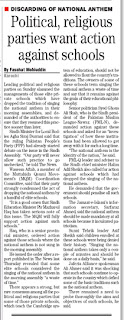
"There appears a strong, but rare consensus among all the political and religious parties that some of those private schools, which teach the Cambridge system of education, should not be allowed to flout the country's traditions."

The News' City pages May 7, 2012


I do not wish to get into the issue of whether singing the national anthem makes someone more or less patriotic (though many of the people dubbed threats to Pakistan by the same political parties mentioned above sing the anthem the loudest). Or whether making a herd of sleepy kids mouth lyrics they often don't understand five times a week instead of once a week is the most productive use of their time in school. Let's just say I too have been moved by the melody of the Land of the Pure, and I too understand why Sesame Street has a character dubbed a grouch. But I do want to comment on the kind of yellow journalism that characterizes these reports:

1) The facts are that the national anthem is sung and taught at all schools in Pakistan, just not always every single day. After these loaded stories, a lot of people now think the anthem is not sung at all. But far more importantly, in a country where the illiteracy rate is easily above 50%,  where the vast majority of children drop out of school before reaching the 6th grade, where there are more children out of school than the entire population of Australia, where 50% of children between the ages of 6-16 who are in school cannot read a single sentence in any language, where less than 1.5% of the GDP is allocated to education (and even that is not fully spent), where just 39% of schools have electricity connections, and where  the average teacher is missing from school one day every week, THIS is what The News believes is the most pressing issue to take up and run as a campaign?!? (For more shocking figures see Education Emergency.)

2) Note the subtle, intelligent manipulation of language in such propaganda, which is perhaps the only time you see subtle, intelligent manipulation of anything in newsprint these days. The four stories consistently claim the anthem has been 'banned' or 'barred' or 'dropped' or 'scrapped' or 'discarded' in the schools they name, and perhaps others, and that is blatantly false, even going by the stories themselves. You'd have to be a real idiot to 'ban' the national anthem anywhere in Pakistan (and how would that even work?). Furthermore, the fact that a parliamentarian floated a resolution calling for the singing of the national anthem to be made mandatory in schools clearly establishes that there exists no such law in the first place. Even if a school head (from Mars) decided a full assembly with the raising of the flag and the national anthem was best done once a week, he/she would not be breaking any laws. Most people keep referring to the "tradition" of singing the anthem, which also shows there is no law mandating the singing of the anthem. (Incidentally it's also a tradition in Pakistan to provide bad education but nobody wants to harp on that.) Yet, note, in story two, we have a reference to how the 'elite' schools considered themselves "above the law." The editors of The News probably also don't even know that parliamentary resolutions are not laws and are not binding. Then, there is the consistent raising of the 'elite' flag, and the equation of private schools with the elite. Had the reporters and editors of The News done a little bit of real research, they would know that more than half of all urban children in Pakistan attend private schools.

3) The statement most guaranteed to raise hackles, "I do not believe in national cohesion", is attributed to an 'anonymous' source. We have no way of knowing if this is actually a real quote or a bit of spice thrown in by the reporter. If someone is unwilling to own up to what is clearly a provocative statement, why include it? What's next for The News' city pages? "A non-Muslim, speaking on condition of anonymity, said 'I do not believe Muhammed was the last prophet"? Why cross the line between reportage and sensationalism? This bring me to…

4) Motive. What beef does The News, or the editors who have okayed these stories (reasonable to assume since more than one reporter has been assigned this particular story) have with these particular schools? Until they can provide us with more fire than smoke, we're going to have to assume this was simply a case of a child or relative refused admittance or employment.

And we're not going to talk about where Mir Shakilur Rehman's children went to school and college.

I shudder to think what all this says about the issues that will power upcoming electoral pleas. The city pages, more than the oped pages (and definitely more than the lifestyle pages) often act as remoras to the sharks apt to surface in the speeches of the coming year. The rhetoric employed in this campaign against certain private schools "which follow the Cambridge system of education" (note the frequency with which two pop up in the first three stories) is reminiscent of that employed by Imran Khan in his magnum opus I Know What You Did Last Summer (But Let's Not Talk About What I Did Because That's So Last Summer). Now that we have decided we don't like America, are we going to be told we don't like anything foreign at all? Shall we be asked to say goodbye to pants, guitars and any kind of learning focussed on inculcating critical thinking rather than rote learning? If we refuse, will we be told we are not Pakistani enough?

 I hope not. Because I have always hated the Indian toilet.

Wednesday, May 2, 2012

Of Governance Scandals And Clean Hands

We are sometimes accused by partisan supporters of opposition political parties of being soft on or for not being more vehement about denouncing the alleged corruption or misgovernance of the currently ruling Pakistan Peoples Party (PPP). While I could point to dozens of examples to dispute these claims, I would like to explain, once again, a couple of things.

Firstly, we do not brook real corrupt practises, arrogance or misgovernance; our only problem is when either claims are made without substantial proof or when such allegations are made arbitrarily only against the PPP and without context, as if everyone else - from the military to the judiciary to other political parties - is innocent of any blame and everything was hunky dory aside from the times that the PPP has been in power. This is not to say that the PPP should not be hauled up for its sins, only to provide a more balanced perspective.

But even more importantly than this is the fact that in the context of a mainstream media that overwhelmingly targets the ruling party (usually because that is in the nature of the media and sometimes because of less salubrious vested reasons), it makes little sense for us to repeat the same charges. The mainstream media has far, far more resources and outreach than we do and, to be sure, it is perfectly justified in its criticisms when it investigates and exposes real corruption and misgovernance. Our role, as we see it on the other hand, is not to reinforce what the dominant narrative is, but to provide, hopefully, some perspective, sometimes corrections and an alternative narrative where required.


Punjab Laptop Scheme: note the personal publicity


In any case, with that bit of explanation out of the way (and there is a connection which I will come to later), let me get down to what this post really is about. Those who follow us on Twitter will know that we already expressed our opposition to the Punjab Goverment's laptop distribution scheme. Our main contention against the scheme was two-fold:

1. That this was a wasteful publicity stunt that, like the disastrous Sasti Roti scheme before it, would drain the public exchequer without addressing real issues and would divert resources that could be better utilized in more productive schemes with more long-term benefit. 
2. That if providing access to computers to students is the goal, giving away laptops to individual students is possibly one of the worst solutions possible. Laptops, by their very nature, are more fragile, less upgradable and more prone to breakage and theft.

Keep in mind that our critique did not revolve around the issues of corruption or maladministration of the scheme, only its conceptualisation.

However, yesterday, Dunya TV's Khari Baat Lucman Ke Saath programme carried a devastating expose of how this scheme has really been run. It is a shocking expose of a scandal that most mainstream media has chosen to ignore so far, probably because it is too busy with stories about Memogate and exposing the federal government's malfeasance in the NRO case. I managed to catch the programme on repeat today and really think everyone who was upset at our opposition to the scheme should take a look at. (Hasan Nisar doesn't really add much to the programme but I am including the whole programme here so that you can appreciate the solid work and research that went into it. Kudos to the young reporter Huzaifa Rehman Qureshi who did most of it and to Mubasher Lucman for carrying it.)

Part 1:


Part 2:


Part 3:


Part 4:


So basically, not only was there apparently huge financial bungling in the procurements of laptops and in the publicity of the scheme, many of those who benefited from the scheme were either PMLN supporters, mediocre students or affluent people who did not deserve to be subsidized by the state.

This laptop scheme was announced in November last year. It has taken the mainstream media six months to raise serious issues about it (even though there were various murmurings against it online for some time). Most of the time, we have been treated only with PR-type statements justifying it, such as this one  in The Daily Times claiming total transparency in the scheme with no counter narrative or actual investigation of the claims. At the same time, the Chief Minister of Punjab, Shahbaz Sharif, is given ample (and often uncritical) coverage in the media vowing to ensure "good governance" and proclaiming that he will "hang the looters of the national wealth (i.e. PPP leaders) publicly."

Coming back to what I began with, can you imagine had such a scandal involved the PPP, that the media would have waited even a moment to pounce on it? Had the PPP been bestowing largesse to its jiyalas, to failed students and making money off it too, would Geo, to cite just one example, have waited six months to run exposes on it? Isn't it about time one questioned why certain people get a much easier ride from the media's vigilant watchdogs than others?

Saturday, April 21, 2012

Yes, Television Was Sometimes Awful But Was Social Media Any Better?

Almost two years ago, I wrote this piece and this piece about reporting on the Air Blue aircraft crash in Islamabad. The tragic crash of Bhoja Air flight from Karachi to Islamabad yesterday and its attendant coverage has compelled me to sit at my keyboard yet again. But whereas my initial disgust with some of the reporting on television was the initial motivation for writing a few words, the subsequent speculation and shoot-everything-in-sight diatribes on social media deserve an equal evaluation.

Bhoja Air crash (Photos via Dawn)

More on the latter later in the post, however. First, let's look at where television coverage went right and where wrong (contrary to the outrage being expressed on social media, all of it was not dire). Generally, most channels did NOT show bodies or limbs. I flipped through most of the major channels during the initial coverage, once reporters and cameramen had reached the site of the crash, and none of them were deliberately showing gore. I have heard that Samaa breached this agreed upon rule during its coverage (I did not personally see it) and, if so, viewers should definitely haul them up for it. Generally, however, good sense dictated the on-site footage, with some minor slip-ups that occurred because of the live nature of the coverage but which were corrected immediately.

Most channels did go over the top in the intrusive way they covered the grieving families and friends of those who had lost their lives in the crash, with one channel's reporter even shoving a mike in the face of a wailing relative and most running footage of distraught people in a loop. This kind of insensitive and senseless reportage (what exactly is a grieving relative going to say that will add to the sum of our knowledge?) needs to be checked and the privacy and dignity of those affected by a tragic event needs to be respected by the media. Ditto for the silly and offensive animations that we have objected to earlier as well that are based on pure speculation (one had a plane nose-diving while ARY even ran a clip from a Hollywood film!)  and only serve to mislead viewers and perhaps cause agony for those affected.

However, those on social media who were of the opinion that there should be absolutely no coverage of those affected and that no such intrusion occurs anywhere else in the world are living in some sort of make-believe world. I'm sorry but, to a certain extent, this is the nature of the medium that television is, it gravitates towards dramatic visuals and I have personally seen Western reporters be equally insensitive and intrusive as well as plenty of footage on Western channels that covers grieving relatives. Instead of talking about having channels shut down over their coverage (on what basis one is still not quite sure) or hauled up and fined, it would be far more productive to build consensus on where the ethical line actually is. A good point to start, as someone pointed out, is for channels and reporters to put themselves in the shoes of those grieving. If one of their own family members had suffered such a tragedy, would they want their and their family's grief to be broadcast in close-up and in a loop to the whole world? Would they want to be asked what they are feeling? Pressure should be built on channel heads and news editors to sit down together - as they did in the case of coverage of people killed - and work out a framework of guidelines on how grief is to be shown, also keeping in mind that overly dramatic scenes of grief are not healthy viewing particularly for children who sometimes can catch them inadvertently.

Where most channels really slipped up, however, in my opinion, was, as in the case of the Air Blue crash, in their knowledge of basic scientific principles and facts and in their propensity to conjecture for no worthwhile reason or on the basis of any real facts. Thus two channels, including Dunya, initially kept insisting that the plane was a Russian aircraft (ostensibly implying poor quality construction) even while others had already pointed that it was an American Boeing. One channel, Express, initially announced that a military helicopter had gone down with soldiers on board (before reversing their 'breaking news') and ARY ran a lengthy clip of a local on site who claimed that the crash was probably caused by aerial firing 'as he had always feared and filed a court petition about'. Other 'eye-witnesses' variously claimed the plane had split up in the air or had been struck by lightning or that its engine was on fire. In most cases, the problem with unsubstantiated stories finding their way on to television news has to do with the 'breaking news' disease, the desire to be the first with the 'news' as part of ratings wars. But news editors should also know by now that 'eye-witness' accounts in such cases are notoriously contradictory and should at least be moderated by an editorial narrative. Wild claims such as that of aerial firing by the conjecturing 'eye-witness' only add to viewers' confusion and really should not be part of the narrative in the first place. I suppose when anchors have seemingly never even heard the term 'cloudburst', they latch on to whatever is easiest for them to grasp, whether it is relevant or not.

Incidentally, as pointed out by a journalist who emailed us, every channel also got one fact completely wrong: that this was Bhoja Air's 'inaugural' flight from Karachi to Islamabad. He pointed out that a friend of his had flown Bhoja on the same route three days earlier. However this wrong bit of information was apparently traced to Bhoja Air's own website. I have no idea why Bhoja would claim this was an inaugural flight when it was not. One suggestion was that, perhaps this was the first afternoon flight on the route while the earlier flights were morning flights. Even in that case, the term 'inaugural' is a bit of an exaggeration.

Of course the default position of all channels is to try and find scapegoats. Everyone knew that the weather had suddenly taken a turn for the worst and freak acts of nature have in the past brought down planes in other places in the world - in fact, pilots who landed in Islamabad just a few minutes earlier confirmed that the weather had suddenly become very dangerous - yet most channels chose to attack the age of the aircraft, the skill of the pilot, the company's chequered history (it ceased operations in 2001 and only started up again a month and a half ago), Civil Aviation Authority's procedures and bizarrely even the government (in the case of Samaa). Geo's anchor, meanwhile, actually asked an astonished aviation expert if, 'had the pilot been more skilled, he could have brought the plane down low enough in the air for the passengers to jump out'. Really Junaid? Have you never travelled in a plane??!

The point is not that one or more of these factors could not have played a part in the tragedy. But that they were discussed ignoring the fact that even with the best and youngest of aircraft, the most skillful of pilots and the best of professional environments, accidents can and do happen with freak forces of nature. What purpose exactly is served, aside from filling up airtime space, from making conjectures whose actual answers will not be known until a proper inquiry is held? Or is creating pointless agitation among the public at large the job of news media? A debilitating lightning strike or devastating wind shear (as is now being discussed) could have solely been responsible without any of the factors being discussed coming into play.

Which brings me to the speculation that swamped Twitter and Facebook right after the crash. Truth be told, it was no better than the conjecture of the television anchors. One common refrain was the age of the aircraft that went down (more than 27 years according to this report in Dawn quoting AviationSafety.net), as if no old planes ever fly anywhere else in the world. In fact, as this answer points out, the average age of DC-9 aircraft operated by the US carrier NorthWest Airlines in 2005 was 34 years old! And that theoretically, depending on regular checks and maintenance, planes can continue to fly forever. (Here's some more info on life spans of aircraft in case you're interested.) In fact, the main reason fleets are replaced is because newer aircraft are more fuel efficient (but fleet replacement, as was blithely being suggested by certain people, obviously requires a lot of investment capital). Once again, the point is not that the age of the aircraft could definitely not have played a part in the tragedy. Only that picking on this one factor without any proof of it being a factor is as absurd as anything the channels were doing.

The other great target of social media activists seemed to be, as is always the case, Geo. I am hardly a defender of Geo's excesses, but as someone who watched most main channels' coverage of the incident, I can tell you that Geo was far more restrained than some of the others. By far the worst in terms of absolute absurdity were Express and ARY, mainly because there seemed to be no sensible editorial control and a surfeit of banal posturing from their reporters. As an example, in one segment on Express, the reporter held up a burnt out fire extinguisher because the anchor goaded him to get in amongst the debris and then spouted this gem: 'This cylinder is a fire extinguisher, used to extinguish fires, but when the plane caught fire, even this was no use.' He then went on to pick up another piece of debris, adding 'This used to be a part of the plane but after its destruction, it is no longer a part of the plane.'

So please, hold Geo's feet to the fire by all means, but let's not lose sight of the wood for the trees.

Thursday, April 19, 2012

Fashion Passions

Recently, the comedian and writer Sami Shah tweeted the following image, accompanying the visuals with the line 'My gift to anyone who tries telling you that fashion in Pakistan should be taken seriously' :


I know this snub has probably enraged all the fashionistas out there, especially those who never tire of telling us how fashionpromotesourculture, how fashioninvolvesbloodsweatandtears, how fashioncanincreaseourexports and how fashionisfightingtheTaliban. But I would submit there's another reason why fashion is not taken seriously by anyone outside the fashionistas' charmed circle or at least certainly not as seriously as they hope it is taken: fashion journalism.

I personally have nothing against fashion designers per se. Some of them can be quite creative at what they do, everyone's got to make a living somehow and most people wear clothes and like nice clothes, even when they can't afford them. It's the fact that commodotized fashion seems to have subsumed every other bit of 'culture' - rather like a giant amoeba plunking its big fat cellular arse over anything of nutrient value and phagocytosisizing it - in the social / cultural / entertainment pages of our newspapers and magazines that I have a problem with. When a society begins to think of good looking people walking up and down ramps as the height of a cultural event, that society's got a problem, Taliban or no Taliban.

Take a look at the pages of our newspapers and you would think there's no higher achievement than a lawn exhibition here or a trade show there (and by God! there are a lot of them) and no greater creativity than the shaping of eyebrows and application of eye-shadow. Forget the advertising onslaught that crowds out city horizons and media space, copious editorial verbiage is dedicated to dissecting the latest twist of a paisley, the half-an-inch raising of a hemline, the ideological differences between the Pakistan Fashion Week, the Fashion Pakistan Week, the Fashion Showcase and the Pakistan Fashion Design Council Week (which of course reminds one of this). But perhaps it might even be somewhat bearable if there was actually any 'dissection' at all. No, the default characteristic of most fashion writing in Pakistan is to 'extol', as if the amoeba's life depended on it, and the position of writers on fashion more akin to phagocytosisized groupies than dispassionate journalists.

Consider what appeared in today's Instep pages in The News for example (by no means the only instance or the only space where such writing appears)...

Here's a box item that pretty much tells us all we need to know in the headline: that designers Hassan Sheheryar Yasin (of HSY) and Shehla Chatoor won awards for their designing at two separate fashion weeks. But then continues for four paragraphs of waffle that includes the following bit of purple prose:

"It’s the glamour of high fashion, the need for something new and the innovation of these designers that has won over the hearts of the voting public. The influence of fashion is breaking borders within the Pakistani public’s mindset. The imposing façade of designer fashion has been lifted and the opinion of the majority has softened the hard line which divided people’s views of fashion as elitist and unattainable. It’s the display of talent and the celebration of beautiful design which the public voted for by way of Shehla Chatoor and Hassan Sheheryar Yasin."

But for real overblown hype you must turn to the main article. A report on Day 4 of the PFDC Sunsilk Fashion Week, it is headlined, in faux deep analysis tone, 'Showmanship, the spirit of fashion and understanding the difference.' The article begins by gushing the following adjectives and phrases about HSY and his clothes: 'most magnificent', 'grand', 'divine', 'gorgeous', 'sexy' and concluding that 'the man is a wiz.'

And that's for a designer the writer claims was not as "exciting fashion-wise" as the others.

For the others and their shows, the following words and phrases are then deployed: 'king and queen', 'exquisitely tailored', 'gorgeous' (again), 'raging hit', 'great', 'masterstroke', 'panache', 'flawless', 'super hit', 'equally brilliant', 'wizard', 'hottest', 'new heights', 'such talent', 'brilliance' (again), 'brightest', 'most cutting edge', 'to die for', 'rollicking collection', 'fashion met art', 'one-of-a-kind', 'collector's item' and 'painstakingly perfect.' Well, at least you know that a thesaurus might be the best gift to get the author.

Seriously, if any other 'beat' carried this type of writing, it would be accused of being dangerously naive and simply promotional advertising rather than journalism. How can anyone then take fashion without a healthy heaping of salt?

The article ends with an exhortation:

“Let’s try something that hasn’t been done before.”

Not to put too fine a point on it, but yes, why don't we.


Monday, April 16, 2012

Difa-e-Pakistan Video of the Day


I would have posted this yesterday but sometimes weekends should remain weekends i.e. work-free, no matter the happiness work may bring. In any case, this has to be the best thing to have happened in Pakistan yesterday or perhaps even the year. And may I add, it could not have happened to a better blowhard at a better occasion (a meeting of the leadership of the Duffer-e-Pakistan Council).


Given his past exploits rigging elections, General Hamid Gul sahib should have known by now that there's no guarantee of the kursi once you leave it.

Wednesday, April 11, 2012

It's Basic Decency, Stupid

I was going to post my outrage over the depths of tabloid-y sleazebaggery that The News sunk to today but blogger Tazeen has already said all that needed to be said, so you should go over and read her post. I concur completely.

Not only did the reporter, editors and owners of The News break all norms of professional journalistic ethics and the right to privacy, they have also abetted a truly despicable hospital administrator in flouting a sacred oath of patient confidentiality and exposed a woman to prosecution from odious Zia-era Hudood laws that they claim to have been in the vanguard of the fight against. They should be ashamed of themselves.

We have in the past protested strongly when sleazy personal and defamatory stories against the Jang Group CEO Mir Shakilur Rahman were publicised on the floor of the Sindh Assembly and in the media. For someone who has borne the brunt of such unethical invasion of personal privacy, it boggles the mind that he would allow his newspaper to perpetrate the same to someone else. The owner of the Jang Group and the editors of The News should also be aware that if they think any of this flouting of basic ethics and decency is justified in any way because their target is an often-mocked celebrity, in the future someone who wishes to humiliate them might decide that they or their families are fair game as well. No one is free of skeletons in their personal closets.


Monday, April 9, 2012

Siachen Tragedy: Prioritizing the News

This is a post about the heart-rending tragedy that struck on the Siachen Glacier early Saturday morning, which has buried - and in all likely probability killed - at least 135 people in one of the biggest avalanches ever to strike Pakistan. The latest estimates say all 124 soldiers stationed at the battalion headquarters in the Gayari sector and some 11-14 civilian support staff are now buried somewhere underneath the avalanche of snow, stone and dirt, said to be over-a-kilometre-wide and up to 80 feet deep.

But this post is not about the futility of maintaining armed forces in such inhospitable terrain (where more soldiers have died from the natural conditions than actual fighting), nor about the ridiculous expenditure this quarter-of-a-century-long deployment imposes on both Pakistan and India whose people still die from hunger, malnutrition, lack of access to clean water and easily treatable diseases. It could well be, but that's become almost a cliche and enough commentators will be focusing on just that. No, I want to focus on the shocking way this tragedy was covered by Pakistan's electronic media.

The following are the headlines from the 9pm bulletin on Geo News from Saturday 7th April 2012. Notice something?


As you can see, the news item about more than 100 Pakistanis having possibly perished was tucked away in fourth priority, behind the usual war of words between the PPP and the PMLN, the preps in India for President Zardari's 'private' visit to the Ajmer shrine and COAS Gen Kayani's banal statement about not letting counter-insurgency operations detract from 'normal' war planning. Sandwiched between these stories and other  news items about a motorbike stunt show, a transvestite wedding and 'Arab' dance on Karachi's food street, you could be almost forgiven for thinking the death of so many citizens of Pakistan was no big deal.

Keep in mind that the avalanche took place at 6 am on Saturday morning. I first saw the news in the 2 pm bulletin (it could have appeared earlier, I am not sure). And I remember feeling incredulous that even then the story was dealt with in such cavalier fashion. The entire day, it never received any higher priority than the third, fourth or fifth top story. It was only at 10.30 pm, when the armed forces' Inter-Services Public Relations (ISPR) department issued a statement detailing the specifics of the catastrophe that, suddenly, the news was turned into 'Breaking News' and finally entered the top slot of news bulletins.

Now, in any country in the world, such a natural disaster, especially one in which over 100 of its citizens had perished or even been trapped, would have or should have made the top story. Forget issues of nationalism, this would be a top story for any news media anywhere in the world. For a media that thrives on human interest stories, the idea that such a huge number of people were buried alive under a wall of snow inherently calls out for top billing. The number of lives directly touched by this tragedy - from family, relations, friends - in itself numbers in the tens of thousands. All the next day's papers, quite rightly, gave the story the main headline.

So what happened with Pakistan's television channels? (Although I have chosen to highlight Geo News here as the largest, by far, of the private media channels, I am told the other channels were similar in their handling of the story.) The only two possibilities are that either the news editors are completely incompetent in their judgement of news-worthiness, or that it was, more likely, pressure from the army that forced them to play down the story the whole day. And I will submit that in the case of the latter, the news editors and their channel's owners have displayed that they are equally incompetent in their judgement.

It is important to keep in mind a couple of things. One, that it was not that the story had not reached the news channels because of the remote location; they were aware of the parameters of the disaster at least by 2pm and were running the story, just not in the spot it deserved. Two, that it is highly, highly improbable that channels that run even the most mundane localized political and crime stories ad nauseam in their bulletins suddenly discovered the value of not 'sensationalizing' such a genuinely 'big' story. Even the argument that time was needed to inform the families of the potential victims does not hold any weight, since anyone whose loved one was deployed at Siachen would already have become aware of the disaster from the news that was running through the day. The only thing the down-playing of the news might have achieved is their resentment that their loved ones' lives were not worth more serious concern.

If channel heads and news editors cannot turn down the silly and unwarranted pressure of the army (if indeed it was this that decided the news priority and not simple incompetence) to play down what is, for any half-wit journalist, a blatantly obvious major story, if they really cannot stand up for their own news sense on such a non-controversial matter, they really should stop tooting the horn about themselves as the "independent media."

Wednesday, March 28, 2012

Read of the Day

I came across an essay today that contained the following passages:


"Widespread ignorance bordering on idiocy is our new national goal. It’s no use pretending otherwise and telling us... that educated people are the nation’s most valuable resources. Sure, they are, but do we still want them? It doesn’t look to me as if we do. The ideal citizen of a politically corrupt state, such as the one we now have, is a gullible dolt unable to tell truth from bullshit. 
An educated, well-informed population, the kind that a functioning democracy requires, would be difficult to lie to, and could not be led by the nose by the various vested interests running amok in this country. Most of our politicians and their political advisers and lobbyists would find themselves unemployed, and so would the gasbags who pass themselves off as our opinion makers. Luckily for them, nothing so catastrophic, even though perfectly well-deserved and widely-welcome, has a remote chance of occurring any time soon. For starters, there’s more money to be made from the ignorant than the enlightened, and deceiving [people] is one of the few growing home industries we still have in this country. A truly educated populace would be bad, both for politicians and for business. 
It took years of indifference and stupidity to make us as ignorant as we are today... If this lack of knowledge is the result of the years of dumbing down of ... school curriculum and of families that don’t talk to their children about the past, there’s another more pernicious kind of ignorance we confront today. It is the product of years of ideological and political polarization and the deliberate effort by the most fanatical and intolerant parties in that conflict to manufacture more ignorance by lying about many aspects of our history and even our recent past."


Exactly what all right-thinking Pakistanis have been moaning about for the longest time, isn't it?

Good to know that celebrated American poets feel the same way.

Tuesday, March 27, 2012

Mysteries of the Week

I know, I know. We've been terribly bad. No need to rub it in. But the simple fact of the matter is, things have changed since we began this blog. On the positive side, far more people are keeping tabs on the media in particular and even the media itself has matured and become more self-critical, which takes some of the burden off us and this is something to be celebrated. On the negative side, we have let our own punishing work schedules make us a bit lazy and perhaps also complacent - it's not easy doing things as kaar-e-khair for so long.


In any case, one of the most daunting things is getting back into writing after a fairly lengthy lay-off. Especially, as is always the case with Pakistan, there is so much piled up worthy of commentary. In fact, one of the things that made me hesitate about a number of different posts I wanted to write was because, after such an long absence, I felt the first post should be something truly substantial. I realize, of course, that this was precisely the wrong approach. One really has to ease back into blogging. Furthermore, one should not give two hoots about the morally outraged trolls who inevitably flood every post with their indignation that it is not about what they think should be addressed instead. You know the sort: 'How can you talk about Maya Khan when drones are raining death down from the sky and Memogate threatens to destroy the country?' 'You're writing about drones? What about the genocide of the Baloch Shia!' 'How dare you make fun of maulvis. Why don't you write about the liberal elite scum that have destroyed this country?' You can never win with this lot. But the point is, why should one care what trolls say? You're so concerned, troll, that each and every post is not what you want it to be, why don't you go write about it and leave us the eff alone?

So, with that realization behind me, I present the two great image mysteries of the past week. Look at the following two photographs, both published in The News.

The first is from the March 23 paper, showing the reaction of a crowd assembled in the Arts Council Auditorium watching the Pakistan cricket team securing a last-ball win against Bangladesh in the Asia Cup finals:


The second is from the March 26 paper, showing the reaction of a crowd attending a Karachi mushaira (poetry reading) when suddenly shots rang out outside the venue:


Now, don't you just want to know more about the Uncle in the top picture and the Aunty in the second one (both circled for easy identification)? I mean, in the first photograph, the entire crowd has erupted in jubilation, yet Uncle seems supremely uninvolved, if not downright glum. Was he supporting Bangladesh? If he was, shouldn't he still show some more emotion than he does? Does he play poker? Does he not care about competitive sports? And if so, why is he there?

The second picture is even more of an enigma. Half the audience seems to be on the floor in terror, apparently to save their lives, while a few seem less concerned. But Aunty, oh Aunty, is not even bothering to look around and staring straight ahead at, one assumes, the stage. Was she transfixed by the beauty of the couplet she had just heard? Is she meditating on the metaphysics of a particularly deep ghazal? Or did she have too much Lexotanil before leaving home?

Come on, journalists of The News. Where is your sense of curiosity?

Monday, February 20, 2012

Lock Up The Lazy (Editor)

Yesterday's print edition of the Express Tribune carried this item in 'News In Brief' in its Life&Style section:

"We regret the inadvertent publication of the article titled "Celebs with mental disorders"by Saba Khalid in our print edition of February 18, 2012 and subsequently on our website. The article has been removed from the website. It was published without exercising proper editorial judgement. We sincerely apologize to our readers who were hurt or offended by the mistake".


Screengrabs of the 'inadvertent' article (possible title for Mohsin Hamid's next book?) can be found in this post by blogger Nabiha Meher Sheikh.


Screen-grab of article on Express Tribune website via Nabiha Meher Sheikh's blog


It features lines like the following:

"Bipolars shift their moods from manic highs to depressive lows. There is a lot of self destructiveness and impulsiveness exhibited in all their relationships. Her partner Brad Pitt has suffered the brunt of her craziness as his physical appearance and career have gone downhill. She's played an integral role in breaking up Brad Pitt's marriage to Jennifer Anniston. The first manic or depressive episode occurs in early adulthood and Jolie was absolutely koo koo in her younger days".


There are also tidbits about Veena Malik's 'exhibitionism' and Meera's 'language disorder'.

Ms. Sheikh, who herself suffers from bipolar disorder, led the way - via tweets- in rightly taking the paper to task for these ill-informed, insensitive, downright offensive attempt at humor. Kudos to the publisher for immediately taking note, retracting the article, and issuing the above apology. Kudos also for recognizing that the burden of responsibility lies more with the supervising editor who demonstrated bad judgment than with the young writer who probably simply did not know any better. This is not the first time Express Tribune has alienated some of its readers with its ham-handed approach to something as nuanced as mental health issues - we did a post on a similar exercise in poor editorial judgement some time ago. We hope it will be the last.

But we should also acknowledge that ET is not the only Pakistani periodical, and Saba Khalid not the only Pakistani writer, to treat mental illness as a bit of a joke. Whatever scant coverage there is tends to be poorly researched - "Women more prone to mental illness"- and badly written - "The mental problems have become serious problem in country because people cannot afford the treatment." In weekend magazines variations on the theme tend to be only the most cursory nod to ticking yet another box in the list of 'important issues' the folks in features must come back to now and again.

Even that most venerable of columnists, Khaled Ahmed, can be accused of making his contempt for the notion of 'bipolar' clear on more than one occasion in lines like this classic from an op-ed titled 'Why Muslim States Fail':

"Dictators with mental bipolar disorder — historically mistaken for charisma — who aimed to achieve romantic goals have crumbled, leaving in their wake equally romantic mobs of youths demanding what they presume is liberal democracy."

Are we to assume that all those editors, cubs and columnists who scatter bipolar, depression and schizophrenia like confetti in their copy actually want to 'lock up the crazy'? Or should we just assume that, in Pakistan, there is a lack of awareness about the scope and seriousness of life from the neck up and work towards rectifying it?

Ms. Sheikh and others who wish to fight for their right to not be ridiculed, misunderstood, or misrepresented deserve support and empathy. It must also be said, though, that that support and empathy will not come easily if, as Ms. Sheikh did on her Twitter feed, the aggrieved party responds by declaring the offending writer must have been "raised by jahils" and -in a gross invasion of privacy - sharing details of their targets' plans for the summer and threatening to wreck them.

Surely, the idea is to make them not want to lock people with mental issues up, isn't it?

Friday, February 17, 2012

Pathetic Express

I don't watch Kamran Shahid's show. I really don't. That's why I had to be told by another Pyala that I should probably see what happened on his show on Express TV yesterday. Having now seen the show in its entirety, I can safely say that my initial position was well-founded.

Here was a show on Balochistan, whose dire situation is, thankfully, finally receiving some space in the media that has long shut its eyes hoping uncomfortable truths would all just go away. Recently there have been a few eloquent and blood-curdling pieces in the print media as well as no-nonsense coverage on some television channels. Some of the best coverage in the mainstream print media has been in Dawn: Here is veteran journalist I. A. Rehman today on "Balochistan's Agony", here is writer Mohammed Hanif's heart-rending front-page piece on February 11 on "The Baloch Who Is Not Missing", and here is Dawn's strong editorial on the same subject a day after. Some of the best programmes on Balochistan have been on the channel everyone loves to hate, Geo. Geo's Lekin, hosted by Sana Bucha, has raised difficult questions about Balochistan a number of times and a recent edition of Aapas Ki Baat provided a very balanced primer on the issues via the programme's in-house analyst Najam Sethi. Even Hamid Mir on Capital Talk has done a series of hard-hitting and much needed programmes on the subject.

Let's just say Kamran Shahid's Frontline will never make that list of thought-provoking programmes.

I watched the first half of the show uncomfortably, not because of the issues that were being discussed, but because of the host's obvious duggapan - I'm sorry but there is no other word that comes to mind for him. He has a knack of making even valid questions seem like cluelessly crude rhetoric. But while discussing a situation as much of a political tinderbox as Balochistan has become, possibly the last thing an anchor sitting in the Punjab should be doing is making incendiary statements with little sense of how they could and would be perceived. In any case, while it was a tense viewing experience things did not completely deteriorate, thanks mainly to the patience of both former Chief Minister Akhtar Mengal and the PPP's Lashkari Raisani, who answered fairly provocative questions without erupting.

And then all hell broke loose. Kamran Shahid took Jamhoori Watan Party head and son of slain Baloch leader Akbar Bugti, Talal Bugti, on line and this is what followed with All Pakistan Muslim League representative Barrister Saif:


Now, there are times when really one is at a complete loss for words. What can I really say here that is not totally, utterly and absolutely self-evident?

Yes, Talal Bugti's regurgitation of his old rhetoric calling for the vigilante killing of General Musharraf (which we have criticised before here) was uncalled for, but Barrister Saif's violent and blatantly vulgar response was in this case even more reprehensible and condemnable. If there is a bigger villain, however, it is Kamran Shahid, the producers of his crappy show and the management of Express TV who allowed this exchange to go on air. Note how all of them were content to let this utter hogwash continue for a full two and a half minutes after it became clear that things were getting out of hand. Why? Simply because it is now considered a good ratings booster to have such conflagarations on television. And if people cross the line, all the better. In fact, Express has had a similar experience before with Talal Bugti which is obviously why they decided to pit him once again against a Musharraf supporter.

It's about time that PEMRA woke up and put an end to this sorry trend that almost makes you yearn for the sobriety of the old Pakistan Television. Pathetic. An uttterly pathetic excuse for a 'talk show'. And even more pathetic that such ratings chicanery should be played out on a topic as important as Balochistan.


Wednesday, February 15, 2012

Love, Pakistani style

It's been a busy day for lovers around the world. In Malaysia, authorities arrested 80 umarried Muslims from budget hotels and parks. The catch would no doubt have tripled if they'd dared to go upmarket. In Pakistan, the transgendered community distributed flowers and luddoos in a hospital. And in Uzbekistan, the state picked bromance over romance and cancelled an annual Valentine's Day concert and aggressively promoted the birthday of the Mughal Emperor Babur instead.

But you know the world really is going to hell in a handbasket (with a little red bow and some flowers) when you turn on the TV to cleanse your palate of the faux-sentimentality of February 14th with that most bitter of things, local politics, and find Hamid Mir on Geo's Capital Talk wearing a red shirt and talking about how what Pakistan needs now is love, sweet love. If that isn't surreal enough for you, consider the intro, in which some of our elected respresentatives unite to wish us Happy Valentine's Day because...

"Dekhain mohabbatain bantnay kay liye kisi din ki zaroorat nahin hoti hai lekin jo mauqa milay uss ko avail karna chaahiye."


The disparate elements which combined to make this possibly the strangest Capital Talk ever - the juxtaposition of deaths in Turbat with love elsewhere, Hamid Mir's unlikely Cupid, Tehrik-e-Insaf's Abrar-ul-Haq's mealy-mouthed hypocrisy (referencing his leader Imran Khan's 'liberal fascists' line yet again), PMLN's Pervez Rashid's mullah-teasing, PPP's sedate Nayyar Bokhari and Sunni Ittehad Council's (SIC's) Sahibzada Fazal-e-Karim's apoplectic response to any love which dares speak its name - continue throughout the rest of the episode.

Highlights include nuggets about how one must love with 'limitations' (Abrar got famous because of rather naughty love songs but is now humming a different tune). The SIC man speaks more on how "aik padri ki yaad main yeh din manana ghair sharaii, ghair Islami hai" [it's unIslamic to celebrate this day in the name of a priest] and how celebrating the day is equivalent to flouting the Two Nation Theory. There is also a random clip from the recent Difa-e-Pakistan rally in Karachi in which a Jamaat-ud-Dawa (JuD) member threatens that "media ka qabiristan issi maidan ko bana diya jaye ga" if presswalas don't give enough coverage to the "mohibban-e-watan" [this ground will be made into a graveyard for the media if it doesn't provide enough coverage to the patriots], after which Hamid Mir reads aloud an apology letter from the spokesman of that (banned) outfit and then deadpans that he - and presumably all the presswalas he speaks for - accepts the "peghaam-i-mohabbat" [message of love] they have sent on Valentine's Day.

In between, the Sahibzada (whose organization was recently outed as the recipient of some $36,000 in US funding) declares that you know there is no rule of law in a society when na-mehram boys and girls are able to send each other roses. And once every five minutes somebody or the other goes back to the latest murders in Balochistan, thus giving Mir the opportunity to again point out that what the rest of Pakistan needs to do is give it more flowers.

No, Mir sahib, we need to stop sending them funeral wreaths.

Wednesday, February 1, 2012

A Small Robbery

Sometimes the most eye-popping stories are seemingly inconsequential ones tucked away on the inside pages of mainstream papers. Here's one from page 3 of the daily Jang yesterday.


Basically, there was a robbery at the house of Jang sub-editor Afsheen Nighat, while she and her family were out. So far, nothing much out of the ordinary. Robberies happen all the time in Karachi or any place for that matter. But what stands out is what was stolen. Here's a translation of the operative part of the small single-column story:

"According to details, while [daily Jang sub-editor] Afsheen Nighat and her family, who reside in Block 10-A Gulshan-e-Iqbal, were participating in a religious gathering at a neighbour's house, more than 80 lakhs worth of valuable (sic) platinum and gold jewellery, over 200,000 US dollars, over 1,000 British pounds and 30 lakhs worth of prize bonds and Pakistani currency were stolen from their house. However the thieves did not even touch the Irani and Egyptian currency also present in the house and it remained safe. A report of the incident has been lodged with the Sharae Faisal police station."

If that didn't make you cough out your beverage of choice, I don't know what will. Whatever one was doing with such unbelievable liquidity at home, I don't even know of anyone with PLATINUM jewellery! Sub-editors sure do better than they used to. As they say on Twitter, FML!

Saturday, January 28, 2012

Lessons from Maya Khan

I thought about simply updating the previous post but decided that this deserved a separate entry.


So, after much pressure from social media, activists, oped writers and blogs as well as the odd well-deserved editorial in mainstream papers, it seems the message did finally get through to Samaa TV's management. Maya Khan and her team have been fired by Samaa and her programme stopped. The following is the letter from Samaa CEO Zafar Siddiqi which was shared with the media:


Dear All
Your feedback is appreciated. As a responsible corporate citizen, Samaa TV did what was required under the circumstances. We do not and have not in the past or intend to in the future to take our viewership or reporting requirements without the seriousness that they deserve.
 
You would appreciate that as an organisation with a functioning management team, we had to conduct certain legal requirements over the past week and internal review processes (which are operational in nature) before procedding further. 
As a result of which I can inform you: 
We asked Maya to apologise unconditionally which she did not.
The CEO asked her to do that on Friday which she refused.
 
As a result of which the following will be put in place on Monday, Jan 30th: 
Maya and her team will receive termination notices.
Her show is being stopped from Monday morning.
 
Our deeds and actions taken since this episode occured are there for the record and hope this will settle issues as far as the station is concerned. 
A lot has been written about the race for ratings. Well, we do [not] absolve such behaviour irrespective of ratings that the show was getting. 
With best regards and thank you for your understanding. 
Zafar Siddiqi
Chairman CNBC Arabiya
Chairman CNBC Africa
President CNBC Pakistan


There are a couple of things to gather from this unfortunate episode:

1. Social pressure works! While Mr Siddiqi must be fully appreciated for being willing to listen to and understand the voices of outrage and for taking swift action, none of this would have been possible without the pressure that built up over the issue. What made the pressure effective was the multi-pronged strategy which involved not just raising the issue with PEMRA, but also writing directly to the Samaa TV management, the petitions and threats of protest as well as the momentum that organizing a consensus provided via Twitter and Facebook and various oped pieces in mainstream papers. It was this momentum that forced the mainstream to raise the issue even in editorials. Let no one doubt the power of a group of people to change things.

2. The importance of thoughtful media management. Even as Samaa quickly issued a clear apology once the matter achieved notoriety, the issue might have been 'handled' with less drastic results had Ms Maya Khan not issued a half-hearted mea culpa (while grinning) at the same time which only made people question Samaa's seemingly sincere apology. On top of it all, her programme's producer, one Sohail Zaidi, was quoted by the BBC defiantly stating that he was "not responsible to anyone but himself." Ms Khan and Mr Zaidi ended up being responsible for making their own cases worse.

3. The importance of perspective and proportion. Some activists and social media types did get carried away in their anger. To be sure, Maya Khan and her unashamed cohorts did infringe on other peoples' privacy and harrass them. But posting details and pictures of Maya Khan's personal life or the personal cell phone numbers of Samaa TV management on public forums was certainly not the way to go. Thankfully, there were calmer heads within activists who immediately called out their fellow activists on the irony of responding to someone's egregious actions by acting in the same coin.

4. Need for ongoing media monitoring. One of the main reasons this blog was set up was because we felt the need for such monitoring at a time when media was booming in Pakistan and there were precious few willing to raise a voice against well-funded media houses. Obviously, however, we neither have the resources to monitor all of the media nor any official mandate to take action on issues we come across. All we can do is play a part in publicising issues as we see them. But what is really needed is for an independent body - hopefully comprising of civil society experts in the media - to oversee public complaints. PEMRA has the official authority to take action but is often criticised variously for being either overly bureaucratic, under the government's thumb (and thus partial), or too beholden to the large corporate media houses. It would be in PEMRA's interests to help set up an independent body, along the lines of the UK's Offcom, to help it monitor content and handle public complaints. This would not only reduce pressure on PEMRA but provide its decisions with the stamp of fairness and consensus it needs.

Hopefully, some of these lessons will be learnt.

Monday, January 23, 2012

Samaa Stoops to New Lows

What a fucking waste of a Sunday. Here I was minding my own business, trying to do some work, relax a little bit, surf the net and... I ended up watching 15 minutes of some five-day old desperate-for-ratings morning show on Samaa TV, hosted by an even more desperate-for-recognition C-grade actor called Maya Khan. I usually steer clear of vapid morning programming on all channels but I watched because so many people were feeling so outraged by what had gone on in the programme that I thought I might as well check.

And guess what? Everyone who was outraged by this show is perfectly right to be outraged. I am outraged. No, actually, outrage seems a small term for what I felt while watching the shenanigans of this miserable cow Maya Khan and her motley crew of rich Defence-type airheads and gossipy burqa-clad crusaders. I felt physically nauseous. This was a new low in sensationalist television crap.


Here were a bunch of television vigilantes serving as the television arm of the Jamia Hafsa crusaders in Islamabad, the cretinous sisters of the Taliban's moral police Amar bil Maaroof, nonsensically claiming to have a "picnic" in a park while harassing poor couples whose only crime seems to be exercising their right to privacy and consensually talking to a member of the opposite sex. (Note that NONE of the couples harassed by this bunch of airhead crusaders were indulging in any act of public indecency as claimed by one man towards the end of the clip.) This is total and utter bullshit. Not only does Samaa TV's goon squad invade the privacy of people, it blatantly ignores the consequences of putting these poor people's faces on air (who knows or cares what their domestic circumstances are) and lies to them about having their mikes and cameras switched off. This is unethical behaviour beyond all limits.

But there is a bigger social issue that the likes of Maya Khan and her rabid cohorts will never understand: the rapidly diminishing public space for the less affluent sections of society. The rich have a thousand options, proverbially speaking. Where are couples who cannot afford upmarket restaurants or have access to private house parties supposed to go to just sit and talk if not places such as parks or by the sea? And the addle-headed cow who argues about unmarried couples not being allowed to see each other? Who let her out of her house to go to a salon and get on television in the first place?

Is this what we have come to with the 'freedom' of the media? A blind rush for ratings at the expense of any civic, social or even common sense? Here is a wonderful Open Letter to Maya Khan from a far more restrained Mehreen Kasana. And there is also a petition that you can sign addressed to Samaa TV CEO Zafar Siddiqui, which I would urge you all to sign. Some people have also initiated letters to the Pakistan Electronic Media Regulatory Authority (PEMRA) asking it to take notice of this content.

However, I think this is far too little for the likes of Maya Khan and her mongrels. This kind of socially destructive vigilantism should be nipped in the bud and taken note of by the government itself. The entire crew and aunty brigade should all be charged, perhaps for taking the law into their hands, for invasion of privacy and also for sexual harrassment. A message should be sent out to ratings-hungry television channels that there are limits to what they can do.

Incidentally, it may be recalled that Samaa has caused serious damage before. Thankfully, it had sacked Meher Bokhari after her sensationalist comments about Punjab Governor Salmaan Taseer helped create the atmosphere that led to his assassination. One had hoped it had learnt its lesson. It looks like it needs a sharp reminder.


Wednesday, January 18, 2012

Um...Is That Who We Think It Is? (Updated)

Some new evidence has come to light related to 'Memogate' that we think should be placed in front of the Commission investigating whether any crime was committed and if there is enough evidence to charge former Pakistan ambassador Husain Haqqani for it... Hey, with Blackberry's parent company RIM dilly-dallying about handing over crucial data, might as well go with whatever evidence you can scrounge...

The bit we're focusing on begins around the 02:45 mark... Thanks to @shehryar69 via @shahidsaeed for it. Enjoy:


: : : Update : : : 

This old video seems to have really caught the public imagination (how could it not!). And has also led to Mr Mansoor Ijaz confirming to the Associated Press (AP) that it is in fact him in the 2004 video. Of course he thinks it's been publicised at the behest of his current nemesis Mr Husain Haqqani in order to discredit him, which fits in perfectly with our earlier assessment of what ails him. We would just like to assure him that we do not have Mr Haqqani goading us on and neither do, we think, any of the people on Twitter who first discovered and shared the video out of a love for, ahem, house music. We would like to admit that we did find it - and him in it - really funny.

Even funnier, however, are the statements being made in earnest by him and on his behalf. Particularly upset about the uncensored version of the video - which reveals all - we have Ijaz telling AP:


"I was never present for any part of the video where those naked girls were shown."

That's the equivalent of Bill Clinton saying that when he smoked marijuana in his younger days, he didn't inhale. Hey, dude, what's the problem even if you were there? Apparently this:

"Ijaz provided the AP with 2004 email correspondence between him and the producer of the video in which he threatens legal action unless the producer removes him from the clip that contains nudity. "Given my political and public profile in the United States and around the world, it is impossible for me to appear in any part of any video clip with nudity of any type," he wrote. He included a reply from the producer, who assured Ijaz he would cut his role from the X-rated version and remove it from the Internet."

Oops. (And boy, talk about being anal about emails!)


Since he's so adamant about not ever being around any nude people, here's a 'Making Of' video of the video (thanks to @Rezhasan). We'll let you judge for yourselves.


Our favourite quote, however, comes from the loquacious Akram Sheikh, Mr Ijaz's lawyer in Pakistan:

"So what if my client has been dancing on the Internet," said Sheikh. "What difference does that make?" 
Now that's what we call fighting wrestling spirit.

Wednesday, January 11, 2012

Pakistan, A Malleable History

Last month, while other pyalas scuttled off to the Pakistan Tehrik-e-Insaf's (PTI’s) Karachi jalsa with visions of free potty training seats in their heads, I stayed at home with a copy of Imran Khan’s Pakistan, A Personal History. I read it with the intention of reviewing it here immediately but, like certain Bufo toads that can, at will, secrete a noxious hallucinogenic substance that acts as a deterrent to predators, the book did not encourage further handling.


I revisited it today because I chanced upon Amir Zia’s review for Newsline last month. He succinctly articulated some of my biggest problems with the content of the memoir, saying:
“Khan’s personal analysis of the origin and spirit of the Pakistan Movement underlines his simplistic and superficial understanding of those times. In fact, it appears more akin to former military ruler General Zia-ul Haq’s distorted and twisted propagandist history, which still remains a part of our curriculum. For instance, Khan, in his zeal to promote the Islamic basis of Pakistan, equates Quaid-e-Azam Mohammed Ali Jinnah’s religious views with those of Mohandas Karamchand Gandhi by saying that both stood on the same page vis-à-vis the role of religion in politics.”
And…
“The tribal system, its code of honour and values are a constant refrain in the book. Khan maintains that the tribal areas were “crime free” before the upheavals of the recent years, ignoring the fact that before the start of the war on terror, the entire belt remained the epicenter of smuggling and gunrunning in the region. The known criminals and absconders used to take refuge in these areas and vehicles snatched from various parts of the country landed in the tribal belt. But Khan, in his zeal to glorify tribalism and the jirga system, shuts his eyes to all these facts. He makes a passing reference to the tribal practice of ‘honour’ killings which are being endorsed by jirgas in the rural areas. In fact, he views these jirgas as an “ancient democratic system.” The oppression, the backwardness, the myopic worldview and total alienation from the modern world, all of which stem from tribalism, fail to bother the Khan.”

Amir Zia did make an effort to balance his take on ‘the Khan’s’ personal history with references to the many good things in it, calling his recollections of cricketing life and building the Shaukat Khanum Memorial hospital ‘moving’ and ‘inspiring’. Mr. Zia is probably a better person than I am because I feel no such compunction. Whatever bright spark once lurked in the heart of this self professed Chosen One – his version of what happened to make an English jury return a verdict of 10-2 in his favour in the Botham libel case can be summarized with “As I was waiting, I got a message from a friend that Mian Bashir wanted to speak to me. I phoned him and found him in a cheerful mood. ‘Allah is changing the jury’s mind!’ he said – has long been obscured by a cloud of magic dust. Like in Pullman’s His Dark Materials, only without its fierce interrogation of dogma and ritual.

If you don’t like my words for it, take a few from the horse’s…er…mouth:

The Khan on what needs to be done to deal with the ‘10%’ of truly militant militants in the tribal areas (the rest apparently prefer crochet, only times are hard and the war blocks access to the market for doilies):
“I have spoken to General Pasha, head of the ISI about this, and he too believes that if we disengage from the US war, start a dialogue with the tribes, and withdraw troops from the tribal areas, we could eliminate this 10 percent in ninety days”.

The Khan on the need for enshrining the difference between a public face and a private face or, as some people might call it, hypocrisy:
‘The main difference Islamic sharia has from Western secular society is in the realm of public morality. This protects the family system, one of Pakistan’s greatest strengths…An Islamic society tries to protect the sanctity of marriage by creating an environment that affords the least temptation for people to commit infidelity. Secondly, it tries to protect impressionable young people from public immorality, the same concept behind the ‘adults only’ film classification…So apart from these vital provisions aimed at protecting the family, a true Islamic society would be no different from the democratic welfare states of Europe.”

Passages like this worried me because they indicate a rigid, conservative mind that thinks along the lines of 'my way or the highway'. It is the disproportionate power given to those who would be custodians of 'public morality', for political purposes, that has landed Pakistan in the soup it is in today. Passages like this also amused me because, for someone whose main vote bank so far seems to be young people, he really is pretty clueless about what young people really want and, more importantly, need. The life of the body, the life of the mind, these are fundamental human rights. And too many of the physical and creative freedoms required to have either would potentially face the chop if somebody decided to place the protection of 'impressionable young minds' above both.

The Khan, for example, only took about two decades of experiential learning to understand "there was a world of difference between happiness and pleasure-seeking".

The Khan on people who might disagree with him:
“…those at the other end of the extreme are called the ‘liberal fanatics’. To liberal fanatics modernization means westernization and Islam can only impede Pakistan’s progress…For them every solution to Pakistan’s problems is imported. Hence liberal fanatics have variously advocated Marxism, a radical version of women’s liberation, market economics and other Western beliefs.”
Yep. Damn redistribution of wealth (don't look now, Ali Shariati). And women voting in parts of Khyber Pakhtoonkhwa. And supermarkets. And mineral water. Especially mineral water.

The Khan on about half of the people who attended his Party In The Park:
“ The elite that consumes most of the country’s educational resources is incapable of providing the intellectual leadership needed to move forward either the religion or the culture. Western education simply does not allow them to do so.”
... Which would, errrr, make the Oxford-educated Khan singularly incapable of providing intellectual leadership, would it not:? But I digress...

Rants about this 'elite' function as periods throughout the memoir, punctuating his opinions on everything from environmental degradation to the need to overhaul the education system to his observations about the injustice of our judicial system. This is a real pity because they undermine the few things he says that actually make sense. Pakistan is indeed, as he hammers home again and again, saddled with a parasitic elite that has insisted on usurping, keeping and abusing power to the detriment of the many hovering around the poverty line; but his reductionist identification of them as people who have strayed from the one faith and become 'westernized' is sadly flawed. The powerful elite of which he speaks include the shallu-wearing landlords and industrialists that are now part of his movement for justice. They can also wear beards, uniforms and burqas as well as jeans and ape Saudi Arabia as well as Western pop culture, but apparently that isn't quite as bad. His position seems to be that if you are not part of the solution (in this case, his notion of Islam) you are part of the problem.

This debauched, rudderless, still mentally colonized elite has done Pakistan a world of harm, he says. For example, post 9/11:
"I have never seen Pakistanis so terrified of US anger as during this period. This is a typical example of how fear can be used as a weapon by the ruling elite to make the people fall in line; at the same time, it shows that policies based on fear always end up in disaster."
That previous nugget comes much before the point towards the end of the book where he says:
"...my biggest worry remains that if things continue as they are we could face a rebellion within the army's ranks, the ultimate nightmare situation for Pakistan."

I could go on, and quote verbatim other choice bits of text, such as his one sentence lament about how mean presswalas kept calling up his good friend Sita White for ‘lurid interviews’, or the paragraph where he mentions one Shah Mehmood Qureshi as an example of what is wrong with Pakistani politics, or how he lambasts the jamaati thugs he is now in bed with, or how it only took him five meetings and nearly as many years to understand Musharraf wasn't a good boy, or how my mother’s brother’s third cousin’s dog inferred a Madonna-whore complex from all the things Khan Saab’s book didn’t say about women in Pakistan when he accidentally sank his teeth into it but, really, what’s the point. Let’s not be liberally fanatical in our negativity and look at the plus points of it.

1) We have been asking for a PTI manifesto and lo and behold there has been one amongst us for a couple of months already, complete with Islamic Fabioesque cover and – just like his first book where the ghost writer really was a ghost - no mention of who actually wrote it.

2) In this book, we learn a lot about poetry. Well, Iqbal’s poetry. Well, those of Iqbal’s poems which fit into Imran Khan’s view of the world. In particular, the one about the shaheen. No not Khayaban-e-Shaheen, the other shaheen, the eagle, which as Khan Saab tells us is “an emblem of royalty which denoted a kind of heroic idealism based on daring, pride and honour.” (No mention of course of that of Iqbal's verse that calls, e.g., for burning down crop fields that do not feed the peasant, but I digress again.)

I was thinking of Khan Saab's fondness for the metaphor of the regal predator driven to hunt rather than scavenge when I read the inimitable Aakar Patel’s column in the Express Tribune today. In the column, the second in his examination of the army’s dominance in Pakistan today, Mr. Patel puts it down to a caste-driven obsession with the notion of ‘warrior’. His hypothesis…
“is that the division of the Punjabi nation in 1947 produced a Pakistani Punjab that was heavily weighted in favour of the martial castes. The trading castes, which tend to be more pragmatic and balance society’s extremism mostly left to come to India. This has produced the imbalance which explains Pakistan’s fondness for a state dominated by soldiers. Gen Pervez Kayani runs the state’s foreign policy, security policy and most of its economic policy because the majority of Punjabis are comfortable with the idea of a warrior being in charge.”

Mr. Patel’s insight into the veneration awarded to ‘leading from the front’- which in my book can also be considered a Pashtun trait- is driven home when, later in the column while mentioning Kayani’s recent statement that our nation’s “honour will not be traded for posterity”, he goes on to say that…
"Only a warrior would make that statement and only a nation of warriors would accept it."

You see the same kind of verbal posturing in Imran Khan's utterances (tsunami = destruction), and the same kind of frenzied, emotional response in his followers (tsunami? a massive tidal wave that kills indiscriminately? hell yeah!) that a popular general would get from his ranks. It is almost as if hundreds of thousands of usually pacifist people have suddenly decided to get in touch with their inner Spartan.

In Imran Khan's Pakistan though, there would be no loincloths.

My basic problem with the worldview that Aakar Patel is skewering and Imran Khan and other balding eagles seem most comfortable inhabiting is that Pakistan can no longer afford to be a nation of warriors. We need a narrative of inclusiveness, tolerance and unity based on achievable things like economic goals, not one that suggests identity is who you're not rather than who you are. Those who want to buy into the PTI’s ‘war' on corruption, the west (and mineral water) might want to stop and ask themselves what impulse, whose hand, they are really strengthening.

My other basic problem with men who think they are berserkers is their propensity for camp followers or, in less offensive terms, their demonstrated opinion of where women would be post-victory. Consider this clip follow up of an excellent Express Tribune report about what happened after Prime Minister Gilani was successfully driven off stage by the soldiers of the Lawyers' Movement at a Lahore Bar Association meeting a couple of days ago...


Incidentally, Imran Khan's last reference to the the Brotherhood of the Black Coats he mentions glowingly several times in his memoir is:
"Though the anti-status quo wave known as the lawyers' movement for genuine democracy was hijacked, it remains simmering beneath the surface; I am convinced the moment the next elections are announced, a 'soft revolution' will explode on our political horizon and sweep away the corrupt status quo from Pakistan once and for all."

Ladies, keep those Rose Petals handy.