Showing posts with label Dawn. Show all posts

Friday, June 1, 2012

Seeing Red (Updated)

The entire country seems to be seized with the issue of whether dual nationality holders should be allowed to hold public office in Pakistan. The Supreme Court is currently hearing a case against four Peoples Party parliamentarians including the President's media adviser Farahnaz Ispahani, whose National Assembly membership has been temporarily suspended by the court on prima facie evidence that she is also an American citizen. The Punjab Assembly has tried to weasel its way out of the same criteria being applied to its members by saying it has no record of which of its members are dual nationality holders. I'm not here to discuss the merits and contradictions of this issue, so if you can please leave that outrage for another time...

What I'm really here to share, however, is an explosive little story that a little tweety bird with impeccable credentials has divulged to us (what, you think only Najam Sethi has mysterious chirryas?).

If you recall, a certain Interior Minister, is among those accused of holding dual British nationality. That he had taken British citizenship while in self-exile from the mid-90s till he returned in 2007 is not even denied by him. He recently made a statement in the Supreme Court (through his lawyer) that he had renounced his UK citizenship in April 2008, upon assuming office in Pakistan and had presented some documents attesting to his claim upon his recent return from a working visit to the UK. (Incidentally, the Supreme Court rejected the documents as insufficient proof of his renunciation.)

 Not quite green (or blue)


Guess what our tweety bird has told us? The colour of the passport the Interior Minister used to travel to the UK - just a few days ago - was distinctly not green or blue (the Pakistani official passport). Those who laid eyes on it say they saw a very British red. Unfortunately, we are not at liberty to reveal our source but what we will confirm clearly is that our tweety bird - which is more than 100 percent sure of its facts - is definitely not of the 'intelligence' variety.

It's one thing to be dheet and a liar. But this just sounds to us like the ultimate in pragmatic stupidity as well.


: : : UPDATE : : :

After this post was put up, a number of people wrote in on Twitter and in the comments to say that the Pakistani diplomatic passport is also red (or maroon) and that while senators and other government officials are issued a blue offical passport, all cabinet members (as the Interior Minister is) are issued a diplomatic passport. The implication was that perhaps our tweety bird had mistaken the colour of the diplomatic passport for the British passport. Senator Rehman Malik himself aslo tweeted that it had been "mischievously reported" that he had used a British passport whereas he had used only his "red diplomatic passport."

The doubt is understandable since in my write-up I had only referred to the colour of the passport, even though our source had not based the information on simply that. Nevertheless we have re-checked with our source to make doubly sure and the tweety bird confirms that it was in fact a British passport, not a Pakistani diplomatic passport. We thus stand by our story.


Friday, May 25, 2012

The Case of Shakil Afridi

The hue and cry over the 33-year sentence handed down to Dr Shakil Afridi, the doctor who may have aided the CIA in tracking down Osama bin Laden in Abbottabad is partly correct. Certainly, the fact that he was tried under the archaic Frontier Crimes Regulations, in secret, and without the chance to defend himself through a lawyer, makes the whole process highly suspect and against the basic principles of a fair trial. Valid questions have also been raised about the hollowness of some of the charges brought against him, including, apparently, 'waging war against Pakistan'.

Dr Shakil Afridi (Photo: Express)

However, some of the apoplectic reaction from members of civil society, which has condemned Dr Afridi being tried at all, is thoroughly misplaced. Some believe he did a great thing by helping rid Pakistan of the world's most dangerous terrorist and so should be thanked or awarded rather than prosecuted. Others have drawn comparisons between his swift trial and conviction and the lack of effective prosecution of real terrorists. Even journalist Najam Sethi, in his programme yesterday, questioned how what Dr Afridi did was any different from the Pakistani state's collaboration with the CIA in going after Al Qaeda's militants and stated that the Americans, after all, are Pakistan's professed strategic allies. All of these are false premises.

Let's be clear about one thing. No country in the world allows its citizens to freelance as spies for another country's agencies, whether friendly or hostile. Which is not to say that people do no do it, just that they know the risks of what can happen to them if they are caught. Forget being spies, the US has laws against its citizens even lobbying public opinion on behalf of foreign interests without revealing their connections. Remember the case of one Dr Ghulam Nabi Fai?  There have been a number of instances of American citizens being convicted of spying or passing information on to its greatest 'ally' Israel. Dr Shakil Afridi apparently confessed (this is a point that is yet to be proved in a fair trial) that he knowingly assisted the CIA in running a fake vaccinations programme set up to obtain DNA samples from the residents of the compound where bin Laden was eventually killed. No matter what one thinks of the outcome, Pakistan has every right to charge him for colluding with a foreign agency, and if the charges are proved in a fair trial, to convict him.

Yes, it's a real and terrible pity that the Pakistani state and Pakistani courts are criminally lax about the prosecution and conviction of far worse people than Dr Afridi, but this line of reasoning, while it scores political points, is really a false equivalence. By this reasoning, nobody should ever be tried for manslaughter in a road accident or theft or kidnapping or for any other everyday crime since they are far smaller crimes than those committed by those terrorists who have killed thousands and got away scot free. Similarly, with respect to Mr Sethi's point about whether what Dr Afridi did was any different from what the government of Pakistan has been doing for years, yes, there is a difference (whether one likes it or not) between a state sanctioned operation and a freelance operation. It is similar to the difference between the police having the right to use firearms versus ordinary citizens using firearms. But more importantly, if the state is violating the law - e.g. by extraditing people to a foreign entity without going through the due legal process - it is something that in and of itself needs to challenged; it still does not confer legitimacy to others who decide to violate the law.

The US Congress' hypocritical outrage over the treatment of Dr Afridi - er, Guantanamo, anyone? - really is not worth commenting over. They are simply looking to protect their asset, their employee.

In my personal opinion, whether Dr Afridi is charged with treason or not, what he certainly should have been charged with is intentional malpractice and stripped of his medical title for violating his Hippocratic Oath. First of all, he placed innocent children and families knowingly in harm's way by running a fake vaccination programme. As detailed by The Guardian's report linked to earlier:


"The doctor went to Abbottabad in March, saying he had procured funds to give free vaccinations for hepatitis B. Bypassing the management of the Abbottabad health services, he paid generous sums to low-ranking local government health workers, who took part in the operation without knowing about the connection to Bin Laden. Health visitors in the area were among the few people who had gained access to the Bin Laden compound in the past, administering polio drops to some of the children. 
Afridi had posters for the vaccination programme put up around Abbottabad, featuring a vaccine made by Amson, a medicine manufacturer based on the outskirts of Islamabad. 
In March health workers administered the vaccine in a poor neighbourhood on the edge of Abbottabad called Nawa Sher. The hepatitis B vaccine is usually given in three doses, the second a month after the first. But in April, instead of administering the second dose in Nawa Sher, the doctor returned to Abbottabad and moved the nurses on to Bilal Town, the suburb where Bin Laden lived."


Secondly, he has endangered the lives of hundreds of thousands of other children in an area where there were already (unfounded) virulent suspicions about vaccination programmes. As the Associated Press reported soon after the programme was revealed:


"Pakistani health officials held meetings about the alleged CIA scheme on Tuesday and expressed concern that it could have a negative impact on immunization programs in other areas of the northwest, especially in Pakistan’s semiautonomous tribal region along the Afghan border, said a Pakistani official involved in polio eradication efforts… 
One of the Pakistani Taliban’s top commanders, Maulvi Faqir Mohammed, recently called on people in the northwest to avoid vaccines offered by the international community, claiming they were made with “extracts from bones and fat of an animal prohibited by God — the pig.”  
“Don’t fall prey to these infidel NGOs and this U.S.-allied government and its army,” said Mohammed over the illegal radio station he transmits from his sanctuary in eastern Afghanistan. Pakistani officials and their international partners have pushed back against these claims, but the CIA’s reported activities in the country may have made their job that much harder."


You can read more about what impact such kind of rumours have had on immunisation programmes in other places here, which also points out the following:


"[T]he allegation that a vaccine program was not what it seemed — that it was not only suspect, but justifiably suspect — has been very widely reported. This is awful. It plays, so precisely that it might have been scripted, into the most paranoid conspiracy theories about vaccines: that they are pointless, poisonous, covert shields for nefarious government agendas meant to do children harm. 
That is not speculation. The polio campaign has already seen this happen, based on just those kind of suspicions — not in a single poor slum in New Delhi, but across much of sub-Saharan Africa... 
The accusations that polio vaccination was a Potemkin cover for anti-Islamic activities almost ruined the international eradication of polio when they were false. Now, on the basis of the CIA’s alleged appalling ruse in Pakistan, they may be made again. And they will be much more believable, because this time they might be be true."


Finally, he has endangered the lives of his fellow - real - health workers. As noted here,

"InterAction, an alliance of 198 American NGOs, such as the International Rescue Committee, Mercy Corps, CARE, ChildFund International, World Wildlife Fund, Plan International USA, Helen Keller International, Action Against Hunger and Relief International, said the CIA’s tactics also endangered the lives of foreign aid workers. “The CIA-led immunization campaign compromises the perception of U.S. NGOs as independent actors focused on a common good and casts suspicion on their humanitarian workers. The CIA’s actions may also jeopardize the lives of humanitarian aid workers in Pakistan.”"

The Guardian reported that Save the Children was forced to evacuate eight of its international workers last July over fears for their safety:


"A senior western official said Afridi told his wife he was working for Save the Children when he was in fact running the fake CIA programme. The allegation emerged during interrogation. 
A senior aid worker corroborated that account, saying Afridi may have mentioned Save the Children "during the early stages of his interrogation". Save the Children said it was horrified that Afridi had abused its name. "We are shocked by the allegations that our name has been falsely used in this way. Save the Children's work in Pakistan is helping the most vulnerable children and their families," said [SCF spokesperson Ishbel] Matheson."


So, yes, demand a fair trial for Shakil Afridi by all means. This is his and all of our right. But let's not build a mercenary rogue into a hero. And I for one would not in the least shed tears if, at the end of an open and fair trial, he were to be convicted not of treason but of unabashed medical malpractice. After all, even the mobster Al Capone was convicted only for tax evasion, wasn't he?


Friday, February 17, 2012

Pathetic Express

I don't watch Kamran Shahid's show. I really don't. That's why I had to be told by another Pyala that I should probably see what happened on his show on Express TV yesterday. Having now seen the show in its entirety, I can safely say that my initial position was well-founded.

Here was a show on Balochistan, whose dire situation is, thankfully, finally receiving some space in the media that has long shut its eyes hoping uncomfortable truths would all just go away. Recently there have been a few eloquent and blood-curdling pieces in the print media as well as no-nonsense coverage on some television channels. Some of the best coverage in the mainstream print media has been in Dawn: Here is veteran journalist I. A. Rehman today on "Balochistan's Agony", here is writer Mohammed Hanif's heart-rending front-page piece on February 11 on "The Baloch Who Is Not Missing", and here is Dawn's strong editorial on the same subject a day after. Some of the best programmes on Balochistan have been on the channel everyone loves to hate, Geo. Geo's Lekin, hosted by Sana Bucha, has raised difficult questions about Balochistan a number of times and a recent edition of Aapas Ki Baat provided a very balanced primer on the issues via the programme's in-house analyst Najam Sethi. Even Hamid Mir on Capital Talk has done a series of hard-hitting and much needed programmes on the subject.

Let's just say Kamran Shahid's Frontline will never make that list of thought-provoking programmes.

I watched the first half of the show uncomfortably, not because of the issues that were being discussed, but because of the host's obvious duggapan - I'm sorry but there is no other word that comes to mind for him. He has a knack of making even valid questions seem like cluelessly crude rhetoric. But while discussing a situation as much of a political tinderbox as Balochistan has become, possibly the last thing an anchor sitting in the Punjab should be doing is making incendiary statements with little sense of how they could and would be perceived. In any case, while it was a tense viewing experience things did not completely deteriorate, thanks mainly to the patience of both former Chief Minister Akhtar Mengal and the PPP's Lashkari Raisani, who answered fairly provocative questions without erupting.

And then all hell broke loose. Kamran Shahid took Jamhoori Watan Party head and son of slain Baloch leader Akbar Bugti, Talal Bugti, on line and this is what followed with All Pakistan Muslim League representative Barrister Saif:


Now, there are times when really one is at a complete loss for words. What can I really say here that is not totally, utterly and absolutely self-evident?

Yes, Talal Bugti's regurgitation of his old rhetoric calling for the vigilante killing of General Musharraf (which we have criticised before here) was uncalled for, but Barrister Saif's violent and blatantly vulgar response was in this case even more reprehensible and condemnable. If there is a bigger villain, however, it is Kamran Shahid, the producers of his crappy show and the management of Express TV who allowed this exchange to go on air. Note how all of them were content to let this utter hogwash continue for a full two and a half minutes after it became clear that things were getting out of hand. Why? Simply because it is now considered a good ratings booster to have such conflagarations on television. And if people cross the line, all the better. In fact, Express has had a similar experience before with Talal Bugti which is obviously why they decided to pit him once again against a Musharraf supporter.

It's about time that PEMRA woke up and put an end to this sorry trend that almost makes you yearn for the sobriety of the old Pakistan Television. Pathetic. An uttterly pathetic excuse for a 'talk show'. And even more pathetic that such ratings chicanery should be played out on a topic as important as Balochistan.


Thursday, October 27, 2011

A Case of Exploding Nerves

We have been frequent critics of Imran Khan the politician in the past and with very good reason. I still hold that his prescriptions for Pakistan's various ills are entirely simplistic and that his flirtations with the mullah lobby are dangerous indicators of his muddle-headed analysis of this country's political economy. And if anything gets my back up more, it's his and his supporters' dour self-righteousness on top of it all.

But even I have to admit that for the first time ever Immy bhai exhibited a sense a wit when he dubbed Nawaz Sharif and Shahbaz Sharif, presiding over a grossly personalized maladministration in the Punjab, the "Dengue Biradraan" (the Dengue Brothers). It actually made me laugh. Perhaps a rising popularity graph in the province can do wonders for your self-confidence. It's certainly loosened Immy bhai's stiff neck it seems.


Imran Khan addressing a big rally in Gujranwala in September


A showdown of egos now looms as the PMLN stages its Lahore rally tomorrow, followed by the Tehrik-e-Insaf (PTI) rally in the city on the 30th. Since Immy bhai has boasted that the size of the back to back rallies in Lahore will determine "whether Lahore is with Insaf (justice) or with dengue", much is at stake for both parties but particularly for the Sharifs who understandably consider Lahore their home turf. It's unlikely that any real analysis can be drawn from the relative sizes of the two rallies (unless one turns out to be surprisingly small, which is unlikely) and, in any case, when have political jalsas - with their bused-in supporters - ever given a clear picture of a party's electoral prospects?

But if any further proof were needed that Immy bhai's apparent advances in the Punjab (Gujranwala's large turnout on September 26 was the turning point) have rattled the PMLN, you need only read the statement given by their Senator Mushahidullah yesterday:


"About Imran Khan’s PTI, he said how they could talk to a person who talks about sweeping the country like a tsunami and builds his arguments on hearsays [sic] and uses ‘uncivilised’ language against political rivals. He alleged that Imran was and is [an] agent of certain forces active only to damage the PML-N vote bank and is politically ‘immature’. 
He claimed that they had documentary evidence about financial corruption of ‘Mr Clean’ and would make it public at an appropriate time. He asked where from [sic] the PTI chief had got the money to arrange successive sit-ins and rallies in the country as just a few months ago he (Imran) had said on record that the party lacked funds to arrange big shows and perform other publicity stunts. 
“Either he has got funds in an underhand deal with the PPP government or the agencies or through betting in cricket as (cricketer) Salman Butt talked to Imran before accepting the alleged deal with the bookies,” the PML-N information secretary added."


Now, one should realize that Mr Mushahidullah was nothing more than a mid-tier officer in the state-owned PIA, active in the airline's PMLN-affiliated union before he was bestowed with the favour of senatorship by his patron Nawaz Sharif. According to PIA sources, his primary job at PIA was apparently carrying the Sharifs' bags whenever they travelled. We have previously posted items about his own level of civility (here and here) which can give you some idea of his intellectual level. However, this is a new low even for him.

Whatever differences one may have with Imran Khan's politics, no one has ever accused him of personal financial impropriety (which, incidentally, the Sharifs have much to answer about despite the media's amnesia on the matter). For Mushahidullah to then go on and insinuate that he was somehow involved in the spot-fixing saga involving Salman Butt (Butt claimed he spoke to Imran Khan from London to get cricketing tips mainly as a way of deflecting allegations that he was more interested in making money with bookies than in the game itself, Imran confirmed the call, and nobody has even in the slightest implied that the former skipper was in any way connected to the fixing scandal), is to only betray the PMLN senator's own absurdity and nervousness.

If, as is apparent from Mushahidullah's rant, the PMLN is clutching at straws, this rivalry should make for some very interesting viewing in the coming days.

Wednesday, September 14, 2011

Trust Us, Even If We Do Not Trust Ourselves

So, most of our readers have probably already heard about the advertisement that the Government of Pakistan took out in the Wall Street Journal (WSJ) on the 10th anniversary of 9/11. According to Dawn, the ad was first offered to the New York Times, which "refused to publish it, forcing Pakistani officials to go to a business newspaper with a specialised but influential readership."

Here is the ad (via the LongWarJournal):

Pakistan's 9/11 ad in the WSJ


Irrespective of the merits of the advertisement - and there are many who have questioned its design and message - one of the intriguing questions that arise is why the New York Times refused to publish it. A half-page ad is, after all, darn good revenue especially in these recessionary times.

According to the WSJ's own blog, which shrugged off the ad's chances of changing the anti-Pakistan narrative in the American media:

"The [New York] Times asked for “more clarity in the ad about who was placing it,” according to a spokeswoman for the newspaper. The Times did not hear back from the government and so has not yet run the ad, she said."

Well, our sources inform us that the problem about the source of the ad arose because neither the Pakistan Embassy in Washington nor the Ministry of Foreign Affairs (MoFA) nor the Ministry of Information & Broadcasting (MoI&B) were the sources of the ad. In fact, our sources confirm that none of these three Pakistani government entities was even consulted about the ad. In fact, the ad, designed by the Pakistani advertising agency Midas, was placed directly from the Prime Minister's Secretariat.

Why, you might ask, would the Prime Minister's Secretariat bypass its own subordinate media departments and its representatives who are specifically tasked with international relations work? Could it be, as our sources indicate, that the advertisement was the first instance of the country's premier intelligence agency directly placing an advertisement in a foreign publication?

The question that the WSJ probably needs to answer is how, if the three obvious points of contact (Embassy, MoFA, MoI&B) for advertisements from the Government of Pakistan did not sign off on the ad, was it able to confirm that the ad was, in fact, placed by the Government of Pakistan. According to the WSJ blog, which also raises this question:

"The ad as printed in the Journal carries a line at the bottom in small font saying “Government of Pakistan” next to a web address for the government. A spokeswoman for the Journal declined to comment."

Is there something essentially wrong about the ad? Aside from quibbles about the precision of some of the figures, some of the cringe-worthy wording ("Promising Peace To The World"?) and the obsequious offering up of Pakistan to the Americans, no. Is it wrong to try and sway public opinion in the US to a better understanding of the suffering Pakistanis have gone through in the fight against Al Qaeda-type terrorism? Once again, no. Those convinced that Pakistan is playing an evil double game will obviously poke fun at some of the assertions of the ad but there is no doubt that the often unnuanced and simplistic American narrative, that ignores how Pakistanis view the maelstorm they are caught in and their own interests, is in dire need of a corrective.

But what does it say about the Pakistani State if its organs feel they need to bypass each other to get a point across that, ostensibly, all of them should be agreed upon? What does it say about how policies are made and implemented?

Then again, we might also point out that the US$150,000 apparently spent on running the ad in the WSJ could have been better utiltized for things with a currently slightly higher priority than a PR exercise.

Tuesday, August 9, 2011

The Ties That Bind

Consider the following lines from an AP distributed article published in Dawn today:


"With... government all but paralysed by scandal, the Supreme Court has taken command of some of the nation’s thorniest issues in what activists hail as an overdue flexing of judicial muscle but critics call an unconstitutional power grab. 
In the past month, the court has frozen..., disbanded..., reversed the seizure of..., and begun searching for billions in illicit cash stashed abroad. 
To many..., the judges are simply filling the vacuum left by politicians who have failed to protect the poor or battle corruption that has grown rampant across the nation. “Because these guys aren’t doing anything, the court is the only saviour right now,” said... 
Parliament collapsed in pandemonium over the winter and reopened last week to similar chaos as lawmakers traded barbs and accused one another of graft and financial mismanagement.... The deluge of scandals and criticism has left Prime Minister... nearly impotent at a crucial time... 
But critics accuse the Supreme Court judges of a frightening overreach, elbowing their way into scandals and ideological debates that are traditionally beyond their mandate. “In no judiciary in the world do you find this kind of activism,” said .... “Some of the judges seem to be not aware of their constitutional limits at times.”... 
The judges appeared to have grown frustrated with the government’s refusal to follow earlier court orders, said... “(The decision) was in response to the complete failure of the government to do anything despite being given numerous chances,” she said. ... 
[X] criticized the ruling and accused the judges of pursuing ideological ambitions at all costs. “Effectively, the judgment disregards the basic constitutional features of the separation of powers,” he wrote in [a] newspaper. ...—AP"


You know who and what the piece is talking about, right?


See if you're right, here.

Sunday, May 22, 2011

Some Thoughts on Imran Khan's Dharna

I have been greatly amused by some of the speculation around the reasons for our blog being untended for the past couple of weeks. Unfortunately none of the speculation centred on us being part of OBL's support staff who could not update the blog because we were currently on the run. That would have really made my day. Sadly, the truth is not only out there, it is decidedly prosaic. Anyhow...


A view of the PTI dharna in Karachi (Photo: Nefer Sehgal / Express Tribune)


Today marked the first day of Imran Khan's grand show of farce force in Karachi. He had vowed a two-day dharna (sit-in) to block NATO supply routes from the Karachi port in protest against continuing American drone strikes in the tribal areas and, by God, he kept his word. Or at least that's what his party faithful will have you believe. Here's what I have been thinking after making a quick round of his dharna site:

1. This must be the first dharna in the world where chairs were provided for the angry revolutionaries. Under shamianas, erected no doubt to protect the angry revolutionaries from the scorching sun. You know, so that the Pakistan Tehrik-e-Imran Insaf (PTI) supporters 'garmi mein kharaab na ho jaayein.'

2. This also must be the first populist gathering where the awaam were divided into three sections, ostensibly in order of their importance. Or as a wag put it, into VIPs, IPs, and Ps.

3. It's rather convenient that the dharna is taking place over the weekend, in order to cause the least amount of inconvenience to not only the PTI's weekend warriors but also to the actual businesses operating from the port, most of which shut down on Sunday anyway. The transporters who actually run the supply trailers that carry the NATO containers announced their support for Immy bhai's mission by proclaiming a two-day suspension of their work over... you guessed it, the weekend.

4. It's also rather convenient that the organizers were able to negotiate with the city administration to stage their sit-in on a side road so as to not actually block any of the main thoroughfares or the Native Jetty bridge that actually are used to transport the goods.

5. In his delayed speech to the thronging seated crowds (estimates vary between a couple of thousand to around 7,000, including the Sunni Tehreek workers who had joined in, once the sun had set on Saturday), Immy bhai pleaded with the gathered faithful to not forget to "return again" on Sunday. Which of course adds another layer of uniqueness to this 'sit-in': the protestors can go home, sleep in their comfy beds (preferably with their ACs on), have a nice leisurely brunch and come back to resume their 'blockage.'

6. In his speech, Immy bhai - who was constantly being fed lines in his ear, in plain sight, by the PTI Secretary General Arif Alvi - once again castigated the President and Prime Minister for following a hypocritical policy on the American drone strikes. He called their private support for drone strikes - as detailed in WikiLeaks revelations from last year - while publicly condemning them, as evidence of their "match-fixing" (oh! those cricket metaphors never stop do they?) and "noora kushti" in connivance with the Americans. Fair enough. I don't know about anyone else but I think he could have said a word or two about some recent WikiLeaks revelations too. We know that he's read them since he was kind of forced to acknowledge them in a press conference a day ago. Oh, but wait, that would be just so inconvenient now, wouldn't it? Especially when you want to remain on the 'right side' in more ways than one.

7. I don't want to get into the question of who exactly the casualties of the drone strikes are but suffice it to say there is plenty of contradictory information / opinion on this point. Immy bhai may also want to back up his claims of "overwhelming" civilian casualties with some real facts, especially since his claims contradict what even Pakistan army generals believe. Of course it is easy to whip up emotionalism on this issue - and Heaven knows that's about the only thing that has happened so far - but if you're out to run a campaign based on claims of civilian casualties and not legality, one would hope you have the hard data to back it up.

As a final thought, you might want to read this recent piece by Herald editor Badar Alam on Immy bhai's politics. It's probably the best piece you will read about the man and what ails him.


Friday, April 22, 2011

You Want 'Real' Data? You Got It

I never expected, when I wrote this small post challenging one by-the-way assertion of The Express Tribune's publisher about ET's online presence vis a vis that of its far more established rival newspaper, Dawn, that it would lead to an all-out flame war in the comments section.

Those jumping to ET's defence began first with trying to discredit our data, interpretation and our web-savvy, followed it up with spin about what was really meant by asserting that ET was "neck in neck" [sic] online with Dawn (hint: it can mean nothing other than readership especially when you're talking about circulations), and ended up by accusing us of carrying out some sort of campaign against ET. I was hugely tempted not to further indulge such grandiose notions of self-importance and (supposed) victimization, not to mention the fact that the comparative online reach of Pakistan's English print media is not an immensely critical issue in my opinion in the larger scheme of things or even as far as the Pakistani media is concerned.

But the reason for a new post on the same topic is because, for one, we promised an independent and thorough analysis to our readers and because some of our friends have gone to great lengths to compile the data for us. More importantly, there is a principle at stake here, namely that of our credibility. We need to set the record straight about some of the wild assertions made in the comments of the last post.

So, without further ado, we present to you a Comparison of the Top English Language News Websites in Pakistan, conducted by our friends at Creative Chaos. (In the interests of full disclosure, it should be pointed out that Creative Chaos is a technology company operating since 2000, was responsible for the pre-launch design and development of The Express Tribune's website, and has also worked with Dawn five years ago to develop their online classifieds (the site was later shut down, ostensibly because management felt it was driving traffic away from the print edition). In addition, the company's CEO, Shakir Husain, is also a columnist for The News and occasionally writes for the Dawn Group's advertising and marketing-related publication Aurora.)

The comparisons of Dawn.com, thenews.com.pk and tribune.com.pk were done using four different internationally renowned website analysis tools, i.e. Compete, WebsiteTrafficSpy, Alexa, and doubleclick ad planner by Google, all of which estimate the web traffic of sites based on numerous data streams and their own analytical algorithms. In addition, social media (Facebook, Twitter) influence of these sites was also separately analysed using Klout which basically calculates its rankings using criteria such as number of retweets, quality of tweets etc. Let us go through them one by one.


WEBSITE ANALYTICS

1. Compete
According to its website, Compete:

"Provides free information for every site on the Internet including site traffic history and competitive analytics; a list of available promotional codes across thousands of online retailers; and site-specific trust scores based on up-to-the-minute data from Compete and third party security services."

This is the data Compete generated:

Click to Enlarge

As you may see, Dawn has a substantial lead over both ET and The News. However, ET and The News can certainly be considered "neck and neck" so far with ET on the up and The News remaining more or less steady.


2. WebsiteTrafficSpy

Though there is no explanation on the WebsiteTrafficSpy website about its methodology of traffic analysis, Creative Chaos believes it aggregates different sources such as Alexa to provide a comprehensive result.

This is the data WebsiteTrafficSpy generated:

Click to Enlarge

According to WebsiteTrafficSpy's estimates, Dawn has 1.96million monthly users, putting it 685,000 ahead of ET which has almost 1.28million monthly users. The News meanwhile, with an estimated 0.93million users is about 350,000 monthly users behind ET. It also puts Dawn's pageviews at approximately 275,000 per day as opposed to ET's 125,000 per day and The News' 92,000 per day. Finally, it ranks Dawn's website at 3,927 worldwide while ET's is ranked at 8,151 and The News' at 11,503.


3. Alexa

According to its website:


"Alexa is continually crawling all publicly-available websites to create a series of snapshots of the web. We use the data we collect to create features and services: 
Site Info: Traffic Ranks, search analytics, demographics, and more
Related Links: Sites that are similar or relevant to the one you are currently viewing
 
Alexa has been crawling the web since early 1996, and we have constantly increased the amount of information that we gather. We are currently gathering approximately 1.6 terabytes (1600 gigabytes) of web content per day. After each snapshot of the web (which take approximately two months to complete), Alexa has gathered 4.5 billion pages from over 16 million sites."


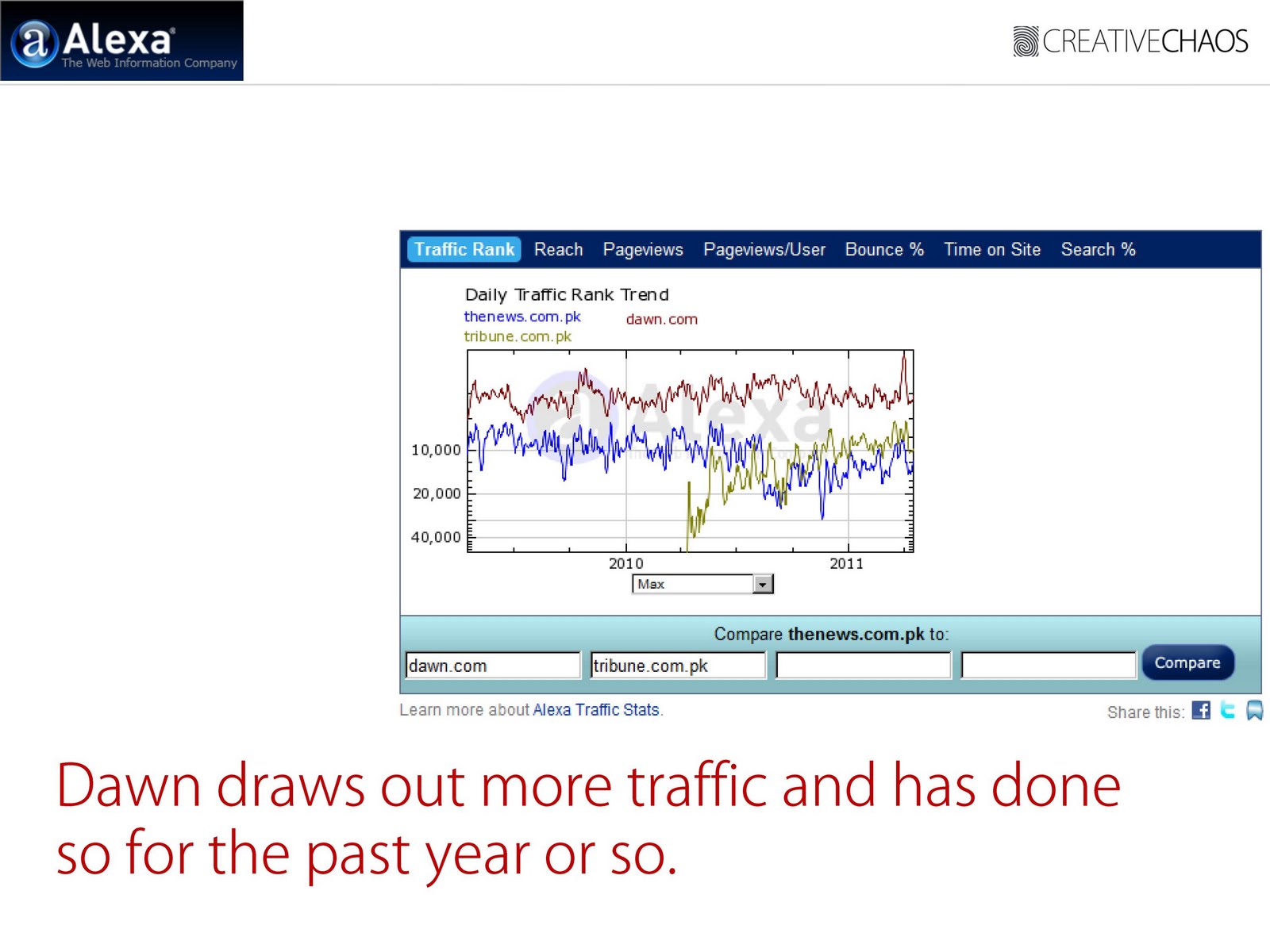
The overall picture generated by Alexa is as follows:

Click to Enlarge

Note that, as opposed to the vociferous pointations from some commenters in the last post that ET's ranking was only 4 or 6 places behind Dawn according to Alexa, the 'within Pakistan' ranking differs by 13 places. However, in the overall scheme of things (since sites are accessed not just from within the country) Dawn's website is ranked by Alexa at 3,914 while ET's website is ranked at 8,181, a whopping 4,267 places behind. The News, meanwhile is far behind in terms of both rankings. (These rankings are, incidentally, pretty much the same as on WebsiteTrafficSpy.)

In case, you're interested, Alexa also provides snapshots of different parameters that can be looked at. We've included three of the ones most pertinent to the discussion at hand:

In terms of daily traffic ranking:

Red=Dawn, Blue=The News, Green=ET (Click to Enlarge)


In terms of daily reach:


Red=Dawn, Blue=The News, Green=ET (Click to Enlarge)


In terms of daily page views:


Red=Dawn, Blue=The News, Green=ET (Click to Enlarge)


4. doubleclick ad planner by Google

This is how doubleclick ad planner explains itself on its website:


"Refine your online advertising with DoubleClick Ad Planner, a free media planning tool that can help you:
Identify websites your target customers are likely to visitDefine audiences by demographics and interests.
Search for websites relevant to your target audience.
Access unique users, page views, and other data for millions of websites from over 40 countries.
Easily build media plans for yourself or your clientsCreate lists of websites where you'd like to advertise.
Generate aggregated website statistics for your media plan."


The data generated separately for all three sites is as follows:

Dawn's traffic stats: Click to Enlarge


ET's traffic stats: Click to Enlarge


The News' traffic stats: Click to Enlarge


This tool once again puts Dawn far ahead of both others with almost 80,000 daily unique visitors. However, according to doubleclick ad planner by Google, The News with some 36,000 daily unique visitors actually edges out ET with about 28,000. Interestingly, The News also has people spending the most time on their site, an average of 18:20 minutes as opposed to Dawn's 7:40 and ET's 6:20. Generally, that might be considered a good thing. However something tells me that's probably simply because that's how long it takes The News' online readers to figure out how to get to the story they really want in the clutter that is that site.

Conclusion


As you can confirm from all the tools used, our original assertions using Google Trends for Websites as a tool were pretty much on the mark. They are not contradicted by a single other tool.


SOCIAL MEDIA

While we did not touch upon social media in our earlier post, since some commenters brought it up, here's a brief analysis.

Social media usage is the one place where ET has a very strong presence and ET seems to use social media well with some of its articles shared around on Facebook by the thousands. Not that it means anything in substantive terms, but Dawn has 37,000 'fans' on Facebook, followed by ET which has about 23,000. The News is almost dormant on Facebook with only 8,000 'fans'.

On Twitter, however, ET really comes into its own, with the widest reach and the largest number of users. As per Creative Chaos' analysis:

"ET's use of Twitter is by far the most aggressive. Not only do they share all links, their writers do the same as well. Very recently, Dawn has started to share its links online whereas The News remains dormant."

5. Klout

As per its website:


"The Klout Score is the measurement of your overall online influence. The scores range from 1 to 100 with higher scores representing a wider and stronger sphere of influence. Klout uses over 35 variables on Facebook and Twitter to measure True Reach, Amplification Probability, and Network Score.
True Reach is the size of your engaged audience and is based on those of your followers and friends who actively listen and react to your messages. Amplification Score is the likelihood that your messages will generate actions (retweets, @messages, likes and comments) and is on a scale of 1 to 100. Network score indicates how influential your engage audience is and is also on a scale from 1 to 100. The Klout score is highly correlated to clicks, comments and retweets.
We believe that influence is the ability to drive people to action -- "action" might be defined as a reply, a retweet, a comment, or a click. We perform significant testing to ensure that the average click-through rate on links shared is highly correlated with a person's Klout Score. The 25+ variables used to generate scores for each of these categories are normalized across the whole data set and run through our analytics engine. After the first pass of analytics, we apply a specific weight to each data point. We then run the factors through our machine-learning analysis and calculate the final Klout Score. The final Klout Score is a representation of how successful a person is at engaging their audience and how big of an impact their messages have on people."


The following data was generated by Klout for all three:


Dawn: Klout score 59 (Click to Enlarge)


ET: Klout score 67 (Click to Enlarge)


The News: Klout score 58 (Click to Enlarge)


What this shows is that ET and its writers are, by far, using social media in the best way to engage audiences. How far that goes in driving traffic towards their website remains to be seen but certainly they have the right idea about digital audiences.

Incidentally, just for fun, we also checked out our own cache on social media using basically only our Twitter presence (Klout did not ask us for our Facebook account details). Here is the result for @cpyala, which as you can see is "neck and neck" in many respects with ET. Make of it what you will.


@cpyala: Klout score 64 (Click to Enlarge)


At the very least, I hope this exhaustive exposition will put to rest the sniping about us having used the "wrong tools" to show ET up and the wild assertions based more on knee-jerk reactions than any real understanding of anything. As we said last time, ET has considerable achievements to its name in its first year. If only its supporters would focus on the genuine ones rather than getting stroppy when imagined ones are called out.

Finally a big thank you to the folks at Creative Chaos for all their hard work and cooperation.

Saturday, April 16, 2011

Necked (Updated)

There were some funny murmurings on Twitter about us not having commented on The Express Tribune's one-year anniversary issue. I really don't see why we needed to. I mean, we don't usually comment on other paper's self-congratulatory anniversary supplements. And contrary to popular perception, we are neither obsessed with ET nor do we go looking for opportunities to stick it to them. And to be fair, ET has matured in many ways since it began. It remains the best looking newspaper in Pakistan and, while there is still plenty to poke fun at in terms of content (as there is in other papers), it is still the only paper to appoint an independent ombudsman for reader complaints, an innovation that other Pakistani papers would do well to emulate.

With all the stuff going on around us politically and even in the media, we also really haven't found the time to do an exhaustive read of the anniversary supplement. I doubt anyone actually does that with any supplement, aside perhaps from the paper's own staff. However, thanks to the urging of friends, I did finally go through it quickly. What I liked about it was the general reliance on colourful graphics and design to convey the journey of the paper rather than boring pages of dense text that nobody would ever read (Dawn Supplements, I am thinking of you). A nod must also be made towards the willingness of ET to laugh at itself, by forthrightly accepting the major bloopers that have graced the pages in this one year (couldn't find the link to the page online), some of which have been the focus of much raucous commentary on this blog too. Many of the articles included from regular oped writers were remarkably double-edged for a congratulatory special issue (try this from Sami Shah or this from Fasi Zaka or this from George Fulton) but at least had the virtue of being honest. This bizarre piece of punnery and indulgence from the paper's City Editor Mahim Maher, however, I have to admit, did leave me quite speechless.

Quite aside from all that, there was one contention in young publisher Bilal Lakhani's piece in the issue that someone pointed out to us which does need to be addressed. In his piece he makes the following assertion:

"The result is that now The Express Tribune is among the top three English language newspapers in the country in terms of circulation; online we are neck in neck with a paper that had a 60-year head start."

I am not going to contest the comparative circulations of Pakistan's English language press (let's just say the assertion can mean nothing even while being perfectly true). However, allow me to just question the latter assertion, that ET's online presence is "neck and neck" in terms of readers with that of Dawn (the only paper with a 60-year head start to ET). And the reason that I can question that assertion is because it is very easy to verify. Keep in mind that we are not talking about aesthetic qualities or better design, simply quantifiable facts.

Here is what I get when I check the online readership of  Dawn (dawn.com) against that of The Express Tribune (tribune.com.pk) on Google Trends, which gives you a handy estimate of daily unique visitors:


The blue line is Dawn, the red one ET. As you can see for yourself, "neck and neck" is not quite how one would characterize the comparison.

Do a comparison between the online hits on Dawn, The News (thenews.com.pk) and ET and this is what you get (blue line is Dawn, red is The News and yellow is ET):


So, according to at least Google Trends, one could ostensibly claim that ET is sort of neck and neck online with The News, but then neither does The News have "a 60-year head start" nor would anyone ever accuse its website of being either user-friendly, hip or well-designed.

Just to put things in perspective, I also did a comparison of these three English papers' online presence with the atrocious ones of the Urdu papers Jang (jang.com.pk) and Express (express.com.pk):


Here the blue line is Jang, red line is Express, yellow is Dawn, green is The News and purple is ET. Yup, so while Express currently rakes in almost double the number of hits Dawn does, Jang towers above them all with over three times as many unique daily visitors as Dawn.

Moral of the tale: Congratulate yourself for your genuine achievements by all means, but don't make silly assertions that can be easily caught out.


: : : UPDATE : : :

In response to various assertions and questions in the comments, we have a new post up with a detailed analysis of the relative positions of Dawn, The News and ET vis a vis  their online presences. The new post can be found here.

Thursday, March 3, 2011

A Graveyard for Lunatics

DISCLAIMER: This piece was written yesterday, and then languished overnight due to a PTCL outage. It contains emotion and other profanity.


I am rarely at a loss for words. I certainly wasn’t this morning, when I started out on a smarmy skewering of George Fulton’s ‘I’m leaving Pakistan because she’s being mean to me dammit!' piece in the Express Tribune yesterday. I was going to run with his personification of the blessed motherland as a flighty female prone to self-destructive megalomania, I was. I was particularly taken with the bit featuring the Bryan Adams song where Pakistan, the impenetrable, fecund, feminine other, sings to him the lyrics To really love a woman/ To understand her - you gotta know her deep inside/ Hear every thought - see every dream/ N' give her wings - if she wants to fly/ Then when you find yourself lyin' helpless in her arms/ You know you really love a woman...

Then I ran it by another Pyala who, with what is in hindsight admirable self-restraint, politely asked me if I’d bothered turning on the TV or reading the news today. I did both and found out that our Federal Minister for Minorities had been assassinated in Islamabad. And then there I was, open mouthed, shell shocked, silent, on the dreaded Island of Lost Words. In such a situation, what is the value of mere words?

Ironically enough, it is Infinite, according to those behind the latest assassination in Islamabad this morning. I will be happy to issue a retraction should the motives behind this senseless tragedy be conclusively proved to be something mundane, like extortion, or something exculpating to the national conscience, like ‘a hidden hand’, but until then I shall continue to assume that, like the late Punjab Governor Salmaan Taseer, Shahbaz Bhatti was killed because of the words he uttered.

These words, for which he had been receiving death threats for the past month, had specifically to do with the late minister’s position on our blasphemy law. Mr. Bhatti, representing as he did some of the most disenfranchised citizens of this blighted nation, bravely and ceaselessly kept pointing out the way the law has been misused to harass and oppress his constituents. His essential argument, that a law that leads to injustice more often than it does justice merits reform if not repeal, was in direct opposition to the simplistic, ignorant stance taken by most of the participants in what passes for public discourse on the subject. For this principled stance Mr. Bhatti, like others before him, paid with his life.

Words then, I have to continue to assume, are powerful enough for other people to feel threatened by. Words that carry truth, particularly when they touch upon the misinterpretation of religion, intimidate those whose words don’t. In our history, or rather our collective amnesia, we have often responded to words of truth and beauty with the vituperation, forcing into exile or silencing of those who utter them. But now I have to ask myself a different question, i.e. what is the value of mere words when the other side is using guns?

There was a time when some of us would have leapt at the chance to throw words into this maelstrom, to comment on a senseless tragedy like the one today. As journalists, as commentators, as columnists, it would have been like going to the Promised Land. High profile murder? Check. Law and order issue? Check. Spectre of extremism? Check. Possibility of point scoring against toothless government? Check. Energizing, empowering, emboldening feeling of being part of a struggle that is bigger than one’s self? Check, Check, Check and Check!

That time is long past.

Now, when we sit down at our keyboards, our desks, or take our notebooks in our hands to begin the process of writing another Pakistani’s obituary, another summation of the life of a brother or sister felled by the demon of militant extremism we have allowed to feed on our children, it is not the purposeful elation of a collective struggle we feel but despair. Despair, in someone else’s words, “of the possibility of ever changing the prevailing state of affairs, of ever being redeemed from it..”

Faced with this insidious, creeping bleakness, even the strongest of us might be tempted, fleetingly, to embrace the self-anesthetization, the comfortable numbness, of those who survive by not speaking at all, by not writing at all, by not thinking at all. But we must. We must because there is soft ground beneath us and if we stop, even for a second, to rest or lick our wounds we might sink and be lost.

So today I write this not as a journalist or a commentator or a columnist or a wiseass but as a Pakistani. I write this for those moderate Muslims who no longer wish to think, write or speak into an apparent vacuum so that you know you are not alone. I write this for my Christian, Hindu, Scheduled Caste, Atheist, Agnostic countrymen and women, so that they know that they are not alone. I write this for me, so that I know I am not alone.

I write that I condemn, in the kind of language I would like to hear from our gutless, myopic leaders, the brutal, unjust slaying of a brave, principled man advocating a return to the pluralistic principles on which this country was founded. I write that I condemn those within the political and military establishment who protect the nest of vipers in our midst. I write that I condemn the spineless, self-preserving hedging about of the spineless, self-preserving fuckwits swarming TV and newsprint. I write that I condemn the willful, witless intolerance seemingly decent people practice through their silence during bloodthirsty sermons delivered in mosques and drawing rooms. I write that I condemn those whose reaction to events like this is a diminishing of their personal and political engagement with the world around them rather than an expansion. I write that I condemn every parent, grandparent or caregiver who lets strangers dictate their child’s moral code.

And I write that I take personal issue with every man, woman or adolescent who says ‘but’ when debating whether dissension merits death.

:::UPDATE:::

I picked up the papers with trepidation this morning, precisely because I was afraid to read passages like the one below, taken from Dawn’s story about PM Gilani’s ‘new strategy to fight extremism’.

"THREE REMAIN SEATED: But many in the house and the galleries were surprised to see three bearded members of the opposition Jamiat Ulema-i-Islam of Maulana Fazlur Rehman remaining seated in their chairs when the rest of lawmakers stood up to observe two minutes’ silence for Mr Bhatti.

There was no immediate explanation what motivated the JUI back-benchers, in the absence of their party leader, to violate a parliamentary etiquette, and a directive given by the chair, in agreement with some voices raised in the house, that members stand up to pay a silent tribute to their assassinated colleague."


Here’s a new strategy for you to fight extremism with PM Gilani: name and shame those who will not rise against it.

Friday, December 3, 2010

Have Cake, Will Eat Too

Much can be said - and is being said - about the latest Wikileaks saga. Around the world, the two biggest issues being grappled with are the future of diplomacy - would interlocutors be open and frank with each other if they fear that what they say in private is going to find its way to the web - and the repercussions on sensitive regions such as the Middle East of some of the explosive confirmations of what people sort of suspected anyway about their leaders and American designs on the world.

Unfortunately, most of what is being said in Pakistan is terribly uninformed, and swings from one extreme of 'it's all a big CIA conspiracy to undermine the Muslim world' on the one hand to 'how can you argue with this gospel truth?' on the the other. The former position does not understand the phenomenon of Wikileaks in the first place and conveniently ignores the fact that, so far, only some 500 of the more than 250,000 confidential cables have been released in the media. The second also conveniently ignores the valid questions regarding Wikileaks' allegedly super-secret structure, how Wikileaks receives information in the first place and the potential for it to be 'played.'

With respect to the first position, the proponents of the "It's all a conspiracy" theory, fed on the idea of homogeneity in the West, are unwilling to believe that there can be ideologically motivated and principled anarchists within the Western world seeking to undermine what they see as repressive state control of information, and simply do not understand how new technological tools can be used to circumvent control. If you are interested, you can read Wikileaks' front-man Julian Assange's treatise on "destroying the invisible government" from 2006, long before Wikileaks became a household word. The conspiracy-minded also ignore the substantive point that none of the principals writing the cables or quoted in them have denied the content of the cables so far (except for Maulana Fazlur Rehman, who admitted meeting US Ambassador Anne Patterson and hosting a dinner for her but denied asking the US to support him for a prime ministerial slot as she claimed in the cable). And, as I pointed out earlier, the bulk of the cables are still yet to come. The decision to stagger the release of the information this time - unlike in July when the 92,000 plus Afghan War Logs were released in one go - is a decision taken by the mainstream media as well, such as the New York Times, The Guardian, Der Spiegel, Le Monde and El Pais. 'Cablegate' will go on for months and will feature far more than the Muslim world.

With respect to the second position, I will refer you to my post in July about the last Wikileaks information dump and my ambivalence about it. Here is what I wrote at that time about Wikileaks itself:

"The second thing that makes me uneasy is WikiLeaks itself. I know this will probably sound terribly conspiratorial, but I cannot say with 100 percent surety that it is not all part of some grand psy-ops strategy: you know, build up an institution with calculated cred boosters (e.g. the leaked Iraq helicopter footage) and then use it to release info you want to release. It's not like it has never been done before, although of course never on a global level. Okay, I know I'm probably sounding like a nutter now but bear with me. Yes, I've read the wonderful profile of maverick Julian Assange (the driving force behind WikiLeaks) in The New Yorker, but I never quite understood the over-dramatized cloak and dagger stuff. Are we really being asked to believe that a man as publicly recognizable as Assange, who jets from continent to continent, can escape being tracked by international security agencies? Or that WikiLeaks, which claims to run entirely on donations (including credit card donations), does not have a single bank account or money transfer that is trace-able? Really?
Ok, forget my questions about WikiLeaks. Is it really beyond the realm of possibility for WikiLeaks and Assange, no matter how pure of heart they are, to be used by psy-op warriors wanting to put certain things out in the public realm? Are we really being asked to believe that 92,000 plus secret documents can be easily smuggled out of the Pentagon (on a Lady GaGa CD, no less, if some reports are to be believed) without anyone having any inkling? Anything is possible I guess but the probability on the other hand is a different matter.
Forgive me for being a doubting Thomas and slightly cynical. But these are the reasons I would not take the leaks at face value even as I accept the mining of the data for useful information. I hope my doubts about WikiLeaks are misplaced though."


Basically, my point is that either completely dismissing the contents of the leaked information as fake or having blind trust that nobody is feeding them to Wikileaks for their own purposes are both logically untenable positions.

But then we have Mr Kamran Khan on his Geo programme, Aaj Kamran Khan Ke Saath, deciding to embrace both positions. His programme tonight (December 2) was a marvel of double-speak and chutzpah. But before I come to tonight's programme, let me also run you through the recent history of this programme since the current Wikileaks saga broke, which I have been following and been amazed by every day.

Monday, November 29: On the day when 'Cablegate' was the top story in the entire world, the first cables having been released late the night before (according to Pakistan Time), guess how much coverage was given to them in Aaj Kamran Khan Ke Saath. None. Zero. Zilch. Cipher. Instead, Kamran Khan devoted the entire programme to an extended promotional interview of Malik Riaz, the controversial billionaire owner of Bahria Town construction, said also to have recently invested heavily in ARY. The only explanation I could come up with for this remarkable detour was that either Khan now had a home in Bahria Town or that Riaz has now invested in Geo as well.

Tuesday, November 30: Kamran Khan grudgingly does a segment on the Wikileaks expose, mainly focusing on those related to Saudi King Abdullah's perceptions of President Asif Zardari but seems still to be unsure about the news-worthiness of the story. Seems inclined to believe it's not really credible information until Professor Hasan Abbas from Washington tells him nobody's really questioning the authenticity of the cables. Manages to use the New York Times misquote about Abdullah calling Zardari "an obstacle to Pakistan's progress" and adding in "because he is not sincere to the country" of his own accord.

Wednesday, December 1: Finally realizing that 'Cablegate' is worth more than just a segment, leads his programme with the statement that the cables have caused a storm ("bhonchal") in the politics of the country. Continues to use the misquoted story and focuses almost entirely on cables related to Zardari. No mention of cables implicating General Kayani in domestic politics or ISI chief General Pasha in talks with Israel or of the alleged involvement of Arab countries in Pakistan's affairs or their instigations to the US to attack Iran, which would obviously have serious implications for Pakistan. No mention also of cables giving the lie to Nawaz Sharif's claims about his interactions with the Saudis.

Which brings us to Thursday, December 2: In an amazing display of whatever you want to call it, the first part of Kamran Khan's show was devoted to decrying the manipulation behind the leaked cables and casting doubt on their credibility. Why? Well, because they had 'tried to besmirch the good name and reputation of the Pakistan army and its well-respected leader General Kayani.' Incidentally, according to Kamran Khan, the army is "a totally uncontroversial institution." He concluded that there is a sinister game afoot to undermine Pakistan's interests through the 'selective' release of these cables. He then proceeded to 'contextualize' General Kayani's positions through "new information received", that shows how "brave" and upright the general is, which incidentally is the same 'information' presented by Syed Talat Hussain in Dawn today. (Hmmm, I wonder where both could possibly have received the information from...)

The second part of the show, on the other hand, was devoted to praising the credibility of and insight given by the leaked cables which have "documented everything" and "not one single word of which has been denied by anyone or cast into doubt." Why? Well, because they showed what a scumbag and how beholden to US interests President Zardari was. "What are the poor, powerless 170 million people of this nation to do?" cries Kamran Khan.

If that's not called having your cake and eating it too, I don't know what is.

You can watch the relevant portions of the programme below:


Having His Cake:


And Eating It:


What are the poor, powerless 170 million people of this nation to do, indeed.

Wednesday, December 1, 2010

Bizarre Newspaper Headline of the Day

Run for your lives, art vultures! Picasso's still alive, he's cloned himself into a small army, and all of them are mighty pissed at how much money you've been making off them!

From Dawn's 'International Pages':

Page 11 of Dawn today


In case you have difficulty reading from the image, the story - about a cache of hitherto unknown works by the master painter discovered at an electrician's home - is headlined "Horde of Picassos discovered in Paris."

Shall we give this the "I Work for an English Paper But Find the Language Really Confusing" Award in today's Bizarre Newspaper Headline Contest?

Monday, November 29, 2010

Going for a Wikileak

Isn't is quite remarkable that almost none of the major newspapers in Pakistan thought that the 'leader of the Muslim Ummah' King Abdullah of Saudi Arabia, and the 'brotherly Muslim countries' of UAE and Qatar egging on the United States to bomb their supposed sibling in faith, the Islamic Republic of Iran - as revealed by Wikileaks - was worthy of any major headline?

Without fail, all of them buried that bit in the secondary 'catch-lines', if at all, with possibly only the Express Tribune and Nawai Waqt attaching it some real significance. Most focused on Abdullah's views on Asif Ali Zardari, while Dawn and the Urdu Express decided that the American plan to take enriched uranium fuel out of Pakistan was the most newsworthy.

Here's how some of the main newspapers' front pages looked today:

Dawn:


Jang:


The News:


The Nation:


Nawai Waqt:


Express:


Express Tribune:


Pakistan Today:


(Apologies for not having The Daily Times up here but they still don't seem to have an e-paper on the web.)

Okay, so obviously in Pakistan, the leaks directly connected to this country are of most immediate interest to people here. But judged purely on the level of news worthy of geo-strategic importance and with potentially massive consequences, wouldn't you say the Saudi desire to take out Iran is slightly bigger than Abdullah thinking Zardari is a loser? Of course, that may be just my personal news sense but I still do find it intriguing that no one else in Pakistan's print media shares it.

Coming to non-subjective issues, however, trust The News' Group Editor Shaheen Sehbai to muck up in the few paras he pens for the main story in his paper. He writes:


"As part of millions of documents dumped on the Internet, Wikileaks put one cable, which gave details of what King Abdullah really thought about President Zardari.Talking to an Iraqi official about the Iraqi PM Nuri Al-Maliki, King Abdullah said: “You and Iraq are in my heart, but that man is not.” “That man” was Asif Zardari."


Er, no Mr Sehbai. When you're "talking about the Iraqi PM Nuri Al-Maliki", you're not actually talking about Asif Zardari. Please get over your obsessions, they are really affecting your thought processes. Or at least learn to read properly.