Showing posts with label Express Tribune. Show all posts

Friday, June 1, 2012

Seeing Red (Updated)

The entire country seems to be seized with the issue of whether dual nationality holders should be allowed to hold public office in Pakistan. The Supreme Court is currently hearing a case against four Peoples Party parliamentarians including the President's media adviser Farahnaz Ispahani, whose National Assembly membership has been temporarily suspended by the court on prima facie evidence that she is also an American citizen. The Punjab Assembly has tried to weasel its way out of the same criteria being applied to its members by saying it has no record of which of its members are dual nationality holders. I'm not here to discuss the merits and contradictions of this issue, so if you can please leave that outrage for another time...

What I'm really here to share, however, is an explosive little story that a little tweety bird with impeccable credentials has divulged to us (what, you think only Najam Sethi has mysterious chirryas?).

If you recall, a certain Interior Minister, is among those accused of holding dual British nationality. That he had taken British citizenship while in self-exile from the mid-90s till he returned in 2007 is not even denied by him. He recently made a statement in the Supreme Court (through his lawyer) that he had renounced his UK citizenship in April 2008, upon assuming office in Pakistan and had presented some documents attesting to his claim upon his recent return from a working visit to the UK. (Incidentally, the Supreme Court rejected the documents as insufficient proof of his renunciation.)

 Not quite green (or blue)


Guess what our tweety bird has told us? The colour of the passport the Interior Minister used to travel to the UK - just a few days ago - was distinctly not green or blue (the Pakistani official passport). Those who laid eyes on it say they saw a very British red. Unfortunately, we are not at liberty to reveal our source but what we will confirm clearly is that our tweety bird - which is more than 100 percent sure of its facts - is definitely not of the 'intelligence' variety.

It's one thing to be dheet and a liar. But this just sounds to us like the ultimate in pragmatic stupidity as well.


: : : UPDATE : : :

After this post was put up, a number of people wrote in on Twitter and in the comments to say that the Pakistani diplomatic passport is also red (or maroon) and that while senators and other government officials are issued a blue offical passport, all cabinet members (as the Interior Minister is) are issued a diplomatic passport. The implication was that perhaps our tweety bird had mistaken the colour of the diplomatic passport for the British passport. Senator Rehman Malik himself aslo tweeted that it had been "mischievously reported" that he had used a British passport whereas he had used only his "red diplomatic passport."

The doubt is understandable since in my write-up I had only referred to the colour of the passport, even though our source had not based the information on simply that. Nevertheless we have re-checked with our source to make doubly sure and the tweety bird confirms that it was in fact a British passport, not a Pakistani diplomatic passport. We thus stand by our story.


Friday, May 25, 2012

The Case of Shakil Afridi

The hue and cry over the 33-year sentence handed down to Dr Shakil Afridi, the doctor who may have aided the CIA in tracking down Osama bin Laden in Abbottabad is partly correct. Certainly, the fact that he was tried under the archaic Frontier Crimes Regulations, in secret, and without the chance to defend himself through a lawyer, makes the whole process highly suspect and against the basic principles of a fair trial. Valid questions have also been raised about the hollowness of some of the charges brought against him, including, apparently, 'waging war against Pakistan'.

Dr Shakil Afridi (Photo: Express)

However, some of the apoplectic reaction from members of civil society, which has condemned Dr Afridi being tried at all, is thoroughly misplaced. Some believe he did a great thing by helping rid Pakistan of the world's most dangerous terrorist and so should be thanked or awarded rather than prosecuted. Others have drawn comparisons between his swift trial and conviction and the lack of effective prosecution of real terrorists. Even journalist Najam Sethi, in his programme yesterday, questioned how what Dr Afridi did was any different from the Pakistani state's collaboration with the CIA in going after Al Qaeda's militants and stated that the Americans, after all, are Pakistan's professed strategic allies. All of these are false premises.

Let's be clear about one thing. No country in the world allows its citizens to freelance as spies for another country's agencies, whether friendly or hostile. Which is not to say that people do no do it, just that they know the risks of what can happen to them if they are caught. Forget being spies, the US has laws against its citizens even lobbying public opinion on behalf of foreign interests without revealing their connections. Remember the case of one Dr Ghulam Nabi Fai?  There have been a number of instances of American citizens being convicted of spying or passing information on to its greatest 'ally' Israel. Dr Shakil Afridi apparently confessed (this is a point that is yet to be proved in a fair trial) that he knowingly assisted the CIA in running a fake vaccinations programme set up to obtain DNA samples from the residents of the compound where bin Laden was eventually killed. No matter what one thinks of the outcome, Pakistan has every right to charge him for colluding with a foreign agency, and if the charges are proved in a fair trial, to convict him.

Yes, it's a real and terrible pity that the Pakistani state and Pakistani courts are criminally lax about the prosecution and conviction of far worse people than Dr Afridi, but this line of reasoning, while it scores political points, is really a false equivalence. By this reasoning, nobody should ever be tried for manslaughter in a road accident or theft or kidnapping or for any other everyday crime since they are far smaller crimes than those committed by those terrorists who have killed thousands and got away scot free. Similarly, with respect to Mr Sethi's point about whether what Dr Afridi did was any different from what the government of Pakistan has been doing for years, yes, there is a difference (whether one likes it or not) between a state sanctioned operation and a freelance operation. It is similar to the difference between the police having the right to use firearms versus ordinary citizens using firearms. But more importantly, if the state is violating the law - e.g. by extraditing people to a foreign entity without going through the due legal process - it is something that in and of itself needs to challenged; it still does not confer legitimacy to others who decide to violate the law.

The US Congress' hypocritical outrage over the treatment of Dr Afridi - er, Guantanamo, anyone? - really is not worth commenting over. They are simply looking to protect their asset, their employee.

In my personal opinion, whether Dr Afridi is charged with treason or not, what he certainly should have been charged with is intentional malpractice and stripped of his medical title for violating his Hippocratic Oath. First of all, he placed innocent children and families knowingly in harm's way by running a fake vaccination programme. As detailed by The Guardian's report linked to earlier:


"The doctor went to Abbottabad in March, saying he had procured funds to give free vaccinations for hepatitis B. Bypassing the management of the Abbottabad health services, he paid generous sums to low-ranking local government health workers, who took part in the operation without knowing about the connection to Bin Laden. Health visitors in the area were among the few people who had gained access to the Bin Laden compound in the past, administering polio drops to some of the children. 
Afridi had posters for the vaccination programme put up around Abbottabad, featuring a vaccine made by Amson, a medicine manufacturer based on the outskirts of Islamabad. 
In March health workers administered the vaccine in a poor neighbourhood on the edge of Abbottabad called Nawa Sher. The hepatitis B vaccine is usually given in three doses, the second a month after the first. But in April, instead of administering the second dose in Nawa Sher, the doctor returned to Abbottabad and moved the nurses on to Bilal Town, the suburb where Bin Laden lived."


Secondly, he has endangered the lives of hundreds of thousands of other children in an area where there were already (unfounded) virulent suspicions about vaccination programmes. As the Associated Press reported soon after the programme was revealed:


"Pakistani health officials held meetings about the alleged CIA scheme on Tuesday and expressed concern that it could have a negative impact on immunization programs in other areas of the northwest, especially in Pakistan’s semiautonomous tribal region along the Afghan border, said a Pakistani official involved in polio eradication efforts… 
One of the Pakistani Taliban’s top commanders, Maulvi Faqir Mohammed, recently called on people in the northwest to avoid vaccines offered by the international community, claiming they were made with “extracts from bones and fat of an animal prohibited by God — the pig.”  
“Don’t fall prey to these infidel NGOs and this U.S.-allied government and its army,” said Mohammed over the illegal radio station he transmits from his sanctuary in eastern Afghanistan. Pakistani officials and their international partners have pushed back against these claims, but the CIA’s reported activities in the country may have made their job that much harder."


You can read more about what impact such kind of rumours have had on immunisation programmes in other places here, which also points out the following:


"[T]he allegation that a vaccine program was not what it seemed — that it was not only suspect, but justifiably suspect — has been very widely reported. This is awful. It plays, so precisely that it might have been scripted, into the most paranoid conspiracy theories about vaccines: that they are pointless, poisonous, covert shields for nefarious government agendas meant to do children harm. 
That is not speculation. The polio campaign has already seen this happen, based on just those kind of suspicions — not in a single poor slum in New Delhi, but across much of sub-Saharan Africa... 
The accusations that polio vaccination was a Potemkin cover for anti-Islamic activities almost ruined the international eradication of polio when they were false. Now, on the basis of the CIA’s alleged appalling ruse in Pakistan, they may be made again. And they will be much more believable, because this time they might be be true."


Finally, he has endangered the lives of his fellow - real - health workers. As noted here,

"InterAction, an alliance of 198 American NGOs, such as the International Rescue Committee, Mercy Corps, CARE, ChildFund International, World Wildlife Fund, Plan International USA, Helen Keller International, Action Against Hunger and Relief International, said the CIA’s tactics also endangered the lives of foreign aid workers. “The CIA-led immunization campaign compromises the perception of U.S. NGOs as independent actors focused on a common good and casts suspicion on their humanitarian workers. The CIA’s actions may also jeopardize the lives of humanitarian aid workers in Pakistan.”"

The Guardian reported that Save the Children was forced to evacuate eight of its international workers last July over fears for their safety:


"A senior western official said Afridi told his wife he was working for Save the Children when he was in fact running the fake CIA programme. The allegation emerged during interrogation. 
A senior aid worker corroborated that account, saying Afridi may have mentioned Save the Children "during the early stages of his interrogation". Save the Children said it was horrified that Afridi had abused its name. "We are shocked by the allegations that our name has been falsely used in this way. Save the Children's work in Pakistan is helping the most vulnerable children and their families," said [SCF spokesperson Ishbel] Matheson."


So, yes, demand a fair trial for Shakil Afridi by all means. This is his and all of our right. But let's not build a mercenary rogue into a hero. And I for one would not in the least shed tears if, at the end of an open and fair trial, he were to be convicted not of treason but of unabashed medical malpractice. After all, even the mobster Al Capone was convicted only for tax evasion, wasn't he?


Monday, May 21, 2012

Absurdity, Thy Name Is...

Must Pakistan - or perhaps one should say specifically its government, its political leaders, its judiciary, its military and its bureaucrats - continue to make an ass of itself? Must it circumvent any attempt to make the world forget that we can be the most absurd cretins in the world?

Graphic by Nick Bilton (Source: New York Times)

Barely had the memory of the Lahore High Court-imposed Facebook ban faded from the collective global 'News of the Weird' consciousness that we were struck with the Twitter ban, which the Ministry of Information Technology people told us was because of "blasphemous and inflammatory content" on the site.


(Update: I had almost finished writing this post when news came in that the Twitter ban had been lifted but am posting this in any case in the off-chance that someone within the corridors of policy-making might read and prevent a recurrence of such ineptitude.) 

According to this Express Tribune story:

"Pakistan’s government had asked Twitter to stop a discussion on Prophet Muhammad (pbuh), which was considered derogatory, [PTA Chairman Dr Mohammad] Yaseen said, adding that “Twitter refused our request.”"

Now, you would have to be totally unaware of what Twitter is and how it works to think the above statement makes any sense whatsoever. Imagine, if you will, the government asking a cell phone company to stop people SMS-ing each other anything derogatory about the Prophet. The only way it would be possible for the cell phone company to enforce such a 'request' would be to either read each and every single SMS from the billions that go out from within its network or to simply ban any SMSes that used the word 'Prophet' or 'Muhammad' or 'Mohammad' or 'Mohd' or any other possible variation (and there would still be ways to circumvent it), which would of course block all Islamic SMSes as well. Any cell phone company would obviously 'refuse' the government's request, simply because it would not be possible to implement.

Of course I am not even touching upon the concept of 'free speech' (and which particularly protects 'speech' that one disagrees with or finds offensive) which is integral to rational societies and which would be another reason for Twitter to refuse to censor something even if it could. But this is a concept which is obviously is too lofty an argument for the cretins in officialdom to understand.

In any case, I am more than sure that there is not a single person within the so-called 'Ministry of Information Technology' who is on Twitter or even has a passing knowledge of it.

In all likelihood, given the storm of outrage and mocking it has unleashed, the ban will not last very long. But let's look at what this ban has actually achieved:

1. It has given free global publicity to offensive material that most people - including us - were not even aware of. 
2. It has shown that those in Pakistan who are supposed to manage information technology actually have no clue what they are in charge of. They are obviously also clueless about the ease with which such bans can be circumvented (it took us and others a total of five minutes to get around it.)
3. It has made Pakistan a target of mocking all around the world yet again as a country that cannot be rational, trust its citizens or tolerate any opinions that don't fit in with its own. 
4. It has made an issue out of a non-issue (most people were unaware of the material as pointed out above) and in that given oxygen to precisely those obscurantist elements who use these things to fan the flames of bigotry and intolerance, both within Pakistan and abroad. Note that there had been NO protests before the Ministry of Information Technology drew attention to this 'issue' but that with its ineptitude it has ensured that it is now on the radar for all rent-a-crowd mullahs and will embolden those racists who enjoy provoking all Muslims. 
5. It has shown that any flimsy excuse can be used to censor opinions, particularly political opinions, that the government of the day is uncomfortable with. Because at the end of the day, it's not alleged blasphemers and pornographers who suffer from Pakistani bans, but common people expressing their personal views, on Twitter, Facebook or on blogs, outside the more easily controlled corporate media.

Let me draw another analogy for our esteemed policy makers. If, on the street, someone were to go around particularly eavesdropping on conversations among random groups of people to check if anyone were using foul language so that he could berate them, or more closely, telling everyone to shut up because he had heard some people using foul language, we would consider such a person a lunatic. Unfortunately, that is exactly what the people at the Ministry of Information Technology have proved themselves to be, overzealous lunatics. It's about time bureaucrats realize that we cannot police the entire world and, more importantly, that there is no need to.

Wednesday, May 2, 2012

Of Governance Scandals And Clean Hands

We are sometimes accused by partisan supporters of opposition political parties of being soft on or for not being more vehement about denouncing the alleged corruption or misgovernance of the currently ruling Pakistan Peoples Party (PPP). While I could point to dozens of examples to dispute these claims, I would like to explain, once again, a couple of things.

Firstly, we do not brook real corrupt practises, arrogance or misgovernance; our only problem is when either claims are made without substantial proof or when such allegations are made arbitrarily only against the PPP and without context, as if everyone else - from the military to the judiciary to other political parties - is innocent of any blame and everything was hunky dory aside from the times that the PPP has been in power. This is not to say that the PPP should not be hauled up for its sins, only to provide a more balanced perspective.

But even more importantly than this is the fact that in the context of a mainstream media that overwhelmingly targets the ruling party (usually because that is in the nature of the media and sometimes because of less salubrious vested reasons), it makes little sense for us to repeat the same charges. The mainstream media has far, far more resources and outreach than we do and, to be sure, it is perfectly justified in its criticisms when it investigates and exposes real corruption and misgovernance. Our role, as we see it on the other hand, is not to reinforce what the dominant narrative is, but to provide, hopefully, some perspective, sometimes corrections and an alternative narrative where required.


Punjab Laptop Scheme: note the personal publicity


In any case, with that bit of explanation out of the way (and there is a connection which I will come to later), let me get down to what this post really is about. Those who follow us on Twitter will know that we already expressed our opposition to the Punjab Goverment's laptop distribution scheme. Our main contention against the scheme was two-fold:

1. That this was a wasteful publicity stunt that, like the disastrous Sasti Roti scheme before it, would drain the public exchequer without addressing real issues and would divert resources that could be better utilized in more productive schemes with more long-term benefit. 
2. That if providing access to computers to students is the goal, giving away laptops to individual students is possibly one of the worst solutions possible. Laptops, by their very nature, are more fragile, less upgradable and more prone to breakage and theft.

Keep in mind that our critique did not revolve around the issues of corruption or maladministration of the scheme, only its conceptualisation.

However, yesterday, Dunya TV's Khari Baat Lucman Ke Saath programme carried a devastating expose of how this scheme has really been run. It is a shocking expose of a scandal that most mainstream media has chosen to ignore so far, probably because it is too busy with stories about Memogate and exposing the federal government's malfeasance in the NRO case. I managed to catch the programme on repeat today and really think everyone who was upset at our opposition to the scheme should take a look at. (Hasan Nisar doesn't really add much to the programme but I am including the whole programme here so that you can appreciate the solid work and research that went into it. Kudos to the young reporter Huzaifa Rehman Qureshi who did most of it and to Mubasher Lucman for carrying it.)

Part 1:


Part 2:


Part 3:


Part 4:


So basically, not only was there apparently huge financial bungling in the procurements of laptops and in the publicity of the scheme, many of those who benefited from the scheme were either PMLN supporters, mediocre students or affluent people who did not deserve to be subsidized by the state.

This laptop scheme was announced in November last year. It has taken the mainstream media six months to raise serious issues about it (even though there were various murmurings against it online for some time). Most of the time, we have been treated only with PR-type statements justifying it, such as this one  in The Daily Times claiming total transparency in the scheme with no counter narrative or actual investigation of the claims. At the same time, the Chief Minister of Punjab, Shahbaz Sharif, is given ample (and often uncritical) coverage in the media vowing to ensure "good governance" and proclaiming that he will "hang the looters of the national wealth (i.e. PPP leaders) publicly."

Coming back to what I began with, can you imagine had such a scandal involved the PPP, that the media would have waited even a moment to pounce on it? Had the PPP been bestowing largesse to its jiyalas, to failed students and making money off it too, would Geo, to cite just one example, have waited six months to run exposes on it? Isn't it about time one questioned why certain people get a much easier ride from the media's vigilant watchdogs than others?

Monday, February 20, 2012

Lock Up The Lazy (Editor)

Yesterday's print edition of the Express Tribune carried this item in 'News In Brief' in its Life&Style section:

"We regret the inadvertent publication of the article titled "Celebs with mental disorders"by Saba Khalid in our print edition of February 18, 2012 and subsequently on our website. The article has been removed from the website. It was published without exercising proper editorial judgement. We sincerely apologize to our readers who were hurt or offended by the mistake".


Screengrabs of the 'inadvertent' article (possible title for Mohsin Hamid's next book?) can be found in this post by blogger Nabiha Meher Sheikh.


Screen-grab of article on Express Tribune website via Nabiha Meher Sheikh's blog


It features lines like the following:

"Bipolars shift their moods from manic highs to depressive lows. There is a lot of self destructiveness and impulsiveness exhibited in all their relationships. Her partner Brad Pitt has suffered the brunt of her craziness as his physical appearance and career have gone downhill. She's played an integral role in breaking up Brad Pitt's marriage to Jennifer Anniston. The first manic or depressive episode occurs in early adulthood and Jolie was absolutely koo koo in her younger days".


There are also tidbits about Veena Malik's 'exhibitionism' and Meera's 'language disorder'.

Ms. Sheikh, who herself suffers from bipolar disorder, led the way - via tweets- in rightly taking the paper to task for these ill-informed, insensitive, downright offensive attempt at humor. Kudos to the publisher for immediately taking note, retracting the article, and issuing the above apology. Kudos also for recognizing that the burden of responsibility lies more with the supervising editor who demonstrated bad judgment than with the young writer who probably simply did not know any better. This is not the first time Express Tribune has alienated some of its readers with its ham-handed approach to something as nuanced as mental health issues - we did a post on a similar exercise in poor editorial judgement some time ago. We hope it will be the last.

But we should also acknowledge that ET is not the only Pakistani periodical, and Saba Khalid not the only Pakistani writer, to treat mental illness as a bit of a joke. Whatever scant coverage there is tends to be poorly researched - "Women more prone to mental illness"- and badly written - "The mental problems have become serious problem in country because people cannot afford the treatment." In weekend magazines variations on the theme tend to be only the most cursory nod to ticking yet another box in the list of 'important issues' the folks in features must come back to now and again.

Even that most venerable of columnists, Khaled Ahmed, can be accused of making his contempt for the notion of 'bipolar' clear on more than one occasion in lines like this classic from an op-ed titled 'Why Muslim States Fail':

"Dictators with mental bipolar disorder — historically mistaken for charisma — who aimed to achieve romantic goals have crumbled, leaving in their wake equally romantic mobs of youths demanding what they presume is liberal democracy."

Are we to assume that all those editors, cubs and columnists who scatter bipolar, depression and schizophrenia like confetti in their copy actually want to 'lock up the crazy'? Or should we just assume that, in Pakistan, there is a lack of awareness about the scope and seriousness of life from the neck up and work towards rectifying it?

Ms. Sheikh and others who wish to fight for their right to not be ridiculed, misunderstood, or misrepresented deserve support and empathy. It must also be said, though, that that support and empathy will not come easily if, as Ms. Sheikh did on her Twitter feed, the aggrieved party responds by declaring the offending writer must have been "raised by jahils" and -in a gross invasion of privacy - sharing details of their targets' plans for the summer and threatening to wreck them.

Surely, the idea is to make them not want to lock people with mental issues up, isn't it?

Saturday, January 28, 2012

Lessons from Maya Khan

I thought about simply updating the previous post but decided that this deserved a separate entry.


So, after much pressure from social media, activists, oped writers and blogs as well as the odd well-deserved editorial in mainstream papers, it seems the message did finally get through to Samaa TV's management. Maya Khan and her team have been fired by Samaa and her programme stopped. The following is the letter from Samaa CEO Zafar Siddiqi which was shared with the media:


Dear All
Your feedback is appreciated. As a responsible corporate citizen, Samaa TV did what was required under the circumstances. We do not and have not in the past or intend to in the future to take our viewership or reporting requirements without the seriousness that they deserve.
 
You would appreciate that as an organisation with a functioning management team, we had to conduct certain legal requirements over the past week and internal review processes (which are operational in nature) before procedding further. 
As a result of which I can inform you: 
We asked Maya to apologise unconditionally which she did not.
The CEO asked her to do that on Friday which she refused.
 
As a result of which the following will be put in place on Monday, Jan 30th: 
Maya and her team will receive termination notices.
Her show is being stopped from Monday morning.
 
Our deeds and actions taken since this episode occured are there for the record and hope this will settle issues as far as the station is concerned. 
A lot has been written about the race for ratings. Well, we do [not] absolve such behaviour irrespective of ratings that the show was getting. 
With best regards and thank you for your understanding. 
Zafar Siddiqi
Chairman CNBC Arabiya
Chairman CNBC Africa
President CNBC Pakistan


There are a couple of things to gather from this unfortunate episode:

1. Social pressure works! While Mr Siddiqi must be fully appreciated for being willing to listen to and understand the voices of outrage and for taking swift action, none of this would have been possible without the pressure that built up over the issue. What made the pressure effective was the multi-pronged strategy which involved not just raising the issue with PEMRA, but also writing directly to the Samaa TV management, the petitions and threats of protest as well as the momentum that organizing a consensus provided via Twitter and Facebook and various oped pieces in mainstream papers. It was this momentum that forced the mainstream to raise the issue even in editorials. Let no one doubt the power of a group of people to change things.

2. The importance of thoughtful media management. Even as Samaa quickly issued a clear apology once the matter achieved notoriety, the issue might have been 'handled' with less drastic results had Ms Maya Khan not issued a half-hearted mea culpa (while grinning) at the same time which only made people question Samaa's seemingly sincere apology. On top of it all, her programme's producer, one Sohail Zaidi, was quoted by the BBC defiantly stating that he was "not responsible to anyone but himself." Ms Khan and Mr Zaidi ended up being responsible for making their own cases worse.

3. The importance of perspective and proportion. Some activists and social media types did get carried away in their anger. To be sure, Maya Khan and her unashamed cohorts did infringe on other peoples' privacy and harrass them. But posting details and pictures of Maya Khan's personal life or the personal cell phone numbers of Samaa TV management on public forums was certainly not the way to go. Thankfully, there were calmer heads within activists who immediately called out their fellow activists on the irony of responding to someone's egregious actions by acting in the same coin.

4. Need for ongoing media monitoring. One of the main reasons this blog was set up was because we felt the need for such monitoring at a time when media was booming in Pakistan and there were precious few willing to raise a voice against well-funded media houses. Obviously, however, we neither have the resources to monitor all of the media nor any official mandate to take action on issues we come across. All we can do is play a part in publicising issues as we see them. But what is really needed is for an independent body - hopefully comprising of civil society experts in the media - to oversee public complaints. PEMRA has the official authority to take action but is often criticised variously for being either overly bureaucratic, under the government's thumb (and thus partial), or too beholden to the large corporate media houses. It would be in PEMRA's interests to help set up an independent body, along the lines of the UK's Offcom, to help it monitor content and handle public complaints. This would not only reduce pressure on PEMRA but provide its decisions with the stamp of fairness and consensus it needs.

Hopefully, some of these lessons will be learnt.

Wednesday, January 11, 2012

Pakistan, A Malleable History

Last month, while other pyalas scuttled off to the Pakistan Tehrik-e-Insaf's (PTI’s) Karachi jalsa with visions of free potty training seats in their heads, I stayed at home with a copy of Imran Khan’s Pakistan, A Personal History. I read it with the intention of reviewing it here immediately but, like certain Bufo toads that can, at will, secrete a noxious hallucinogenic substance that acts as a deterrent to predators, the book did not encourage further handling.


I revisited it today because I chanced upon Amir Zia’s review for Newsline last month. He succinctly articulated some of my biggest problems with the content of the memoir, saying:
“Khan’s personal analysis of the origin and spirit of the Pakistan Movement underlines his simplistic and superficial understanding of those times. In fact, it appears more akin to former military ruler General Zia-ul Haq’s distorted and twisted propagandist history, which still remains a part of our curriculum. For instance, Khan, in his zeal to promote the Islamic basis of Pakistan, equates Quaid-e-Azam Mohammed Ali Jinnah’s religious views with those of Mohandas Karamchand Gandhi by saying that both stood on the same page vis-à-vis the role of religion in politics.”
And…
“The tribal system, its code of honour and values are a constant refrain in the book. Khan maintains that the tribal areas were “crime free” before the upheavals of the recent years, ignoring the fact that before the start of the war on terror, the entire belt remained the epicenter of smuggling and gunrunning in the region. The known criminals and absconders used to take refuge in these areas and vehicles snatched from various parts of the country landed in the tribal belt. But Khan, in his zeal to glorify tribalism and the jirga system, shuts his eyes to all these facts. He makes a passing reference to the tribal practice of ‘honour’ killings which are being endorsed by jirgas in the rural areas. In fact, he views these jirgas as an “ancient democratic system.” The oppression, the backwardness, the myopic worldview and total alienation from the modern world, all of which stem from tribalism, fail to bother the Khan.”

Amir Zia did make an effort to balance his take on ‘the Khan’s’ personal history with references to the many good things in it, calling his recollections of cricketing life and building the Shaukat Khanum Memorial hospital ‘moving’ and ‘inspiring’. Mr. Zia is probably a better person than I am because I feel no such compunction. Whatever bright spark once lurked in the heart of this self professed Chosen One – his version of what happened to make an English jury return a verdict of 10-2 in his favour in the Botham libel case can be summarized with “As I was waiting, I got a message from a friend that Mian Bashir wanted to speak to me. I phoned him and found him in a cheerful mood. ‘Allah is changing the jury’s mind!’ he said – has long been obscured by a cloud of magic dust. Like in Pullman’s His Dark Materials, only without its fierce interrogation of dogma and ritual.

If you don’t like my words for it, take a few from the horse’s…er…mouth:

The Khan on what needs to be done to deal with the ‘10%’ of truly militant militants in the tribal areas (the rest apparently prefer crochet, only times are hard and the war blocks access to the market for doilies):
“I have spoken to General Pasha, head of the ISI about this, and he too believes that if we disengage from the US war, start a dialogue with the tribes, and withdraw troops from the tribal areas, we could eliminate this 10 percent in ninety days”.

The Khan on the need for enshrining the difference between a public face and a private face or, as some people might call it, hypocrisy:
‘The main difference Islamic sharia has from Western secular society is in the realm of public morality. This protects the family system, one of Pakistan’s greatest strengths…An Islamic society tries to protect the sanctity of marriage by creating an environment that affords the least temptation for people to commit infidelity. Secondly, it tries to protect impressionable young people from public immorality, the same concept behind the ‘adults only’ film classification…So apart from these vital provisions aimed at protecting the family, a true Islamic society would be no different from the democratic welfare states of Europe.”

Passages like this worried me because they indicate a rigid, conservative mind that thinks along the lines of 'my way or the highway'. It is the disproportionate power given to those who would be custodians of 'public morality', for political purposes, that has landed Pakistan in the soup it is in today. Passages like this also amused me because, for someone whose main vote bank so far seems to be young people, he really is pretty clueless about what young people really want and, more importantly, need. The life of the body, the life of the mind, these are fundamental human rights. And too many of the physical and creative freedoms required to have either would potentially face the chop if somebody decided to place the protection of 'impressionable young minds' above both.

The Khan, for example, only took about two decades of experiential learning to understand "there was a world of difference between happiness and pleasure-seeking".

The Khan on people who might disagree with him:
“…those at the other end of the extreme are called the ‘liberal fanatics’. To liberal fanatics modernization means westernization and Islam can only impede Pakistan’s progress…For them every solution to Pakistan’s problems is imported. Hence liberal fanatics have variously advocated Marxism, a radical version of women’s liberation, market economics and other Western beliefs.”
Yep. Damn redistribution of wealth (don't look now, Ali Shariati). And women voting in parts of Khyber Pakhtoonkhwa. And supermarkets. And mineral water. Especially mineral water.

The Khan on about half of the people who attended his Party In The Park:
“ The elite that consumes most of the country’s educational resources is incapable of providing the intellectual leadership needed to move forward either the religion or the culture. Western education simply does not allow them to do so.”
... Which would, errrr, make the Oxford-educated Khan singularly incapable of providing intellectual leadership, would it not:? But I digress...

Rants about this 'elite' function as periods throughout the memoir, punctuating his opinions on everything from environmental degradation to the need to overhaul the education system to his observations about the injustice of our judicial system. This is a real pity because they undermine the few things he says that actually make sense. Pakistan is indeed, as he hammers home again and again, saddled with a parasitic elite that has insisted on usurping, keeping and abusing power to the detriment of the many hovering around the poverty line; but his reductionist identification of them as people who have strayed from the one faith and become 'westernized' is sadly flawed. The powerful elite of which he speaks include the shallu-wearing landlords and industrialists that are now part of his movement for justice. They can also wear beards, uniforms and burqas as well as jeans and ape Saudi Arabia as well as Western pop culture, but apparently that isn't quite as bad. His position seems to be that if you are not part of the solution (in this case, his notion of Islam) you are part of the problem.

This debauched, rudderless, still mentally colonized elite has done Pakistan a world of harm, he says. For example, post 9/11:
"I have never seen Pakistanis so terrified of US anger as during this period. This is a typical example of how fear can be used as a weapon by the ruling elite to make the people fall in line; at the same time, it shows that policies based on fear always end up in disaster."
That previous nugget comes much before the point towards the end of the book where he says:
"...my biggest worry remains that if things continue as they are we could face a rebellion within the army's ranks, the ultimate nightmare situation for Pakistan."

I could go on, and quote verbatim other choice bits of text, such as his one sentence lament about how mean presswalas kept calling up his good friend Sita White for ‘lurid interviews’, or the paragraph where he mentions one Shah Mehmood Qureshi as an example of what is wrong with Pakistani politics, or how he lambasts the jamaati thugs he is now in bed with, or how it only took him five meetings and nearly as many years to understand Musharraf wasn't a good boy, or how my mother’s brother’s third cousin’s dog inferred a Madonna-whore complex from all the things Khan Saab’s book didn’t say about women in Pakistan when he accidentally sank his teeth into it but, really, what’s the point. Let’s not be liberally fanatical in our negativity and look at the plus points of it.

1) We have been asking for a PTI manifesto and lo and behold there has been one amongst us for a couple of months already, complete with Islamic Fabioesque cover and – just like his first book where the ghost writer really was a ghost - no mention of who actually wrote it.

2) In this book, we learn a lot about poetry. Well, Iqbal’s poetry. Well, those of Iqbal’s poems which fit into Imran Khan’s view of the world. In particular, the one about the shaheen. No not Khayaban-e-Shaheen, the other shaheen, the eagle, which as Khan Saab tells us is “an emblem of royalty which denoted a kind of heroic idealism based on daring, pride and honour.” (No mention of course of that of Iqbal's verse that calls, e.g., for burning down crop fields that do not feed the peasant, but I digress again.)

I was thinking of Khan Saab's fondness for the metaphor of the regal predator driven to hunt rather than scavenge when I read the inimitable Aakar Patel’s column in the Express Tribune today. In the column, the second in his examination of the army’s dominance in Pakistan today, Mr. Patel puts it down to a caste-driven obsession with the notion of ‘warrior’. His hypothesis…
“is that the division of the Punjabi nation in 1947 produced a Pakistani Punjab that was heavily weighted in favour of the martial castes. The trading castes, which tend to be more pragmatic and balance society’s extremism mostly left to come to India. This has produced the imbalance which explains Pakistan’s fondness for a state dominated by soldiers. Gen Pervez Kayani runs the state’s foreign policy, security policy and most of its economic policy because the majority of Punjabis are comfortable with the idea of a warrior being in charge.”

Mr. Patel’s insight into the veneration awarded to ‘leading from the front’- which in my book can also be considered a Pashtun trait- is driven home when, later in the column while mentioning Kayani’s recent statement that our nation’s “honour will not be traded for posterity”, he goes on to say that…
"Only a warrior would make that statement and only a nation of warriors would accept it."

You see the same kind of verbal posturing in Imran Khan's utterances (tsunami = destruction), and the same kind of frenzied, emotional response in his followers (tsunami? a massive tidal wave that kills indiscriminately? hell yeah!) that a popular general would get from his ranks. It is almost as if hundreds of thousands of usually pacifist people have suddenly decided to get in touch with their inner Spartan.

In Imran Khan's Pakistan though, there would be no loincloths.

My basic problem with the worldview that Aakar Patel is skewering and Imran Khan and other balding eagles seem most comfortable inhabiting is that Pakistan can no longer afford to be a nation of warriors. We need a narrative of inclusiveness, tolerance and unity based on achievable things like economic goals, not one that suggests identity is who you're not rather than who you are. Those who want to buy into the PTI’s ‘war' on corruption, the west (and mineral water) might want to stop and ask themselves what impulse, whose hand, they are really strengthening.

My other basic problem with men who think they are berserkers is their propensity for camp followers or, in less offensive terms, their demonstrated opinion of where women would be post-victory. Consider this clip follow up of an excellent Express Tribune report about what happened after Prime Minister Gilani was successfully driven off stage by the soldiers of the Lawyers' Movement at a Lahore Bar Association meeting a couple of days ago...


Incidentally, Imran Khan's last reference to the the Brotherhood of the Black Coats he mentions glowingly several times in his memoir is:
"Though the anti-status quo wave known as the lawyers' movement for genuine democracy was hijacked, it remains simmering beneath the surface; I am convinced the moment the next elections are announced, a 'soft revolution' will explode on our political horizon and sweep away the corrupt status quo from Pakistan once and for all."

Ladies, keep those Rose Petals handy.

Wednesday, November 30, 2011

News After It Happens

Apparently some erstwhile DawnNews staffers are mighty miffed that we haven't given the sudden closure of Express 24/7 early this morning the same sort of coverage that we once gave to DawnNews' woes (when it existed as an English channel). They might be upset for their own personal reasons but it really was neither completely unexpected nor will it have the same repercussions on the group or on the media market.


There is no doubt that we did not have the story before it happened, but then neither did most of the staff at Express 24/7. Consider the following tweets from some staffers:

@Rabail26: Express 24/7 is closing down & I'm jobless, so I guess its time to edit the twitter bio. #tweetingtodistractingself

@mirza9: Not sure about the details of the channel closing down. I just found out in an e-mail. #Express24/7RIP

@mirza9: So should I text message my mom and tell her so she doesn't find out when she wakes up at 530AM and checks my twitter feed?

@mirza9: wow the channel has already stopped running news. Only promos running now. That was quick. Express 24/7 quick death.

@ahmedjung: no one has any idea about what's next and it's funny that even the HR claims that they didn't know about this!

@ahmedjung: lhr office staff told me that the drivers didn't pick the English morning shift staff! Even drivers knew before us

@ayza_omar: Executive producer EN24/7 giving his final speech. Said he didn't hav a clue till 2am.V went off air at 1am.Says its good we didn't knw.how?

@ayza_omar: All will get their November salaries immediately. One month salary for every year worked will be compensation.

I suppose you could congratulate the Lakhanis on a secret well kept. However, there are two things to consider here:

1. There was never any financial sense in running Express 24/7, not especially after the ignominious backtracking of DawnNews from being 'Pakistan's first English language channel' into an Urdu channel and the still-birth of Geo English had made the business feasibility abundantly clear. The only people really watching Express 24/7 were diplomats who did not know Urdu at all and wanted to keep abreast of what Pakistani media was covering (here's a thought: perhaps they should have been asked to fund the channel). The fact that it continued to exist for almost three years was primarily because the media house's owners made it a matter of prestige and ego. The claim by the owners that the closure was a result of "a dismal economic climate" is thus slightly disingenuous. It was always a losing proposition and it was only a matter of time that the plug was pulled. Mr Sultan Lakhani, the CEO, is however, spot on in his further explanation:

"Unlike other countries where niche channels can survive and even prosper through subscription and where there are multiple distribution platforms such as DTH, in Pakistan niche channels are wholly dependent on advertising. This system works well for mass market channels like our sister channel Express News but does not work effectively for niche channels which cater to a smaller audience.”


Express 24/7 Lahore staffers pose for a group photo (Photo: Khurram Husain)


2. While one sympathises with those of the staff who will not be "accomodated" in the media house's other ventures (and there are likely to be a substantial part of the 100-odd staff) as promised by the CEO, we would like to remind readers of what we had written back in 2009 about the way Mr Lakhani often does business. Although we had recounted this anecdote in reference to the launch of Express Tribune (which is in no danger at the moment) and not Express 24/7, it may seem very prescient to some recently laid-off staffers of the channel:

"All those being recruited may want to ask one simple question of Mr Lakhani: what about Business Today? Some of you may remember that that paper, also owned by Sultan Lakhani, was shut down one fine day at 5 pm with Mr Lakhani coming in and telling the newsroom that the paper would not be publishing the next day and that everyone should henceforth go home. They may want to ensure that this is not the fate awaiting them one fine day down the road..."


Perhaps the only funny thing about this whole episode is that, as of now - some 24 hours after it officially went off air - Express 24/7 continues to run promos detailing itself as 'Pakistan's only English news channel', and proclaiming 'Bringing you the news is our only business' and 'News as it happens', even as there is no news now available on the channel. Only the travel and personality fillers it had developed running incessantly...

...Which leads one to question whether the slot is being saved for the intended launch in January or February of the planned Express Entertainment channel. Incidentally, Dunya too is set to launch its own entertainment channel around the same time, which may give an indication of how the scales have tipped in Pakistan's media market. Suddenly, entertainment is once again being seen as a revenue earner after a long run wherein news and political talk shows were the only game in town.


Monday, October 3, 2011

Comedy As Serious Business

“Ever wondered what you could do in light of ongoing terrorism, the Haqqani network, the Taliban, the al Qaeda? Tried shooting off a punch line, or throwing a joke at them?”


So began this piece in the Express Tribune today praising This Is Standup Comedy, a four-part web series in which local comics Saad Haroon and Danish Ali ostensibly “try and explore the effect terrorism has had on Pakistani society”. In the interests of full disclosure, I have to say that as the series loaded I was already thinking but haven’t we got any psychologists for that?


Half the point of good comedy is that it isn’t earnest, well-meaning or motivated by the desire to please people or explain the world. It is about subversion. A good comic will not say the right things. He or she will say the wrong things. And if, in the process of saying the wrong thing, they punch a hole in my own Line Of Bullshit Control, well then ladies and gentlemen we have a winner. Or rather, a loser. Because that’s what genuinely funny people or POVs tend to be, losers aka misfits, underdogs, freaks, misanthropes, outsiders.

Take the delightful David Baddiel-written film starring Iranian funnyman Omid Djalili, The Infidel:


Take Sanjeev Bhaskar, Kulvinder Ghir, Meera Syal and Nina Wadia’s experiences of growing up in multicultural Britain in Goodness Gracious Me:


Take Fifty Fifty, which proved that censorship doesn’t have to be a bar to the pithiest of social commentary:


Take Chris Cooper, Sam Bain and Jesse Armstrong’s Four Lions, which showed us the difference between making fun of jihadis and making a funny about jihadis:


Now take This Is Standup Comedy, which consists largely of Saad Haroon and a host of other people pretending stand up comedy didn’t exist before English-speaking Muslims in a post-9/11 world discovered it, lamenting how hard it is to a) be misunderstood b) get a visa, and go outside and jump up and down on it.

You should do this not just because it’s good for your hams and glutes, but also because both Haroon and Sami Shah* – the genuinely wacky Danish Ali, despite his top billing, sadly only has four lines – are both talented, experienced comics and really should have known better than to try to pass of intellectual laziness as an ethical stance.

[*Update: We have received clarification from Sami Shah that he was not involved in the creation of the series and was merely interviewed for it. We apologize if a misleading impression was given by the above lines.]

The series does not explore the effect terrorism has had on Pakistani society as much as it explores the unfortunate results of comics being unable to transcend their own social/religious/ethnic/sexual identities. The answer to why this is so might lie in this line from the ET review:

"Haroon and Ali are well known among the hip crowd for being Pakistan’s première English language stand-up comics."

This is pretty much the comedic equivalent of jumping into a river with a concrete block around your ankles, which, as anyone else who has tried it at home can tell you, is really not funny.

When it happens – as This Is Standup Comedy inadvertently showcases - what you are left with is not the tight writing or detached dissection of universal human traits the four examples above feature but different versions of punch lines that can be summarized thus:

Terrorists are stupid.

People who think I’m a terrorist are stupid.

Why don’t you like me?


Live shows or series inhabiting this position don’t do themselves any favors. First, the comics seem to feel that being brown, from a conservative background and funny is in itself a novelty so they don’t work very hard and the material just isn’t good enough, especially when you compare it to thematically similar work that has already been done in both English and vernacular languages. This goes back to that notion of the wider world, and specifically discrimination, not existing before 9/11. Local comics looking to get mileage out of Islamophobia as a lived experience should look to the Jews. Not to convert (you’d have to be a real motherfucker to do that) but to contemplate what Jewish comics learned years ago; the trick is not to make fun of the goyim being anti-Semitic but to make fun of the Jew experiencing anti-Semitism instead. For example, Sami Shah's throwaway line about just wanting to 'understand the Taliban' could have led into a riff on hipsters at Espresso discussing ideology over a latte, but instead we are left again with the hackneyed profiling joke.

Second, I don’t really believe a stand up show on the day after a bomb blast is fighting the Taliban any more than I believe a fashion show an hour after a bomb blast is fighting the Taliban or my naanwala sticking bread in a tandoor the morning after a bomb blast is fighting the Taliban. Sometimes trying to make a living is just that, trying to make a living. The only difference between a certain kind of Pakistani in the creative sphere and my naanwala is that he doesn’t make a song and dance (and documentary) about it.

And now for something completely different…


Friday, April 22, 2011

You Want 'Real' Data? You Got It

I never expected, when I wrote this small post challenging one by-the-way assertion of The Express Tribune's publisher about ET's online presence vis a vis that of its far more established rival newspaper, Dawn, that it would lead to an all-out flame war in the comments section.

Those jumping to ET's defence began first with trying to discredit our data, interpretation and our web-savvy, followed it up with spin about what was really meant by asserting that ET was "neck in neck" [sic] online with Dawn (hint: it can mean nothing other than readership especially when you're talking about circulations), and ended up by accusing us of carrying out some sort of campaign against ET. I was hugely tempted not to further indulge such grandiose notions of self-importance and (supposed) victimization, not to mention the fact that the comparative online reach of Pakistan's English print media is not an immensely critical issue in my opinion in the larger scheme of things or even as far as the Pakistani media is concerned.

But the reason for a new post on the same topic is because, for one, we promised an independent and thorough analysis to our readers and because some of our friends have gone to great lengths to compile the data for us. More importantly, there is a principle at stake here, namely that of our credibility. We need to set the record straight about some of the wild assertions made in the comments of the last post.

So, without further ado, we present to you a Comparison of the Top English Language News Websites in Pakistan, conducted by our friends at Creative Chaos. (In the interests of full disclosure, it should be pointed out that Creative Chaos is a technology company operating since 2000, was responsible for the pre-launch design and development of The Express Tribune's website, and has also worked with Dawn five years ago to develop their online classifieds (the site was later shut down, ostensibly because management felt it was driving traffic away from the print edition). In addition, the company's CEO, Shakir Husain, is also a columnist for The News and occasionally writes for the Dawn Group's advertising and marketing-related publication Aurora.)

The comparisons of Dawn.com, thenews.com.pk and tribune.com.pk were done using four different internationally renowned website analysis tools, i.e. Compete, WebsiteTrafficSpy, Alexa, and doubleclick ad planner by Google, all of which estimate the web traffic of sites based on numerous data streams and their own analytical algorithms. In addition, social media (Facebook, Twitter) influence of these sites was also separately analysed using Klout which basically calculates its rankings using criteria such as number of retweets, quality of tweets etc. Let us go through them one by one.


WEBSITE ANALYTICS

1. Compete
According to its website, Compete:

"Provides free information for every site on the Internet including site traffic history and competitive analytics; a list of available promotional codes across thousands of online retailers; and site-specific trust scores based on up-to-the-minute data from Compete and third party security services."

This is the data Compete generated:

Click to Enlarge

As you may see, Dawn has a substantial lead over both ET and The News. However, ET and The News can certainly be considered "neck and neck" so far with ET on the up and The News remaining more or less steady.


2. WebsiteTrafficSpy

Though there is no explanation on the WebsiteTrafficSpy website about its methodology of traffic analysis, Creative Chaos believes it aggregates different sources such as Alexa to provide a comprehensive result.

This is the data WebsiteTrafficSpy generated:

Click to Enlarge

According to WebsiteTrafficSpy's estimates, Dawn has 1.96million monthly users, putting it 685,000 ahead of ET which has almost 1.28million monthly users. The News meanwhile, with an estimated 0.93million users is about 350,000 monthly users behind ET. It also puts Dawn's pageviews at approximately 275,000 per day as opposed to ET's 125,000 per day and The News' 92,000 per day. Finally, it ranks Dawn's website at 3,927 worldwide while ET's is ranked at 8,151 and The News' at 11,503.


3. Alexa

According to its website:


"Alexa is continually crawling all publicly-available websites to create a series of snapshots of the web. We use the data we collect to create features and services: 
Site Info: Traffic Ranks, search analytics, demographics, and more
Related Links: Sites that are similar or relevant to the one you are currently viewing
 
Alexa has been crawling the web since early 1996, and we have constantly increased the amount of information that we gather. We are currently gathering approximately 1.6 terabytes (1600 gigabytes) of web content per day. After each snapshot of the web (which take approximately two months to complete), Alexa has gathered 4.5 billion pages from over 16 million sites."


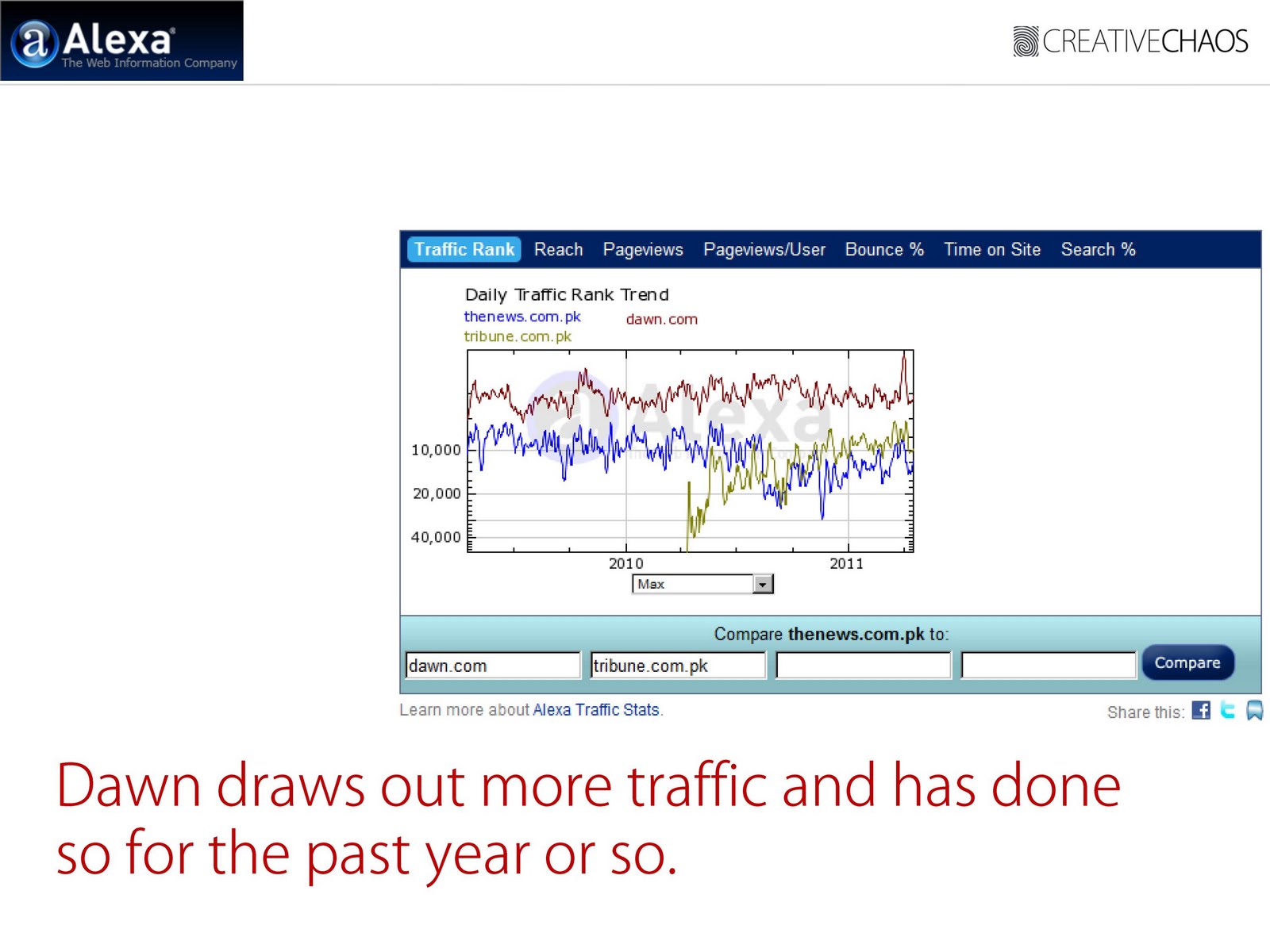
The overall picture generated by Alexa is as follows:

Click to Enlarge

Note that, as opposed to the vociferous pointations from some commenters in the last post that ET's ranking was only 4 or 6 places behind Dawn according to Alexa, the 'within Pakistan' ranking differs by 13 places. However, in the overall scheme of things (since sites are accessed not just from within the country) Dawn's website is ranked by Alexa at 3,914 while ET's website is ranked at 8,181, a whopping 4,267 places behind. The News, meanwhile is far behind in terms of both rankings. (These rankings are, incidentally, pretty much the same as on WebsiteTrafficSpy.)

In case, you're interested, Alexa also provides snapshots of different parameters that can be looked at. We've included three of the ones most pertinent to the discussion at hand:

In terms of daily traffic ranking:

Red=Dawn, Blue=The News, Green=ET (Click to Enlarge)


In terms of daily reach:


Red=Dawn, Blue=The News, Green=ET (Click to Enlarge)


In terms of daily page views:


Red=Dawn, Blue=The News, Green=ET (Click to Enlarge)


4. doubleclick ad planner by Google

This is how doubleclick ad planner explains itself on its website:


"Refine your online advertising with DoubleClick Ad Planner, a free media planning tool that can help you:
Identify websites your target customers are likely to visitDefine audiences by demographics and interests.
Search for websites relevant to your target audience.
Access unique users, page views, and other data for millions of websites from over 40 countries.
Easily build media plans for yourself or your clientsCreate lists of websites where you'd like to advertise.
Generate aggregated website statistics for your media plan."


The data generated separately for all three sites is as follows:

Dawn's traffic stats: Click to Enlarge


ET's traffic stats: Click to Enlarge


The News' traffic stats: Click to Enlarge


This tool once again puts Dawn far ahead of both others with almost 80,000 daily unique visitors. However, according to doubleclick ad planner by Google, The News with some 36,000 daily unique visitors actually edges out ET with about 28,000. Interestingly, The News also has people spending the most time on their site, an average of 18:20 minutes as opposed to Dawn's 7:40 and ET's 6:20. Generally, that might be considered a good thing. However something tells me that's probably simply because that's how long it takes The News' online readers to figure out how to get to the story they really want in the clutter that is that site.

Conclusion


As you can confirm from all the tools used, our original assertions using Google Trends for Websites as a tool were pretty much on the mark. They are not contradicted by a single other tool.


SOCIAL MEDIA

While we did not touch upon social media in our earlier post, since some commenters brought it up, here's a brief analysis.

Social media usage is the one place where ET has a very strong presence and ET seems to use social media well with some of its articles shared around on Facebook by the thousands. Not that it means anything in substantive terms, but Dawn has 37,000 'fans' on Facebook, followed by ET which has about 23,000. The News is almost dormant on Facebook with only 8,000 'fans'.

On Twitter, however, ET really comes into its own, with the widest reach and the largest number of users. As per Creative Chaos' analysis:

"ET's use of Twitter is by far the most aggressive. Not only do they share all links, their writers do the same as well. Very recently, Dawn has started to share its links online whereas The News remains dormant."

5. Klout

As per its website:


"The Klout Score is the measurement of your overall online influence. The scores range from 1 to 100 with higher scores representing a wider and stronger sphere of influence. Klout uses over 35 variables on Facebook and Twitter to measure True Reach, Amplification Probability, and Network Score.
True Reach is the size of your engaged audience and is based on those of your followers and friends who actively listen and react to your messages. Amplification Score is the likelihood that your messages will generate actions (retweets, @messages, likes and comments) and is on a scale of 1 to 100. Network score indicates how influential your engage audience is and is also on a scale from 1 to 100. The Klout score is highly correlated to clicks, comments and retweets.
We believe that influence is the ability to drive people to action -- "action" might be defined as a reply, a retweet, a comment, or a click. We perform significant testing to ensure that the average click-through rate on links shared is highly correlated with a person's Klout Score. The 25+ variables used to generate scores for each of these categories are normalized across the whole data set and run through our analytics engine. After the first pass of analytics, we apply a specific weight to each data point. We then run the factors through our machine-learning analysis and calculate the final Klout Score. The final Klout Score is a representation of how successful a person is at engaging their audience and how big of an impact their messages have on people."


The following data was generated by Klout for all three:


Dawn: Klout score 59 (Click to Enlarge)


ET: Klout score 67 (Click to Enlarge)


The News: Klout score 58 (Click to Enlarge)


What this shows is that ET and its writers are, by far, using social media in the best way to engage audiences. How far that goes in driving traffic towards their website remains to be seen but certainly they have the right idea about digital audiences.

Incidentally, just for fun, we also checked out our own cache on social media using basically only our Twitter presence (Klout did not ask us for our Facebook account details). Here is the result for @cpyala, which as you can see is "neck and neck" in many respects with ET. Make of it what you will.


@cpyala: Klout score 64 (Click to Enlarge)


At the very least, I hope this exhaustive exposition will put to rest the sniping about us having used the "wrong tools" to show ET up and the wild assertions based more on knee-jerk reactions than any real understanding of anything. As we said last time, ET has considerable achievements to its name in its first year. If only its supporters would focus on the genuine ones rather than getting stroppy when imagined ones are called out.

Finally a big thank you to the folks at Creative Chaos for all their hard work and cooperation.

Saturday, April 16, 2011

Necked (Updated)

There were some funny murmurings on Twitter about us not having commented on The Express Tribune's one-year anniversary issue. I really don't see why we needed to. I mean, we don't usually comment on other paper's self-congratulatory anniversary supplements. And contrary to popular perception, we are neither obsessed with ET nor do we go looking for opportunities to stick it to them. And to be fair, ET has matured in many ways since it began. It remains the best looking newspaper in Pakistan and, while there is still plenty to poke fun at in terms of content (as there is in other papers), it is still the only paper to appoint an independent ombudsman for reader complaints, an innovation that other Pakistani papers would do well to emulate.

With all the stuff going on around us politically and even in the media, we also really haven't found the time to do an exhaustive read of the anniversary supplement. I doubt anyone actually does that with any supplement, aside perhaps from the paper's own staff. However, thanks to the urging of friends, I did finally go through it quickly. What I liked about it was the general reliance on colourful graphics and design to convey the journey of the paper rather than boring pages of dense text that nobody would ever read (Dawn Supplements, I am thinking of you). A nod must also be made towards the willingness of ET to laugh at itself, by forthrightly accepting the major bloopers that have graced the pages in this one year (couldn't find the link to the page online), some of which have been the focus of much raucous commentary on this blog too. Many of the articles included from regular oped writers were remarkably double-edged for a congratulatory special issue (try this from Sami Shah or this from Fasi Zaka or this from George Fulton) but at least had the virtue of being honest. This bizarre piece of punnery and indulgence from the paper's City Editor Mahim Maher, however, I have to admit, did leave me quite speechless.

Quite aside from all that, there was one contention in young publisher Bilal Lakhani's piece in the issue that someone pointed out to us which does need to be addressed. In his piece he makes the following assertion:

"The result is that now The Express Tribune is among the top three English language newspapers in the country in terms of circulation; online we are neck in neck with a paper that had a 60-year head start."

I am not going to contest the comparative circulations of Pakistan's English language press (let's just say the assertion can mean nothing even while being perfectly true). However, allow me to just question the latter assertion, that ET's online presence is "neck and neck" in terms of readers with that of Dawn (the only paper with a 60-year head start to ET). And the reason that I can question that assertion is because it is very easy to verify. Keep in mind that we are not talking about aesthetic qualities or better design, simply quantifiable facts.

Here is what I get when I check the online readership of  Dawn (dawn.com) against that of The Express Tribune (tribune.com.pk) on Google Trends, which gives you a handy estimate of daily unique visitors:


The blue line is Dawn, the red one ET. As you can see for yourself, "neck and neck" is not quite how one would characterize the comparison.

Do a comparison between the online hits on Dawn, The News (thenews.com.pk) and ET and this is what you get (blue line is Dawn, red is The News and yellow is ET):


So, according to at least Google Trends, one could ostensibly claim that ET is sort of neck and neck online with The News, but then neither does The News have "a 60-year head start" nor would anyone ever accuse its website of being either user-friendly, hip or well-designed.

Just to put things in perspective, I also did a comparison of these three English papers' online presence with the atrocious ones of the Urdu papers Jang (jang.com.pk) and Express (express.com.pk):


Here the blue line is Jang, red line is Express, yellow is Dawn, green is The News and purple is ET. Yup, so while Express currently rakes in almost double the number of hits Dawn does, Jang towers above them all with over three times as many unique daily visitors as Dawn.

Moral of the tale: Congratulate yourself for your genuine achievements by all means, but don't make silly assertions that can be easily caught out.


: : : UPDATE : : :

In response to various assertions and questions in the comments, we have a new post up with a detailed analysis of the relative positions of Dawn, The News and ET vis a vis  their online presences. The new post can be found here.