Saturday, May 28, 2011

Right, Said TED

TED is an acronym for Technology, Entertainment, Design. According to its web home:

"TED is a nonprofit devoted to Ideas Worth Spreading. It started out (in 1984) as a conference bringing together people from three worlds: Technology, Entertainment, Design."

TEDx, according to the mothership, is:

"designed to give communities, organizations and individuals the opportunity to stimulate dialogue through TED-like experiences at the local level. At TEDx events, a screening of TEDTalks videos -- or a combination of live presenters and TEDTalks videos -- sparks deep conversation and connections."

Karachi’s first TEDx event happened last year, and the second wrapped up a few hours ago. Here lies the unembalmed corpse of The Reluctant Teddy, and its well preserved diary. Any resemblance to real persons dead, alive or in charge of the events twitter feed are purely coincidental...

The TEDx Karachi Diary

12 pm: Don’t wanna go

12:15pm: Can’t make me

2:00pm: Still don’t wanna go

2:15pm: Still can’t make me

3:00pm: WTF am I doing in the back of this car?

3:15pm: I love it when Pakistanis queue. It’s like that moment as a parent when you realize your child is not mildly retarded, only too lazy to be buggered enough to make the effort, any effort, unless significant social stigma ensues.

3:25pm: So, let me get this straight. You made me carry this luxuriant invite – which by the way would make an excellent coaster/doorstop/non-sterile gauze for injuries incurred in buffet lines in non-queuing demographics – and a ticket print out, AND some form of identification, just so three random teenagers could highlight bar codes and put a tick next to the highlighted bar code at three different stops? Excellent. Now, when are we playing dodge ball in the high school gym?

3:30pm: It’s 3:30. I’m in my seat. On time. Are we having fun yet?

3:45pm: Nope.

4:00pm: Still nope. On the up side, the aunty with the ageless Vuitton on my left agrees that it is people who show up late and not people who show up on time who should be penalized. She must have gone to Kinnaird.

4:05pm: TEDx Karachi stage set consists of…

- two bookshelves with what might or might not be fake books
- two gilt edged mirrors punctuating fake bookshelves, possibly catering to Imran Khan’s peccadilloes
- two maps of what could either be the world or Karachi’s incestuous society’s idea of the world
- two bell-shaped leather-backed chairs generally seen in the lesser known fetish films, separated by a Victorian era skirted table topped with a gramophone, there is a metaphor here but I am too afraid to tap it
- a ship’s wheel
- a clock that doesn’t work
- a metal man on a metal horse, could be Tamerlane, could be the spirit of the organizers' time
- decapitated head of antelope, antlers included
- complete absence of any TEDx speaker, presenter, anchor

4:10pm: Ten seconds away from walking out and filing ‘I went to TEDxKhi and all I got was this lousy ripped-from-body-of-intern T-shirt’ post

4:10pm and some: Ah. It begins.


Fasi Zaka on the surreal TEDx Karachi stage


4:11pm: Dr. Awab Alvi introduces, badly, the notion of TED and TEDx, before introducing Fasi Zaka, the first speaker on the theme of ‘Making The Impossible Possible.’


The TEDious

4: 25pm: Fasi Zaka is funny. But I knew that already. So far he has told us that:

a) Pakistan has an education emergency.
b) An education emergency is a bad thing.
c) This Education Task Force he was a part of wanted to fight this bad thing with a month-long, sustained assault via the media because they felt that not understanding the effect of living with an education emergency was akin to being the person in a burning cinema whose charred corpse is found burned into a seat, still waiting for the moment when the rush to the exits abates and the panicked ‘flight’ response kicks in.
d) They were pleasantly surprised by how many Pakistani media anchors volunteered their time, space and belief to this noble cause.
e) Hamid Mir and Talat Hussain were cases in point. Hamid put aside his anger about the time Fasi called him a tool over email long enough to say "Anyone who is a friend to education is a friend of mine." And Talat’s munificence extended to volunteering to spend even more airtime against the backdrop of a school.
f) At the end of the day, the 170,000 signatures they gathered on their "Make Education a Priority" themed petition made no difference whatsoever.

4:30pm: Fasi’s central premise then, is that you can’t always make the impossible happen but you can always count on at least two people in an English speaking audience to laugh at a Yoda joke.

4:32pm: Awab Alvi introduces a TEDTalk by an Iraqi woman called Zainab Sabli. This was presumably meant to be an inspirational ‘I lived with bombs then I learned to channel that kinetic energy into positivity’ talk. I say presumably because a technical glitch meant the DVD got stuck and Dr. Awab had to scurry back on and introduce the next speaker instead. Don’t know much about him other than that he is an aerospace design engineer. Excited because I have always wanted to be the best space cadet I can be.


The drone from a small college in the USA

4:35pm: Raja Sabri Khan makes drones. Raja Sabri Khan saved money for his first drone by supplementing his income with fashion photography. Raja Sabri Khan went to MIT. I know this because in his introduction he made an MIT joke along the lines of "I went to MIT, a little college in the USA." This told me a few things:

a) RSK feels he is in a space where he can make an in-joke about MIT
b) If humility and RSK met in a dark alley, RSK would win

4:40pm: Er, did whoever curated this talk bother telling this man the theme of the evening? Because so far I have heard a lot about what a prodigiously gifted scraper of model aeroplanes / fashion models he was, and absolutely nothing about how exactly he has contributed to making the impossible happen.

4:41pm: He did not just say “Saying no to drone strikes is something I support. Saying no to drone technology is something I do not support.” He DID NOT!

4:42pm: He did. And the smattering of applause has only encouraged him. And now we who have sat and watched authentic inspirational TED talks about how we can make the world a better place by focusing on solutions instead of problems must sit here and ask ourselves why it is that we are afraid of breathing air devoid of politics.

4:44pm: Oh yes, an anti-drone drone. Truly an idea worth spreading.

4:45pm: And behold, it is the obligatory PNS Mehran reference, brought to you by the last person you would have expected to hear it from, a featured speaker at a TED-connected event. Yes please, lets muddy the waters further some more, and work together as a people devoted entirely to the idea that we will never step out of the circumstances of our physical lives long enough to live our intellectual ones. In other words, if the Pakistani establishment had bothered realizing how much drone technology could do for internal security the attack would never have happened. So it is, in effect, a side effect of not worshipping aerospace design engineering as opposed to a side effect of being half-formed dimwits.

4:46pm: TEDxKhi co-organizer Sharmeen Obaid Chinoy just walked up to the most-visible-from-podium point in the auditorium and made the 'T' gesture. You know, when you hold one hand perpendicular to the other to indicate ‘Time’... How much do I have to pay her to make the hand-slashing-across-the-neck-indicating-‘Death’ gesture?


TEDx Karachi audience: an elite gathering 

4:47pm: Dr Awab Alvi is now telling us how badly he and the erstwhile fashion photographer turned aerospace design engineer (I could have you told about all the jokes RSK made about how drone technology in Pakistan was initially inadvertently funded by the fashion industry, but then I’d have to kill me) wanted to fly a drone across the South End Club jogging track and transmit a live feed into the auditorium but the administration would not let him.

4: 48pm: I’m a cynic. A heartless cynic. I have this great opportunity to feel like a part of the herd, to celebrate the way we privileged few float above the cluelessness of the general population / random Defence Club administration, and instead I sit here and lament the way everything is an in-joke, an aside to the familiar. I should hang myself from the nearest energy drink billboard with a rope of regurgitated gum. Die MSS Die!

4:50pm: Wait, Imran Khan is coming on. Maybe he will save me?

4:55pm: Imran Khan will not save me. I only said that to make you think I was open to the idea that he could. Actually, I have never thought he could. My first clue to this was the ‘I, me, myself’ speech he made in 1992. My last clue to this was the moment, a few minutes into his TEDx talk today, when he said “There was never a possibility that I would not become a test cricketer, it was just a question of when.”
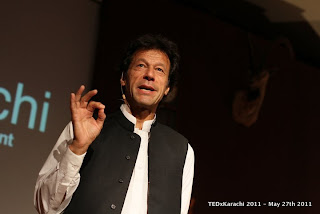

Imran Khan indicates his electoral prospects

To those of you who happened to be in the audience and might have taken this to be an insight into the mind of a natural leader, I say, yes, sure, let me take your thumb impression and plant it firmly on this here vote form. To those of you who happened to be in the audience and might have taken this to be an insight into the mind of a natural megalomaniac, I say yes, sure, let me take your thumb and plant it firmly on your nose and encourage you to waggle your fingers rudely in the air. And recite to yourselves the most telling sentence from his unfocused, rambling, practice campaign speech: “I am probably the only bowler in history to retrain my action to suit my ambition.”

5:10pm: Teatime in a basement buffet. A man behind a friend and I in the line follows us to a table and, plucking up courage, asks whether we were invited, like most of the people around us, or applied successfully to attend, like the many he says he knows who are watching or will watch at home. “I don’t understand,” he says, “what criteria these organizers had to select who could attend. And why did they not have it at someplace like the FTC where people from all over could come easily instead of this place in phase 8?”

5:14pm: In a bathroom stall, having internal dialogue about the term ‘elitist.’ The original TED conference takes pride in the notion, because it is based on the premise that, in the modern world, there is a direct correlation between the financial success and the technological / artistic / entrepreneurial drive of those who attend. Is this a viable position to have in a society where pedigree / connections / inherited social currency still rule?

5:18pm: What do you mean the cake is finished you dumb waiter? Who ate all the cake?

5:40pm: Asad Rahman is a much better presenter than Awab Alvi. For starters, he doesn’t mumble. And is smart enough to understand spin. Just look at the way he introduces Noori as the second coming of Christ.

6:00pm: Noori earns brownie points for dressing down and acting, generally, like accountants with guitars as opposed to rock stars with brains. Much easier to do, for one.


The accountants with guitars look

6: 03pm: Dear Bulleh Shah, I hope you are well. I am glad you are not here to see massacre at Aik Alif Corral. In other news, Baby Noori (aka Ali Hamza) can sing, and most people did not mind that he referred to you as the "Che Guevara of his time" for "walking around dressed in women’s clothes telling people stories."

6:05pm: What a nice little riff these nice boys do on "fast" things. If I close my eyes I can almost pretend I am at a party and the Three Stooges are performing for chicks in the crowd who still buy the "inner self versus worldly goods" lines. Actually, I don’t think I have to close my eyes.

TED and Shoulders Above

6:30pm: For the first time today I am feeling the chill down my spine that one feels in the presence of the real. Dr Quratulain Bakhteari’s talk, hopefully coming soon to a TED channel near you, suddenly makes the sacrifice of the last two hours worthwhile.


Quratulain Bakhteari: The authenticity of the real

I don’t want to spoil it for you by doing a verbatim account but I will say this: inspired, inspiring and all those other things one has come to expect from an hour or two of communing with the spirit of TED. Is that focus, courage and vision I see before me? What is this ache in my chest cavity when she speaks of the "blunt knife twisting" constantly in the heart of a mother without her children? Who clapped these soft hands together when she refers to the shame of being a Pakistani after East Pakistan has been cast away? Wherefore this unbidden nodding of the head when she says we may be told to be fearless but we are hardly ever reminded that we must live with pain if we are to live honestly? Is it authenticity that is melting my cold heart? Are these tears trickling down my cheeks? And who put an empty water bottle on my seat to sit back down on when I got up for the standing ovation, dammit?

6:50pm: And now on stage in wheelchair, Sarmad Tariq, the first 6’ 3”quadraplegic to represent Pakistan in the New York marathon who makes his living with words and isn’t afraid to make you feel mildly uncomfortable about it. Again, this is a talk I think it would be infinitely preferable to watch rather than read about and I look forward to seeing it online soon.


Sarmad Tariq: sitting tall

7:10pm: Like Dr Bakhteari before him, his mixture of wisdom, charm, determination and clarity earn him a standing ovation, the irony of which is not lost on him, considering – as he points out once the hooting has died down – standing and clapping are both things he is no longer able to do. Both these speakers are on par with TED Talks I have seen on international stages. It occurs to me that it isn’t just that their struggle to make the impossible happen hasn’t been, unlike the gormless offerings of the first half, contrived, but rather genuine. It could also be that they benefited from focused, intelligent advice from a TEDx organizer who doesn’t see this local event as just an amateurish exercise in self promotion. I think this because there was in these two presentations the minimalist, subtle attention to narrative tension and dramatic flow that was wholly lacking in the first four. There was also a marked absence of the ‘Well we’re all in this auditorium so we must all be the same so I don’t really have to challenge myself or you’ attitude those four showcased. Kudos to whichever Teddy held their hands and walked them through it beforehand.

Then there is, out of the blue, a viewing of a TEDtalk by Salman Khan about The Khan Academy. I learn two very important things in this. One, technology can help us make the world a global classroom. Two, The Khan Academy is not run by an infamous Indian actor seeking to atone for running over homeless people and shooting endangered species but a former hedge fund manager in the US whose cousins inadvertently led him up a lucrative career path in remedial math. I think this was a great way to break the momentum, can relate completely to the idea of bringing things down to a more sustainable pace, and look forward to secretly doing some of his online tutorials so my brain stops short circuiting when faced with numbers larger than 2.

Better TED Than Dead?

7:20pm: The last speaker of the evening is Mukhtaran Mai. This is how TEDxKhi sold me on the idea of 'Making The Impossible Possible' in the first place, by putting Imran Khan and Mai on the same stage, and then pretending they were there for reasons other than the public personas they inhabit while simultaneously doing absolutely nothing to delve a little deeper into who they are.

Imran Khan’s slip accidentally showed when he talked about how his first foray into politics was a result of his party mates calling his bluff. He had intended to raise his profile and then announce a boycott of his first ever election, he felt comfortable enough to say, because "the match was fixed", but "they were new to politics" and insisted he go ahead. Mukhtaran Mai did not feel as comfortable.


Mukhtaran Mai: uncomfortable showpiece

Possibly because of things like the fact that, when she came out, was placed in a chair and asked her first question (her talk was in the form of a Q&A), her mike didn’t work so she had to be escorted off and brought back and start all over again (technical glitches were, sadly, a sub-plot throughout the evening). Possibly because the first question from 'society' was "What was your childhood like?" Possibly because, when the moderator at some point asked her how she felt about the situation she was in and she expressed her frustration and disappointment and wondered aloud whether she would ever get justice, the moderator changed the subject. And when talk resumed, Mukhtaran Mai had the sense to not bring it up again.

People were, after all, clearly wandering around wanting to feel it was possible to make the impossible possible. How the story of Mukhtaran Mai, as it was presented, makes that point is anybody’s guess.

Wednesday, May 25, 2011

Straight Talk Continues from KK

I don't really know what's happened to Kamran Khan. Since that day, a couple of days after the Abbottabad raid, he has been more outspoken about the failures of our military establishment and the hypocrisy of our "strategic" security policies than he has probably ever been in his broadcasting career. It does make a nice change from the one-sided diatribes against civilian bungling that had allowed his programme to become extremely predictable and monotonous over the past year. (Lest this be misunderstood, I am not at all arguing that the ineffectiveness or corruption of civilian leaderships and bureaucracy should not be exposed. Only that in matters of security and on foreign policies regarding Kashmir, India, Afghanistan and the US there should be an equally fair assessment of the military which sets the tone, if not the entire agenda, of these issues. And also that the electronic media needs to provide some perspective to viewers when discussing the multiple crises of the Pakistani state - let's just say in the most understated manner that it's certainly not all the fault of the civilians who have been in partial control of this blighted country for less than half its existence).

In any case, whatever it is that has happened to Kamran Khan, I hope it continues.

Watch particularly from around 5:55 through to the end of the clip (from today's show Aaj Kamran Khan Ke Saath on Geo)...


Tuesday, May 24, 2011

Security Lapse? What Security Lapse?

I realize that everyone is now in a position to lecture our defenders on how to defend themselves. Shut down PAF Museum, close down the shaadi business, demolish Shah Faisal Colony, replace those security cameras, take away Rehman Malik's Blackberry etc. etc. etc.

Can I take the opportunity to share a minor security lapse that I was personally a witness to a couple of months ago?

Like most mid-career journalists I dream of real estate, basically owning my own little beach hut on Hawke's Bay. Occasionally I rent or beg my more resourceful friends but wouldn't it be nice to have a little one-room place there? I, along with a friend, found myself in a Colonel sahib's car in the pursuit of this beach fantasy. An enterprising real estate dealer had convinced us that Colonel sahib has a little plot on Hawke's Bay that he would like to sell for a bargain price.

As we reached that blighted turning on Mauripur Road from where you turn for Hawke's Bay and Sand Spit (you know the one which hasn't been paved for past 20 years, because truckers, you know, will ruin it anyway) Colonel Sahib kept driving towards Masroor Air Base. Much better road, he promised us. As we approached the gate, Colonel sahib rolled down his window and gave out his name and rank, and three layers of security melted away, and we started a very pleasant drive on a very nice road inside the base. It puzzled me as it was a private car with no security stickers or anything else.

"Colonel sahib, do you come here quite often?" I asked earnestly.
"Nahin yaar, haven't been here in six years."
"Is this an army car then?"
"No. Bought it myself."
"So why didn't those people ask for your ID? I mean, this is a very important operational base, how do they know that you are a colonel?"
"What?! Don't I look like a colonel?"


An aerial view of Masroor Air Base from the Federation of American Scientists' website


Colonel sahib lowered the volume on Anoop Jalota's sharabi ghazal and stared at us. He wore a white, starched shalwar qameez and Raybans. Okay, he had the fauji haircut, but I have seen lots of non-colonels who look exactly like him.

"Of course you do, Colonel sahib," I reassured him.

The drive through the base was uneventful. It wasn't as posh as we hacks think these things are. We passed by signboards that pointed to Mirage squadrons, the Senior NCO Mess, and lots of empty fields. Colonel sahib admitted that the security was a bit of joke. I wasn't sure if he was indulging potential customers or actually believed it. We exited through a tiny gate which was manned by two sleepy unarmed men in a uniform that we had never seen before.

"They are not soldiers, just chowkidars," Colonel sahib explained. "Somebody has just given them some uniforms."

As we hit the main civilian road we were reassured to see that we had managed to avoid the truck-congested part of the route but not missed the famous snack shop called Chillkaro.com.

And that beach plot? It turned out to be too expensive for me.

Sunday, May 22, 2011

Some Thoughts on Imran Khan's Dharna

I have been greatly amused by some of the speculation around the reasons for our blog being untended for the past couple of weeks. Unfortunately none of the speculation centred on us being part of OBL's support staff who could not update the blog because we were currently on the run. That would have really made my day. Sadly, the truth is not only out there, it is decidedly prosaic. Anyhow...


A view of the PTI dharna in Karachi (Photo: Nefer Sehgal / Express Tribune)


Today marked the first day of Imran Khan's grand show of farce force in Karachi. He had vowed a two-day dharna (sit-in) to block NATO supply routes from the Karachi port in protest against continuing American drone strikes in the tribal areas and, by God, he kept his word. Or at least that's what his party faithful will have you believe. Here's what I have been thinking after making a quick round of his dharna site:

1. This must be the first dharna in the world where chairs were provided for the angry revolutionaries. Under shamianas, erected no doubt to protect the angry revolutionaries from the scorching sun. You know, so that the Pakistan Tehrik-e-Imran Insaf (PTI) supporters 'garmi mein kharaab na ho jaayein.'

2. This also must be the first populist gathering where the awaam were divided into three sections, ostensibly in order of their importance. Or as a wag put it, into VIPs, IPs, and Ps.

3. It's rather convenient that the dharna is taking place over the weekend, in order to cause the least amount of inconvenience to not only the PTI's weekend warriors but also to the actual businesses operating from the port, most of which shut down on Sunday anyway. The transporters who actually run the supply trailers that carry the NATO containers announced their support for Immy bhai's mission by proclaiming a two-day suspension of their work over... you guessed it, the weekend.

4. It's also rather convenient that the organizers were able to negotiate with the city administration to stage their sit-in on a side road so as to not actually block any of the main thoroughfares or the Native Jetty bridge that actually are used to transport the goods.

5. In his delayed speech to the thronging seated crowds (estimates vary between a couple of thousand to around 7,000, including the Sunni Tehreek workers who had joined in, once the sun had set on Saturday), Immy bhai pleaded with the gathered faithful to not forget to "return again" on Sunday. Which of course adds another layer of uniqueness to this 'sit-in': the protestors can go home, sleep in their comfy beds (preferably with their ACs on), have a nice leisurely brunch and come back to resume their 'blockage.'

6. In his speech, Immy bhai - who was constantly being fed lines in his ear, in plain sight, by the PTI Secretary General Arif Alvi - once again castigated the President and Prime Minister for following a hypocritical policy on the American drone strikes. He called their private support for drone strikes - as detailed in WikiLeaks revelations from last year - while publicly condemning them, as evidence of their "match-fixing" (oh! those cricket metaphors never stop do they?) and "noora kushti" in connivance with the Americans. Fair enough. I don't know about anyone else but I think he could have said a word or two about some recent WikiLeaks revelations too. We know that he's read them since he was kind of forced to acknowledge them in a press conference a day ago. Oh, but wait, that would be just so inconvenient now, wouldn't it? Especially when you want to remain on the 'right side' in more ways than one.

7. I don't want to get into the question of who exactly the casualties of the drone strikes are but suffice it to say there is plenty of contradictory information / opinion on this point. Immy bhai may also want to back up his claims of "overwhelming" civilian casualties with some real facts, especially since his claims contradict what even Pakistan army generals believe. Of course it is easy to whip up emotionalism on this issue - and Heaven knows that's about the only thing that has happened so far - but if you're out to run a campaign based on claims of civilian casualties and not legality, one would hope you have the hard data to back it up.

As a final thought, you might want to read this recent piece by Herald editor Badar Alam on Immy bhai's politics. It's probably the best piece you will read about the man and what ails him.


Thursday, May 5, 2011

Signs Of The Times?

Let's get some things straight. There are still a large number of BIG questions unanswered about the killing in Abbottabad of Osama bin Laden. Many in Pakistan are choosing to obsess over how the American Navy SEALs team managed to come in and go out of Pakistan without being detected by the vaunted and financially over-indulged Pakistani military. Others are also questioning whether one should take the US government's and the ISI's word that OBL was indeed present in the compound that was attacked and whether he was, in fact, killed as stated. These are NOT the questions I am talking about.

The question that really needs to be answered is how it was possible for the most wanted man in the world to be living literally under the nose of Pakistan's men in khaki, whose leader had declared almost at the same spot only a week ago that his men had broken the back of terrorism and that Pakistani "dignity" would not be compromised for the sake of "prosperity." The question that really needs to be answered is why we - the people of Pakistan - should take anything he says with any seriousness if, in fact, he and his boys are really that incompetent. And why the Pakistani people should continue to give up their prosperity to fund such incompetence. The question that really needs to be answered, if the boys in khaki are not to be taken as the most incompetent people on the face of the earth, is what they were hoping to gain from such brazen duplicity. Because that really is the only choice available in their defence: nincompoop-ness vs two-facedness. Thanks to whatever their defence may be, Pakistan has a choice of being considered either a failed or a rogue state.

But if any good can come out of this fiasco, it had to be what I witnessed while watching Aaj Kamran Ke Saath on Geo tonight. The tone was in remarkable contrast to what most of the Pakistani electronic media (with a couple of notable exceptions) had decided to feed the Pakistani public over the last two days. The 'line' seemed to be completely reversed from what the Pakistani public has been force-fed generally over the last decade. And if it means what I think it does, coming from the well-connected Kamran Khan, it might just indicate some sort of silver lining for a future that looked increasingly bleak.

See this clip of the first 12-odd minutes of the programme and decide for yourself (you can watch the whole programme here):


Can one still hope to dream?


Wednesday, May 4, 2011

The Pakistanian Defence And Its Alternatives

Pakistan Today's cover May 3, 2011


It can be argued that the world’s most powerful countries are those that understand the difference between perception and reality, and attach equal importance to controlling both. Pakistan’s reality is a harsh, challenging one, but unless we move proactively and immediately to counter the further degradation of our already distorted image, it is about to get a lot worse.


Consider this, from Al Jazeera English:


“The Arab Spring has eroded many of the conventional assumptions about the relationship between dictators, Islamists and the West. In Tunisia, Egypt, Libya, Yemen and Syria, we heard dictators playing the Islamist card for three decades – "support us unless you want the terrorists to win".
The reality has been quite different...Today, the US continues to lavishly fund the Pakistani military, while using drones and secret soldiers such as Raymond Davis to attack the extremist forces that the same regime supports. It is up to the US to stop feeding the beast.”


Or this, from The New York Times:

“... Bin Laden’s death near Islamabad has rekindled suspicions in Afghanistan…“Pakistan is the problem, and the West has to pay attention,” said Amrullah Saleh, the former intelligence director of Afghanistan, who resigned last summer. Though jubilant at the death of Bin Laden, he said it was time for the United States to “wake up to the fact that Pakistan is a hostile state exporting terror.”


Or this, from Salman Rushdie for The Daily Beast:


“ There is not very much evidence that the Pakistani power elite is likely to come to its senses any time soon. Osama bin Laden’s compound provides further proof of Pakistan’s dangerous folly.
As the world braces for the terrorists’ response to the death of their leader, it should also demand that Pakistan give satisfactory answers to the very tough questions it must now be asked. If it does not provide those answers, perhaps the time has come to declare it a terrorist state and expel it from the comity of nations .”

Despite American and British efforts to diffuse the situation, this hard-line ‘enough is enough’ stance is being echoed across the globe. It is neither surprising nor unexpected, and in the long run questions of whether it is justified will remain, as they are now, relevant only to Pakistan’s internal dialogue, but more on that later. The world, like the mob, is ultimately uninterested in the nuances of things. Can it, like the beast, be lulled into stillness with the right tune?


I cannot comment with any authority on the PR plan our politicians, military, past/future leaders and broadcast journalists are currently following. I know that most of the politicos are sticking with the ostrich routine, most of our leaders are rechecking their visa-to-safer-climes status, most of our broadcast journalists are continuing to miss the forest for the trees, and that the ISPR is shooting a feature film, written possibly by the official behind the 'We're good, but we're not God' line featured in this BBC report. The two sole Pakistani voices who have spoken for us internationally today, then, are the rather Laurel and Hardyesque pairing of novelist Mohsin Hamid and President Asif Ali Zardari; Hamid in an opinion piece for The Guardian and Zardari in a comment for The Washington Post.


Both have chosen to follow what I would like to dub ‘The Pakistanian Defense’ (a nod to George Bush, which is also interestingly often a feature of the PD, as is the kind of ironic self referencing you see here). The Pakistanian Defense has a few standard features, some of which are listed below, which can be tweaked to accommodate word length, timing and audience.


1) More of my countrymen have died than all of yours combined.


Zardari, or his resident ghost writer, does it with: 

“Let us be frank. Pakistan has paid an enormous price for its stand against terrorism. More of our soldiers have died than all of NATO’s casualties combined. Two thousand police officers, as many as 30,000 innocent civilians and a generation of social progress for our people have been lost.”

Hamid does it with: 

“Less well known is the statistic that since the subsequent US invasion of Afghanistan, terrorists have killed nearly five times that number of people in Pakistan. The annual number of Pakistani fatalities from terrorism has surged from fewer than than 200 in 2003 to almost 1,000 in 2006, to more than 3,000 in 2009. In all, since 2001 more than 30,000 have died here in terror and counterterror violence; slain by bombs, bullets, cannons and drones. America's 9/11 has given way to Pakistan's 24-7-365.”

Zardari’s piece is simple in structure and word choice, much like a lot of the hostility currently emanating from the pens of opinion makers in other countries. It, like Clinton’s ‘you cannot wait us out, you cannot defeat us’, outlines the outer limits of the diplomatic dance. Hamid, on the other hand, co-opts the linguistic weapons of choice of the other side (surged, counterterror, America’s 9/11 has given way to Pakistan’s 24-7- 365) and in doing so creates a space where nuance may one day live.


2) Pakistanis want peace, not war.


Zardari raises the facts that: 

“Radical religious parties have never received more than 11 percent of the vote. Recent polls showed that 85 percent of our people are strongly opposed to al-Qaeda. In 2009, when the Taliban briefly took over the Swat Valley, it demonstrated to the people of Pakistan what our future would look like under its rule — repressive politics, religious fanaticism, bigotry and discrimination against girls and women, closing of schools and burning of books. Those few months did more to unite the people of Pakistan around our moderate vision of the future than anything else possibly could.”

Hamid reinforces that with: 

“If Osama Bin Laden's death means that the war in south and central Asia can now begin to end, that America can begin to withdraw its forces from the region, and that Pakistan and Afghanistan can somehow rediscover peace, then one day there may be celebrations here as well.”

3) They will be gunning for us even more viciously now.


Zardari points this out with: 

“Only hours after bin Laden’s death, the Taliban reacted by blaming the government of Pakistan and calling for retribution against its leaders, and specifically against me as the nation’s president.”

Hamid says it with: 

“As news of terrorist leader Osama bin Laden's death reverberates in Pakistan, embassies here are shutting down, hotels are ramping up security, restaurants are reporting cancelled reservations and public gatherings like plays, concerts and lectures, are being postponed. The feeling in Lahore is familiar: it is like the dread that lingers over the city in the days after it has suffered a massive terrorist attack. This time, though, the attack has not yet happened, and the dread spans the entire country. Pakistanis know they may pay a blood price for Bin Laden's killing. A purported mirror has been broken. Bad luck is to be expected.”

Zardari makes the mistake of sticking with the royal ‘we’, demanding an acknowledgement of worth nobody currently wants to give us. Hamid comes in from the other end and makes us ordinary, human, sketching life for Pakistanis in details The Other can understand, even if they are details actual ordinary, human Pakistanis would scratch their heads at (hotels, restaurants, plays, concerts, lectures…er…what?). A universal symbol of bad luck, the broken mirror, is weaved in too, to reinforce the pathos and significance of ‘dread’ and ‘blood price’. Zardari invites you to stick a sock on your hand and pillory his pomposity. Hamid invites you to sit down, listen and sympathize.


4) Why on earth would we want to make the most trigger-happy nation in the world angry with us?


Zardari feels the best way to make this point is:

“The war on terrorism is as much Pakistan’s war as it is America’s…My government endorses the words of President Obama and appreciates the credit he gave us Sunday night for the successful operation in Khyber Pakhtunkhawa. We also applaud and endorse the words of Secretary of State Hillary Clinton that we must “press forward, bolstering our partnerships, strengthening our networks, investing in a positive vision of peace and progress, and relentlessly pursuing the murderers who target innocent people.”

Hamid goes with: 

“But there are other, truly frightening theories, such as that even in a town with as dense a military presence as Abbottabad, Bin Laden managed to elude Pakistani security forces, suggesting a remarkable degree of incompetence. More terrifying still would be if there were official complicity in harbouring him, putting Pakistan on a collision course with the US. Pakistanis must hope that neither of these is true.”

The royal megaphone of royalty sticks with the moving speechwriting software writs and having writ moves on. Hamid establishes the difference between the sheep and the shepherds with one fluid reference to the ‘incompetence’ of the state within a state that consistently fails to protect its charges. 


To be fair to President Zardari, this is where the difference between a novelist and a head of state is, governed by realpolitik as much as it is by style. The privilege of implying, publicly, that their nation's army is either incompetent or duplicitous rests only with one. This is evident also in the contrast between Sir Salman Rushdie's Down With Pakistan and David Cameron's more measured public stance.


5) Forget the past, it is not in our power to change it. Lets talk about what happens next.


According to our president: 

“We can become everything that al-Qaeda and the Taliban most fear — a vision of a modern Islamic future. Our people, our government, our military, our intelligence agencies are very much united. Some abroad insist that this is not the case, but they are wrong. Pakistanis are united.”

According to one of our brightest literary lights: 

“In the meantime American, Pakistani, Afghan, and terrorist commanders will go on conducting their operations, the slaughter will continue, and human beings – all equal, all equal – will keep dying, their deaths mostly invisible to the outside world but at a rate evoking a line of aircraft stretching off into the distance, bearing down upon tower after tower after tower. Bin Laden is dead. But many Pakistanis sense the impending arrival of yet another murderous plane, headed their way.”

Zardari takes the opportunity to tell people Pakistanis are united against ‘terrorism’. Hamid points out that Pakistanis are united only in being the direct target of everybody else’s cross hairs.


The defining characteristic of The Pakistanian Defense, finally, is that…


6) People are no longer buying it.


And that, really, is the point of the deconstruction. It doesn’t matter how well or how badly written our responses to this situation are, what notes we hit or don’t hit in our explanations, the rest of the world no longer gives a shit.

Consider this, from an Economics Times report on our President’s article:

“Pakistani President Asif Ali Zardari defended his country on Monday against accusations it did not do enough to track down Al-Qaeda leader Osama bin Laden, but made no direct comment on alleged intelligence failures…Zardari provided no detailed explanation on how bin Laden managed to live for years undetected in Abbottabad, a hillside retreat popular with retired Pakistani generals just a few hours drive from Islamabad. “

Or consider this, from one of the responses posted to Hamid’s article in The Guardian:


“I once referred to Pakistan as the classic informant, who tells the thief about the whereabout of the owner of the property and then informed the owner of the property the thief is coming…Pakistan as I have also posted before is a country the world should fence off and throw away the key. It is a country that its only contribution to the world is misery and danger to lives and limbs. In fact it is terrorist country. The most dangerous terrorist country on the planet.
Every western gov't including ours should not only cease aid to Pakistan, immigration from Pakistan should also be stopped. The world should let Pakistan sleep in the bed it made.”


Back now, to the question of whether the bile and revulsion this ‘rogue state’ and ‘terrorist sanctuary’ is currently provoking is justified. You can choose to find your answer amongst the six points of The Classic Pakistanian Defense outlined above. You can find it while channel surfing, watching someone like Ansar Abbasi holding forth on how Osama Bin Laden was a Muslim Hero. You can find it in the pages of an Urdu paper as a columnist obsesses over the burial ritual of one murderer and not the mass graves of the multitudes of innocents he, and those he was a figurehead for, killed. You can find it in the online edition of an English one detailing how the banned Laskhkar-e-Taiba held funeral prayers for Bin Laden in Karachi today.


People of that ilk make Pakistan’s image crisis worse by openly exposing their – and by extension our - tolerance for intolerable positions. If what the foreign commentators I have quoted above said offends you, and you think they are refusing to distinguish between Pakistanis and those elements within Pakistan that gave Bin Laden shelter, acknowledge the role those elements play in shaping the outside world’s refusal to make that distinction. This, from outside the bubble, is a country where a sentence is blasphemy but a murder is not, rape victims are vilified for attempting to challenge patriarchy, terrorists are sheltered after slaughtering innocent civilians, and the challenge to sovereignty by a western force is always more important than the steady, decades long erosion of sovereignty by some imported, medieval hogwash.


Once, there might have been room in the world for an ideology that thinks it is special, God gifted, exempt from the rules and norms of the comity of nations of which one commentator speaks, but that place has already been taken. Certain Pakistanis need to accept that we are not Israel. By this I mean we cannot defend an indefensible position by virtue of association with unshakeable allies because really, at the end of the day, we have none. Even Saudi Arabia had the sense to let its most notorious son slip quietly into the sea, we on the other hand built him a home in a hill resort.


Today, we have a twofold crisis. One, the incompetence, exposed, of a bloated institution that has never lost an opportunity to enrich itself and steadfastly refused to fix itself. Two, a perception that Pakistan is populated by illiterate Muslims who will come out on the street to protest Danish cartoon strips but not to protest an almost comical, internationally inflammatory misstep. How do we fix the first? The rogue state within a state needs to be broken, examined forensically, and rebuilt in the shelter of a democratically elected civilian government, never to take a step without a popular mandate again, and then only to protect our citizens not endanger them further. 


How do you fix the second? For a start, apologize. Apologize Mr. President, Mr. Prime Minister, to the world for not keeping your side of the bargain, to your country for letting us be shamed on your watch. Apologize even if it kills you. Because your subsequent loss of face might embolden you enough to hold others accountable. And because somebody or the other is always trying to kill you anyway and you might as well die on the right side of the line.

Monday, May 2, 2011

What Passes For Political Debate

Only a couple of weeks ago, I had posted a couple of exchanges on live television which provided a sad commentary on the levels political debate in this country had sunk to. One of those exchanges involved Jang columnist and Geo presenter Hasan Nisar and the PML(N)'s Senator Mushahidullah. We had no hesitation in laying the fault for that disgraceful verbal sparring at the feet of Nisar and had called on him to offer apologies.

But it seems Mr Mushahidullah is no stranger to crudities on television. See the following clip from News One's Bang-e-Dara programme with host Faisal Qureshi from April 28 (thanks to Jalal Hussain for bringing it to our notice). The target of Mushahidullah's seemingly petty wrath (thankfully, we are spared the worst of it because of News One's bleeps) is Pakistan Tehrik-e-Insaaf's Secretary General Dr Arif Alvi.


Having watched the entire programme here, I can safely say that no one in the programme comes away with flying colours. Dr. Alvi's smugness and self-righteousness is grating as are the host's overtly partisan interjections once he too loses his cool. Dr Alvi's snipes when Mushahidullah first tries to answer the host's questions precipitate the eventual free-for-all. The less said about the screeching Nargis Faiz Malik, PPP MPA in the Punjab, the better. However, none of the political provocations provides an excuse for Mushahidullah's final descent into bazaari language.  Some people, it seems, just don't know the meaning of the phrase 'earning respect.'


Thursday, April 28, 2011

Channeling Anger

At certain points during a quick reading of these excerpts from Kim Barker’s new book, featuring the shenanigans of our very own friendly neighborhood Teletubby, I found myself laughing out loud. It wasn’t the ‘ oh god that’s funny’ laughter though, it was – again – the helium like hysteria of you just can’t make this shit up. The excerpts didn’t just entertain, they educated too. I learnt many important things. For example, that tigers are people too. That a certain kind of politician’s favorite tune continues to be ‘how much is that journo in the window’. And that it is only a matter of time before ‘What do you think, Kim?’ becomes a popular pick up line.

Then I watched the beginning of the Mubashir Lucman programme episode mentioned in that post and it wiped the smile right off my face. The story he covered before he got around to setting the stage for Tinky Winky’s public humiliation was the latest twist in Mukhtaran Mai’s tragically prolonged quest for justice. And when I say covered, I mean stripped, laughed at, and then paraded down the street naked, as sometimes happens to women in this our blessed country.

You should watch the clips and hear the language employed to understand what I mean:

Part 1: Relevant portions are from 00:00-01:18 and then from 02:56-12:10


Part 2: Relevant portion is up until 06:00


I’m not going to go into details of how and why Mubashir Lucman, who has never exactly been a poster boy for decorum, managed to find hitherto undiscovered levels of lowness to sink to in his treatment of the story and his hapless guest, Mukhtaran Mai. This piece by Sana Saleem on Dawn Blogs has already done so. I would like to add something though, and that is what exactly can we do about it?

I’m also not going to more than flirt with the visceral impact of this particular juxtaposition of fact and farce. A foreign ‘lady journalist’ detailing the loneliness of a man with power, insecure enough to get hair plugs and fret about his weight problem, yet clinging desperately to the belief that power alone is an irresistible aphrodisiac. A local male anchor following in the footsteps of others before him taking pleasure in reducing a heroic woman it has been conclusively proven was raped to an attention seeking media whore. A panel of corpulent scavengers echoing his position, just as happy to imply that there is justice in reminding women who have stepped out of line what their proper place is. Beneath them, presumably. But yes, do not dwell too long on the contrast between the soft handed flabbiness of men who should still be wearing diapers and the gaunt, haunted faces of the women who pay for their infantile natures. That way lies hell.

Mr Lucman is clearly the sort of person who, when he gets attention, does not care whether it is positive or negative but only congratulates himself on having gotten it. This is not surprising; it seems to be a part of the genetic coding of 99% of the world’s talk shows hosts. It is also not surprising that the channel in question gives this sorry sud a soapbox. The more incendiary the content, the better the ratings. So, considering the chances of a public apology by Mr Lucman as a result of an online petition are about as high as Nawaz United’s chances of scoring against Barkerlona, back then to what exactly can we do about it?

Here’s an idea: complain to the Pakistan Electronic Media Regulatory Authority (PEMRA).

Their Council of Complaints ostensibly comprises of "eminent citizens who have rich experience in their respective fields i.e. law, journalism, electronic media, public relations, etc. None of such Councils may have any official from PEMRA or any other government department as its member which vouch their complete autonomy. Each Council of Complaints is also required to have at least two female members." According to PEMRA's website, the PEMRA Regional General Manager only acts as a Secretary to the Council and also "[encourages] women to come forward to lodge their complaints without any reluctance." PEMRA also claims that “since their inception, Councils of Complaints have done commendable job in [the redressal] of complaints to [the] complete satisfaction of all stake-holders.”

Try it out, publicly. Get in touch with any of these listed Councils of Complaint and lodge a protest against that episode of the Lucman show for being in violation of various clauses of Rule 1 of PEMRA's Code of Conduct for Media Broadcasters and Cable TV Operators, for example…


(Rule) 1: No programme shall be aired which...

(c) contains an abusive comment that, when taken in context, tends to or is likely to expose an individual or a group or class of individuals to hatred or contempt on the basis of race or caste, national, ethnic or linguistic origin, colour or religion or sect, sex, sexual orientation, age or mental or physical disability;

(d) contains anything defamatory or knowingly false;

(f) contains anything amounting to contempt of court;

(h) maligns or slanders any individual in person or certain groups, segments of social, public and moral life of the country;

(i) is against basic cultural values, morality and good manners;

(k) promotes, aids or abets any offence which is cognizable under the applicable laws;

(l) denigrates men or women through the depiction in any manner of the figure, in such a way as to have the effect of being indecent or derogatory;

(n) anything which tends to glorify crime or criminals


Keep a record of your phone/fax/email correspondence with PEMRA. Set up a coordinating body via website or list or group to share information and keep others posted on progress or lack thereof. The worst thing that can happen is nothing. The best thing that can happen is another small step towards letting the system know that you too are a stakeholder, you too believe you have the right to air your opinion, and you too are mad as hell and not going to take it anymore.

Those of a PML(N)cholic disposition may, of course, replace Mukhtaran Mai with Nawaz Sharif at relevant parts of the complaint.

Wednesday, April 27, 2011

Fast Friends (Redacted)

I was actually going to put up a different post, on Pak-US relations, tonight but some last minute technical glitches mean that post will have to wait another day at least. Meanwhile, the next big political scandal is about to hit the headlines so I thought we could give you all a bit of a heads-up.

Some of you may have already heard about the Kim Barker - Nawaz Sharif hullabaloo (if you haven't, I can assure you you will be hearing a lot more of it in the coming days). I learnt about it only after a journo colleague mentioned it in vague terms. Then I came across a clip of Mubashar Lucman's show on Dunya TV from a couple of days ago discussing the same in his usual sensational manner (which @kamran9558 sent us). In case you don't have any idea of what I'm referring to, it basically involves what former South Asia correspondent for the Chicago Tribune and current ProPublica reporter Kim Barker has written in her book The Taliban Shuffle: Strange Days in Afghanistan and Pakistan about her interactions with Sharif. Let's just say that it doesn't paint an entirely flattering picture of the former prime minister. The book came out in the US about a month ago and having sold out in bookstores across Pakistan (probably in small numbers), is being re-ordered in large quantities.


Kim Barker, author of 'The Taliban Shuffle'


We all know why Dunya would be interested in making the contents of this book into an issue (Dunya's owner, Mian Aamir Mahmood, is of course associated with Sharif's rival party the PMLQ). Now Sharif's other nemesis, General Musharraf has jumped into the fray calling on Sharif to apologize to the nation for, according to him, helping Barker find the whereabouts of Mumbai attacker Ajmal Qasab's hometown and for leaking "important intelligence reports of the country" to her. It should be pointed out that the book is about much more than Sharif (it is scathing, for example, about Afghan President Hamid Karzai who Barker calls "whiny and conflicted, a combination of Woody Allen, Chicken Little and Jimmy Carter"). But, as far as Pakistan is concerned, I am willing to bet that the Sharif-related episodes are what are going to sell this book.

I have to admit that I found the Nawaz Sharif-related writing hilarious. It confirmed much of what one already knows about Sharif, his ability to be easily distracted, his obsession with hi-tech gadgetry and his inherent shyness which manifests itself in an inability to communicate. But unfortunately for him, it also depicts a lonely, almost desperate man. I say unfortunately for him because it is this evidence of his humanity which is probably going to be used by his political opponents to attack him.

Since all sorts of people will come up with all sorts of spin on the contents of the book, I thought I would share with our readers some choice excerpts from the book related to the author's conversations with Nawaz Sharif. You really have to read through the excerpts to understand how Barker's relationship develops with Sharif. These excerpts are shared without comment and without authentification as to their veracity; you are free to make up your own mind about them.

Warning: This is a fairly lengthy post. But you will understand the reason for the length once you read through the excerpts. And I am fairly certain you will enjoy it.


******


:::UPDATE:::


Because of a request from author Kim Barker we are removing the lengthy excerpts originally posted below. A few shorter excerpts remain to provide a taste of the book.


******


From "The Taliban Shuffle" by Kim Barker (published by Doubleday):

"With Bhutto gone, I needed to meet the lion of Punjab, or maybe the tiger. No one seemed to know which feline Nawaz Sharif was nicknamed after. Some fans rode around with stuffed toy lions strapped to their cars. Others talked about the tiger of Punjab. By default, Sharif, a former prime minister like Bhutto, had become the most popular opposition leader in the country. He was already the most powerful politician in Punjab, which was the most powerful of Pakistan’s four provinces, home to most of the army leaders and past rulers. Some people described Sharif as the Homer Simpson of Pakistan. Others considered him a right-wing wing nut. Still others figured he could save the country. Sharif was once considered an invention of the establishment, a protégé of the former military dictator in Pakistan, General Zia, but like all politicians here, he had become a creature of himself. During his second term, Sharif built my favorite road in Pakistan, a hundred and seventy miles of paved, multilaned bliss.....
......
"One of Sharif’s friends tried to explain him to me: “He might be tilting a little to the right, but he’s not an extremist. Extremists don’t go do hair implants. He also loves singing.” 
          ......

"The inside of the house appeared to have been designed by Saudi Arabia—a hodge-podge of crystal chandeliers, silk curtains, gold accents, marble. A verse of the Holy Quran and a carpet with the ninety-nine names of God hung on the walls of Sharif’s receiving room, along with photographs of Sharif with King Abdullah and slain former Lebanese prime minister Rafik Hariri. Finally I was summoned. “Kim,” Sharif’s media handler said, gesturing toward the ground. “Come.” I hopped up and walked toward the living room, past two raggedy stuffed lions with rose petals near their feet. So maybe Sharif was the lion of Punjab... His press aide tapped his watch, looked at me, and raised his eyebrows. I got the message and proceeded with my questions, as fast as I could. But it soon became clear that this would be unlike any interview I had ever done. 
“You’re the only senior opposition leader left in Pakistan. How are you going to stay safe while campaigning?” In Pakistan, campaigns were not run through TV, and pressing the flesh was a job requirement. Candidates won over voters by holding rallies of tens and hundreds of thousands of people. Even though Sharif was not personally running, his appearance would help win votes for anyone in his party. 
Sharif looked at me, sighed, and shook his head. “I don’t know. It’s a good question. What do you think, Kim?”
“I don’t know. I’m not the former prime minister of Pakistan. So what will you do?”
“Really, I don’t know. What do you think?”
This put me in an awkward position—giving security advice to Nawaz Sharif. “Well, it’s got to be really difficult. You have these elections coming up. You can’t just sit here at home.”
“What should I do?” he asked. “I can’t run a campaign sitting in my house, on the television.”
 

...... 
"I stood up. Sharif’s aide was already standing. “I should probably be going,” I said. “Thanks very much for your time.” “Yes, Mian Sahib’s schedule is very busy,” Sharif’s handler agreed.  
“It’s all right,” Sharif said. “She can ask a few more questions.” I sat down. I had whipped through most of my important questions, so I recycled them. I asked him whether he was a fundamentalist. Sharif dismissed the idea, largely by pointing to his friendship with the Clintons. I tried to leave again, fearing I was overstaying my welcome. But Sharif said I could ask more questions. “One more,” I said, wary of Sharif’s aide. Then I asked the question that was really on my mind.  
“Which are you—the lion or the tiger?”
Sharif didn’t even blink. “I am the tiger,” he said.
“But why do some people call you the lion?”
“I do not know. I am the tiger.”
“But why do you have two stuffed lions?”
“They were a gift. I like them.” 

...... 
"We drove to the next rally. I looked at my BlackBerry and spotted one very interesting e-mail—a Human Rights Watch report, quoting a taped conversation from November between the country’s pro-Musharraf attorney general and an unnamed man. The attorney general had apparently been talking to a reporter, and while on that call, took another call, where he talked about vote rigging. The reporter had recorded the entire conversation. I scanned through the e-mail. 
“Nawaz,” I said. I had somehow slipped into calling the former prime minister by his first name. “have to hear this.” I then performed a dramatic reading of the message in full, culminating in the explosive direct quote from the attorney general, recorded the month before Bhutto was killed and just before Sharif flew home... It was unclear what the other man was saying, but Human Rights Watch said the attorney general appeared to be advising him to leave Sharif’s party and get a ticket from “these guys,” the pro-Musharraf party, the massive vote riggers. 
Sharif’s aide stared at me openmouthed. “Is that true? I can’t believe that.” “It’s from Human Rights Watch,” I said. “There’s apparently a tape recording. Pretty amazing.”  
Sharif just looked at me. “How can you get a text message that long on your telephone?”  
“It’s an e-mail,” I said, slightly shocked that Sharif was unconcerned about what I had just said. “This is a BlackBerry phone. You can get e-mail on it.” 
“Ah, e-mail,” he said. “I must look into this BlackBerry.” 
        
          ......
"After more than eight years of political irrelevance, Sharif was back. I sent him a text message and asked him to call. A few hours later, he did, thrilled with his victory.  
“I saw a car today, where a man had glued blankets to it and painted it like a tiger,” I told him at one point. “Really?” he asked. “Yeah. It was a tiger car.”
He paused. “What did you think of the tiger car, Kim? Did you like the tiger car?”  
Weird question. I gave an appropriate answer. “Who doesn’t like a tiger car?” 

...... 
"This time, in a large banquet hall filled with folding chairs and a long table, Sharif told his aides that he would talk to me alone. At the time, I barely noticed. We talked about Zardari, but he spoke carefully and said little of interest, constantly glancing at my tape recorder like it was radioactive. Eventually, he nodded toward it. “Can you turn that off?” he asked. 
“Sure,” I said, figuring he wanted to tell me something off the record. 
“So. Do you have a friend, Kim?” Sharif asked. I was unsure what he meant. 
“I have a lot of friends,” I replied. 
“No. Do you have a friend?” 
I figured it out. 
“You mean a boyfriend?” “Yes.” I looked at Sharif. I had two options—lie, or tell the truth. And because I wanted to see where this line of questioning was going, I told the truth. “I had a boyfriend. We recently broke up.” I nodded my head stupidly, as if to punctuate this thought. 
“Why?” Sharif asked. “Was he too boring for you? Not fun enough?” 
“Um. No. It just didn’t work out.” 
“Oh. I cannot believe you do not have a friend,” Sharif countered. 
“No. Nope. I don’t. I did.” 
“Do you want me to find one for you?” Sharif asked.

To recap: The militants were gaining strength along the border with Afghanistan and staging increasingly bold attacks in the country’s cities. The famed Khyber Pass, linking Pakistan and Afghanistan, was now too dangerous to drive. The country appeared as unmoored and directionless as a headless chicken. And here was Sharif, offering to find me a friend. Thank God the leaders of Pakistan had their priorities straight.

“Sure. Why not?” I said.

The thought of being fixed up on a date by the former prime minister of Pakistan, one of the most powerful men in the country and, at certain points, the world, proved irresistible. It had true train-wreck potential.

......
"In the sitting room, I immediately turned on my tape recorder and rattled off questions. Was Sharif at the negotiations? What was happening? He denied being at any meetings, despite press reports to the contrary. I pushed him. He denied everything. I wondered why he let me drive all this way, if he planned to tell me nothing. At least I’d get free food. 
He looked at my tape recorder and asked me to turn it off. Eventually I obliged. Then Sharif brought up his real reason for inviting me to lunch.
“Kim. I have come up with two possible friends for you.” 
At last. “Who?”
He waited a second, looked toward the ceiling, then seemingly picked the top name from his subconscious. “The first is Mr. Z.”
That was disappointing. Sharif definitely was not taking this project seriously. “Zardari? No way. That will never happen,” I said. 
“What’s wrong with Mr. Zardari?” Sharif asked. “Do you not find him attractive?” 
Bhutto’s widower, Asif Ali Zardari, was slightly shorter than me and sported slicked-back hair and a mustache, which he was accused of dying black right after his wife was killed, right before his first press conference. On many levels, I did not find Zardari attractive. I would have preferred celibacy. But that wasn’t the point. Perhaps I could use this as a teaching moment. 
“He is the president of Pakistan. I am a journalist. That would never happen.” 
“He is single.” Very true—but I didn’t think that was a good enough reason. “I can call him for you,” Sharif insisted. I’m fairly certain he was joking. 
“I’m sure he has more important things to deal with,” I replied.  
“OK. No Mr. Z. The second option, I will discuss with you later,” he said. That did not sound promising. 

......
"I needed to get out of there. “I have to go.” 
“First, come for a walk with me outside, around the grounds. I want to show you Raiwind.” 
“No. I have to go. I have to go to Afghanistan tomorrow.” 
Sharif ignored that white lie and started to talk about where he wanted to take me. “I would like to take you for a ride in the country, and take you for lunch at a restaurant in Lahore, but because of my position, I cannot.” 
......
"Once the interview was finished, Sharif looked at me. “Can you ask your translator to leave?” he asked. “I need to talk to you.” My translator looked at me with a worried forehead wrinkle. “It’s OK,” I said. He left.
Sharif then looked at my tape recorder. “Can you turn that off?” I obliged.
“I have to go,” I said. “I have to write a story.” 
He ignored me. “I have bought you an iPhone,” he said. 
“I can’t take it.” 
“Why not? It is a gift.” 
“No. It’s completely unethical, you’re a source.” 
“But we are friends, right?” I had forgotten how Sharif twisted the word “friend.” 
“Sure, we’re friendly, but you’re still the former prime minister of Pakistan and I can’t take an iPhone from you,” I said. 
“But we are friends,” he countered. “I don’t accept that. I told you I was buying you an iPhone.” 
“I told you I couldn’t take it. And we’re not those kind of friends.” 
He tried a new tactic. “Oh, I see. Your translator is here, and you do not want him to see me give you an iPhone. That could be embarrassing for you.” 
Exasperated, I agreed. “That’s it.” 
He then offered to meet me the next day, at a friend’s apartment in Lahore, to give me the iPhone and have tea. No, I said. I was going to Faridkot. 
Sharif finally came to the point. “Kim. I am sorry I was not able to find you a friend. I tried, but I failed.” He shook his head, looked genuinely sad about the failure of the project. 
“That’s OK,” I said. “Really. I don’t really want a friend right now. I am perfectly happy without a friend. I want to be friendless.” 
He paused. And then, finally, the tiger of Punjab pounced. “I would like to be your friend.” 
I didn’t even let him get the words out. “No. Absolutely not. Not going to happen.” 
“Hear me out.” He held his hand toward me to silence my negations as he made his pitch. He could have said anything—that he was a purported billionaire who had built my favorite road in Pakistan, that he could buy me a power plant or build me a nuclear weapon. But he opted for honesty. 
“I know, I’m not as tall as you’d like,” Sharif explained. “I’m not as fit as you’d like. I’m fat, and I’m old. But I would still like to be your friend.”  
“No,” I said. “No way.”
He then offered me a job running his hospital, a job I was eminently unqualified to perform. “It’s a huge hospital,” he said. “You’d be very good at it.” He said he would only become prime minister again if I were his secretary. I thought about it for a few seconds—after all, I would probably soon be out of a job. But no. The new position’s various positions would not be worth it. 
Eventually, I got out of the tiger’s grip, but only by promising that I would consider his offer. Otherwise, he wouldn’t let me leave. I jumped into the car, pulled out my tape recorder, and recited our conversation. Samad shook his head. My translator put his head in his hands. “I’m embarrassed for my country,” he said. 
After that, I knew I could never see Sharif again. I was not happy about this—I liked Sharif. In the back of my mind, maybe I had hoped he would come through with a possible friend, or that we could have kept up our banter, without an iPhone lurking in the closet. But now I saw him as just another sad case, a recycled has-been who squandered his country’s adulation and hope, who thought hitting on a foreign journalist was a smart move. Which it clearly wasn’t."

......